|
VOOZH | about |
|
VOOZH | about |
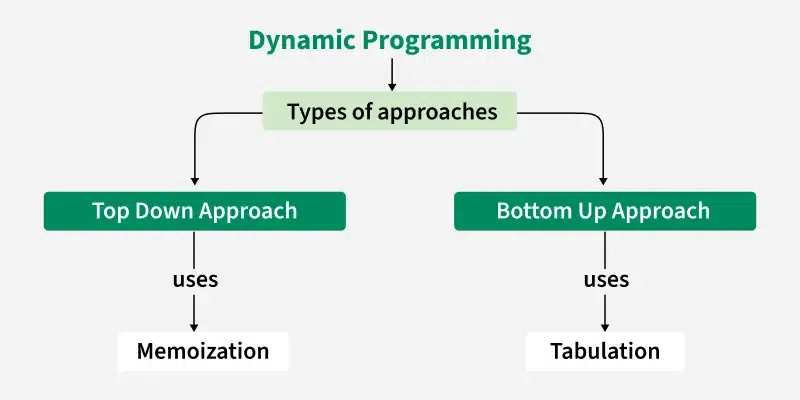
Tabulation and memoization are two techniques used to implement dynamic programming. Both techniques are used when there are overlapping subproblems (the same subproblem is executed multiple times). Below is an overview of two approaches.
Memoization | Tabulation | |
|---|---|---|
| State | State Transition relation is easy to think | State transition relation is difficult to think |
| Code | Code is easy to write by modifying the underlying recursive solution. | Code gets complicated when a lot of |
| Speed | Slow due to a lot of recursive calls. | Fast, as we do not have recursion call overhead. |
| Subproblem solving | If some subproblems in the subproblem space need not be solved at all, the memoized solution has the advantage of solving only those subproblems that are definitely required | If all subproblems must be solved at least once, a bottom-up dynamic programming algorithm definitely outperforms a top-down memoized algorithm by a constant factor |
| Table entries | Unlike the Tabulated version, all entries of the lookup table are not necessarily filled in Memoized version. The table is filled on demand. | In the Tabulated version, starting from the first entry, all entries are filled one by one |
Given a rod of length n inches and an array price[]. price[i] denotes the value of a piece of length i. The task is to determine the maximum value obtainable by cutting up the rod and selling the pieces.
Examples:
Input: price[] = [1, 5, 8, 9, 10, 17, 17, 20]
Output: 22
Explanation: The maximum obtainable value is 22 by cutting in two pieces of lengths 2 and 6, i.e., 5 + 17 = 22.Input : price[] = [3, 5, 8, 9, 10, 17, 17, 20]
Output : 24
Explanation : The maximum obtainable value is 24 by cutting the rod into 8 pieces of length 1, i.e, 8*price[1]= 8*3 = 24.Input : price[] = [3]
Output : 3
Explanation: There is only 1 way to pick a piece of length 1.
In the rod cutting problem, the goal is to determine the maximum profit that can be obtained by cutting a rod into smaller pieces and selling them, given a price list for each possible piece length. The approach involves considering all possible cuts for the rod and recursively calculating the maximum profit for each cut. For detailed explanation and approaches, refer to Rod Cutting.
In this implementation of the rod cutting problem, memoization is used to optimize the recursive approach by storing the results of subproblems, avoiding redundant calculations.
22
We iteratively calculate the maximum profit for each possible rod length. For each length i, we check all possible smaller cuts, update the profit by comparing the current maximum profit with the profit obtained by combining smaller cuts, and ultimately return the maximum profit for the entire rod.
22