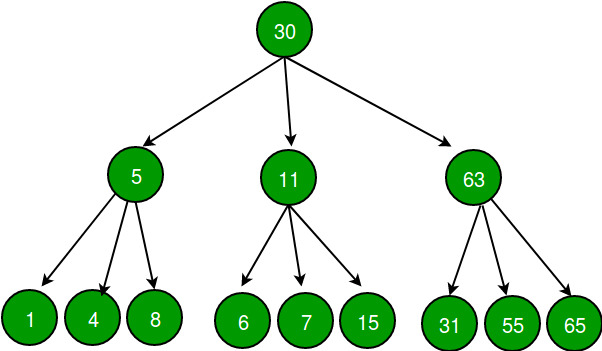
Generic tree or an N-ary tree is a versatile data structure used to organize data hierarchically. Unlike binary trees that have at most two children per node, generic trees can have any number of child nodes. This flexibility makes them suitable for representing hierarchical data where each node can have several branches or children.
What is a Generic Tree?
A generic tree is a tree where each node can have zero or more children nodes. Unlike a binary tree, which has at most two children per node (left and right), a generic tree allows for multiple branches or children for each node.
Key Features of a Generic Tree:
Nodes and Children: Every node in a generic tree can have any number of children nodes, including none (which makes it different from a binary tree).
Hierarchical Structure: Nodes in a generic tree are arranged in a hierarchical order, with each node potentially having its own subtree (a smaller tree within the larger tree structure).
Root and Leaf Nodes:
Root Node: This is the topmost node of the tree, from which all other nodes descend.
Leaf Nodes: These are nodes that do not have any children.
Example of a Generic Tree:
Let’s consider an example to better understand a generic tree: