 |
VOOZH | about |
|
VOOZH | about |
For many years, the 8051 microcontroller architecture is vital and important component in embedded systems design due to its common use. Its strong architecture and multiple uses in a variety of industries from consumer electronics to industrial automation are the main causes of its appeal.
An 8051 microcontroller is an 8-bit Harvard architecture microcontroller and it consists of a CPU, RAM, ROM, I/O ports, timers, and serial communication ports all combined on one chip. It can control simple to highly complex operations in embedded systems since it can carry out instructions which are retrieved from its internal memory.
The 8051 microcontroller family consists of several variations, including the original 8051, the 8031 (which has less functionality), and the upgraded 8052. Each variant offers a different peripheral configuration and memory size to meet the needs of a particular application.
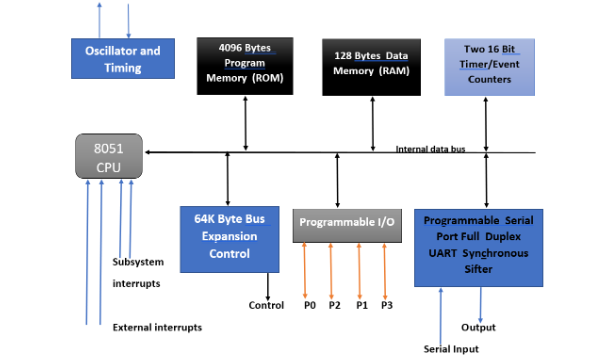
The following diagram shows the overall idea and working principles of the 8051 microcontroller.
The system bus is used to connect all of the support devices to the CPU. The system bus is operated by bus control signals, a 16-bit address bus, and an 8-bit data bus. The system bus is serves as an interface between the CPU and all other devices, including program memory, ports, data memory, interrupt control, serial interface, and timers.
A microcontroller uses all the functions of a microprocessor into a single integrated circuit, acting as a miniature computer. It depends extensively on on-chip features including RAM, ROM, I/O ports, timers, serial ports, clock circuits, and interrupts to support a variety of applications. Microcontrollers find application in a wide range of automatically operated gadgets, including power tools, toys, office equipment, medical equipment, remote controls, car engine control systems, and other embedded systems.
The microcontroller has all of these peripherals built in, but the microprocessor requires us to interface extra circuitry outside for things like RAM, ROM, I/O ports, timers, serial ports, clock circuits, and other peripherals. Allow us to briefly examine the 8051 microcontroller pin diagram.
The microcontroller retrieves, decodes, and sequentially executes instructions from memory. It can carry out operations according to preprogrammed logic by interacting with external devices via I/O ports and timers.
The internal basic components of the architecture of the 8051 microcontroller are:
The central processing unit, or CPU, functions as any processing machine's brain. It coordinates and oversees every operation performed by the microcontroller. The user has no control over how the CPU operates. It executes from storage, interprets the program that is kept in ROM, and then carries out its intended function. The CPU controls the many register types that the 8051 microcontroller has to offer.
Interrupts: The interrupt subroutine is called by the microcontroller when a high-priority program requests to access the system buses. This causes interruptions in the program that is now executing. An interrupt can be used to delay the present process using In order to complete a subroutine task and then resume the main program.
Different 8051 microcontroller interrupt types:
Let's look at the 8051 microcontroller's five interrupt sources:
To do an operation The microcontroller needed a program. The tasks that the microcontroller is supposed to accomplish are guided by this software. A portion of the on-chip memory was needed for the microcontroller's installed program to be stored. Memory was also needed by the microcontroller in order to store operands and data for brief periods of time. In addition to 128 bytes of data memory (RAM), the microcontroller 8051 includes 4 KB of code or program memory, or 4 KB ROM.
A Bus is a collection of wires that is used as a data transfer or communication channel. Eight, sixteen, or more cables are included in the various bus arrangement. As a result, a bus can support 8 bits, or 16 bits total.
Bus types in an 8051 microcontroller
Let's show the two bus types that the 8051 microcontroller uses:
It requires a timer to function because the microcontroller is a digital device. An on-chip oscillator is externally linked or connected for the microcontroller to execute timer functions. An embedded system is used a microcontroller to control device functionality. The two 16-bit counters and timers are operated by the 8051. The oscillator inside the microcontroller is utilized to operate the timers and counters.
The 8051 microcontroller, which is made with CMOS technology, combines every part into a single silicon chip for dependability and compactness.
the following examples is operated using of the 8051 microcontroller:
Variants differ in terms of memory capacity, peripheral setups, and clock speed capabilities, which affect application appropriateness and performance
the following industries uses the 8051 microcontroller.
Despite developments in microcontroller technology, the 8051 microcontroller is still a reliable option for embedded systems because of its cost-effectiveness, integrated peripherals, and small architecture. It finds applications in a variety of industries.

.jpg)