|
VOOZH | about |
|
VOOZH | about |
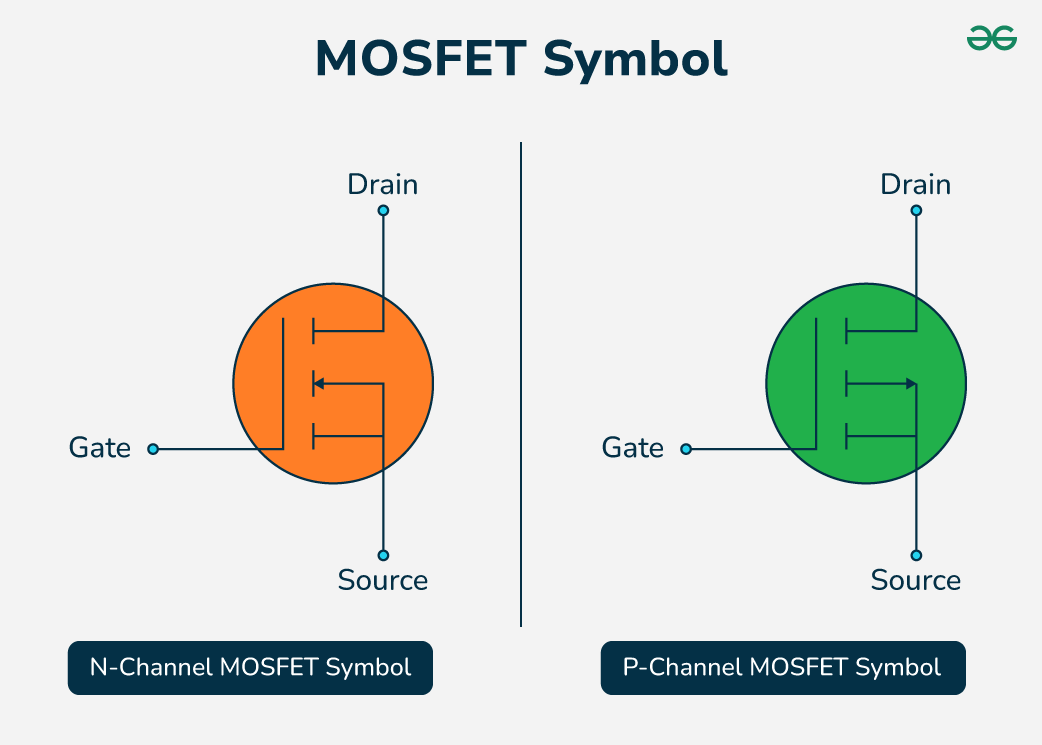
MOSFETs (Metal-Oxide-Semiconductor Field-Effect Transistors). It is a transistor that controls the flow of electric current in the circuit. The MOSFETs have 3 main terminals: the Gate (G), the Drain (D), and the Source (S). They are popular because they work efficiently. MOSFETs are able to handle high currents and voltages, making them useful for both small digital circuits and larger power systems.
MOSFET is a transistor that is used as a switch or amplifier and in many other applications. The basic construction of MOSFET can be explained as below:-
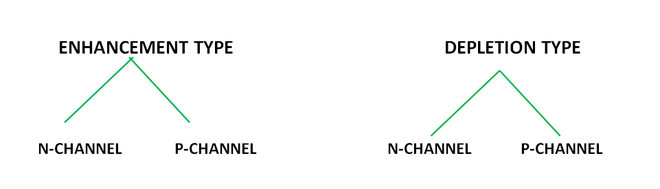
There are two major types of MOSFETs
N-channel MOSFET: More common and efficient, in this the current will only flows when a positive voltage is applied to the gate.
P-channel MOSFET: Current flows when a negative voltage is applied to the gate.
When some voltage is given to the gate terminal of a MOSFET , it creates an electric field that allows current to flow between the drain of MOSFET and the source of the MOSFET. Hence the amount of the current flowing in the MOSFETs can be controlled by changing the gate voltage according to the need.
Now the central part of the article, her we will learn about the characteristics of MOSFET. There are basically two types of characteristics of a MOSFET:
1. Drain characteristics
2. Transfer characteristics
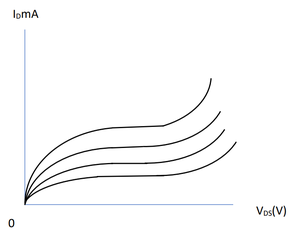
Characteristics between output current and output voltage. O/P i -> ID, O/P v -> VDS , control variable = VGS. Here we will plot a graph between ID and VDS for various levels of VGS.
Now let's understand by cases:
Case 1: VGS1 > VT
(where VT is the threshold voltage)
Veff = VGS1 – VT
It will directly affect the width of the n-channel
significant amount of drain current will flow through it.
When VDS is increased to a certain level, drain current becomes constant. This is called pinch-off condition.
VDS + VGD – VGS = 0
VGD = VGS – VDS
VGD = VT , pinch off voltage
Case 2: VGS1 > VGS2
conductivity of 1 > conductivity of 2
R2> R1
slope of 2 < slope of 1
Now there are few regions in this graph:-
Saturation region : Region in which drain current is constant.
Triode region : Left area of locus of VDS saturation.
Cut-off region : When it can’t achieve the threshold voltage, MOSFET remains OFF. Current is 0 amp.
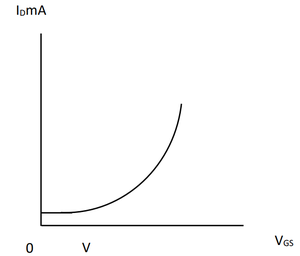
Characteristics between output current and input voltage.
V = VT (Threshold Voltage)
A MOSFET (Metal-Oxide-Semiconductor Field-Effect Transistor) is a transistor used to control electric current in circuits. It has three main terminals: Gate (G), Drain (D), and Source (S), and is built on a silicon substrate with an insulating layer of SiO₂. The gate terminal controls current flow between the drain and source. MOSFETs come in two types: N-channel (current flows with positive gate voltage) and P-channel (current flows with negative gate voltage).
The working principle involves applying a voltage to the gate, creating an electric field that allows current to flow between the drain and source. MOSFET characteristics are divided into drain characteristics (relationship between output current and voltage) and transfer characteristics (relationship between output current and input voltage). Key regions in the drain characteristics include the saturation region (constant drain current), triode region, and cut-off region (no current flow).