|
VOOZH | about |
|
VOOZH | about |
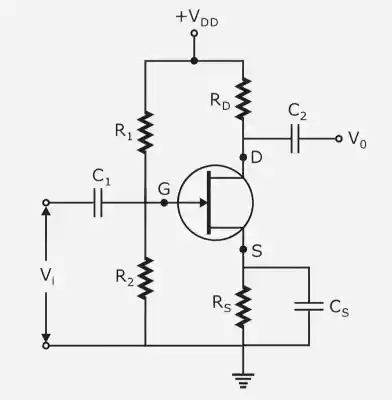
The most popular JFET amplifier configuration is the common source (CS) amplifier because of its straightforward design and high voltage gain. In this arrangement, the source terminal is shared by the input and output, the input is applied at the gate terminal, and the output is obtained from the drain terminal.
Depending on whether the source resistor bypass capacitor is present, there are two kinds of common source amplifiers:
This circuit establishes the gate voltage using a voltage divider bias network made up of resistors and . Only the AC component can travel through the coupling capacitors and , which separate DC biasing from the AC signal.
A bypass capacitor is linked across the source resistor . In AC analysis, this capacitor is crucial.
For mid-frequency analysis:
Input impedance:
Output impedance:
Voltage gain:
Since is bypassed by , there is no degeneration effect, which results in:
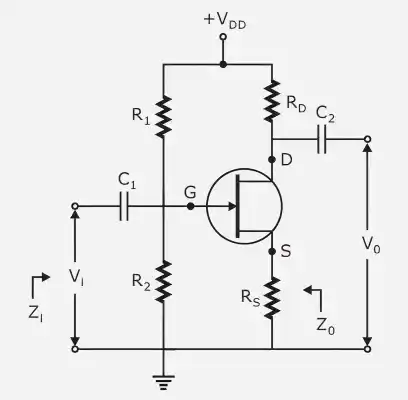
The source resistor in this setup is not circumvented by a capacitor. As a result, it stays in the AC equivalent circuit and has an immediate impact on amplifier performance.
Given that is found in the AC path, it creates negative feedback.
The circuit is stabilized by this feedback.
The presence of modifies the gain expression.
Voltage gain:
assuming
Output impedance:
Input impedance:
Due to the presence of in AC analysis:
| Feature | With Bypass Capacitor | Without Bypass Capacitor |
|---|---|---|
| Source resistor in AC | Removed | Present |
| Voltage gain | High | Reduced |
| Feedback | No | Yes |
| Stability | Lower | Higher |
| Distortion | Higher | Lower |