|
VOOZH | about |
|
VOOZH | about |
Bandwidth and frequency spectrum are two major fundamental concepts in communication systems which play a vital role in determining how signals are transmitted and how efficiently data is carried from one place to another place. Both assist in developing communication systems that are efficient, reliable, and also have the capacity to handle large amounts of data for modern applications such as mobile networks, internet services, and satellite communication systems. The frequency spectrum is compared to a highway, and the bandwidth is compared to the number of lanes used by a particular vehicle. A vehicle using more lanes (higher bandwidth) can carry more load (data), while fewer lanes mean less data can be transmitted.
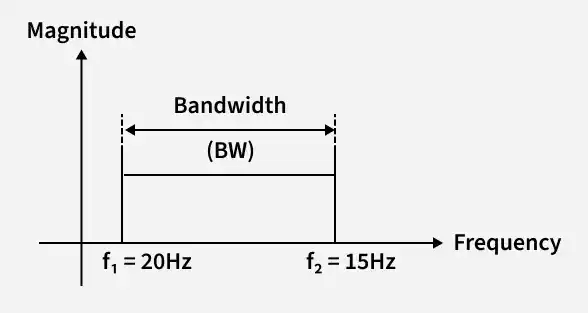
Portion of the electromagnetic spectrum occupied by a signal or frequency range over which an information signal is transmitted. Bandwidth is the difference between the upper and lower frequency limits of the signal. Different types of passband signals, such as voice signals, music signals, TV signals, etc. Each of these signals will have its own frequency range. This frequency range of a signal is known as its bandwidth.
Example - The range of music signals is 20 Hz to 15 kHz.
Bandwidth = (f2 – f1)
Bandwidth = 15000 – 20 = 14980 Hz
| S. No. | Type of the Signal | Range of Frequency (in Hz) | Bandwidth (in Hz) |
|---|---|---|---|
| 1 | Voice signal (speech) for telephony | 300 – 3400 | 3100 |
| 2 | Music signal | 20 – 15000 | 14980 |
| 3 | TV signals (picture) | 0 – 5 MHz | 5 MHz |
| 4 | Digital data | 300 – 3400 (if using telephone line) | 3100 |
Presentation of a signal in the frequency domain shows how much of each frequency is present in the signal. This can be done using either the Fourier series or the Fourier transform. The frequency domain representation includes two parts: the amplitude spectrum and the phase spectrum. The frequency spectrum tells us the strength (amplitude) and the timing (phase) of different frequency parts in the signal. This helps in understanding and building up the signal.
Analyse the spectrum of .
Solution - :
Frequency spectrum of
Magnitude spectrum of
Phase spectrum of
If X(ω) is Fourier transform of a signal x(t) then,
Where, X(ω) is frequency spectrum
|X(ω)| is magnitude spectrum
∠X(ω) is phase spectrum