Digital signal processing plays an important role in modern electronics such as communication systems, audio processing, biomedical devices, and image processing. In these systems, filters are used to modify or shape signals by allowing certain frequency components to pass while attenuating others.
Among digital filters, Finite Impulse Response (FIR) filters and Infinite Impulse Response (IIR) filters are two major categories. These filters differ in their impulse response, design methods, stability, and computational complexity.
FIR Filter
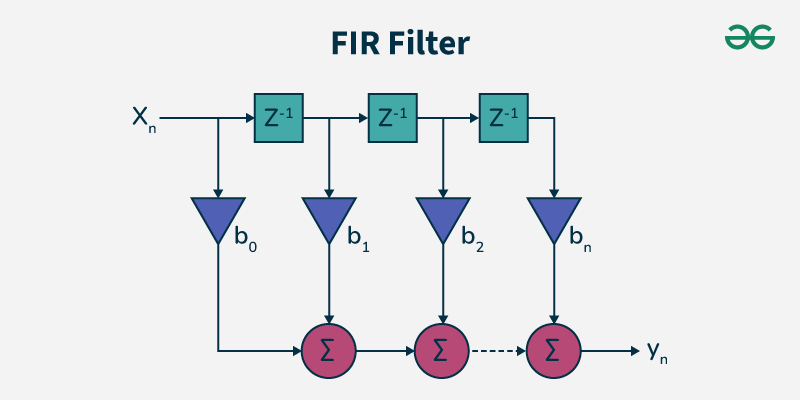
A digital filter whose impulse response becomes zero after a finite number of samples.
FIR filters do not use feedback, meaning the output depends only on the present and past input values.
Because of the absence of feedback, FIR filters are inherently stable and can be designed to have a linear phase response, which preserves the shape of the signal waveform.
Low-Pass FIR Filter: Allows signals with frequencies lower than the cutoff frequency to pass and attenuates higher frequencies.
High-Pass FIR Filter: Passes signals with frequencies higher than the cutoff frequency and suppresses lower frequency components.
Band-Pass FIR Filter: Permits signals within a specific frequency range and rejects frequencies outside that range.
Band-Stop FIR Filter: Blocks a particular band of frequencies while allowing all other frequencies to pass.
Multi-Band FIR Filter: Designed to pass multiple frequency bands while rejecting the remaining frequencies.
Advantages
Always Stable: No feedback loop is used.
Linear Phase Response: Preserves waveform shape.
Simple Implementation: Easier to implement using digital hardware.
Flexible Design: Can be designed for many filter characteristics.
No Feedback: Simplifies filter design.
Disadvantages
Higher Filter Order: Needed to achieve sharp cutoff frequencies.
More Computations: Requires more arithmetic operations.
Higher Memory Requirement: More coefficients must be stored.
Longer Delay: Produces larger group delay compared to IIR filters.
Applications
Audio Signal Processing: Implemented in equalizers and noise reduction systems to improve audio quality.
Data Transmission: Helps in channel filtering and signal shaping in modems and communication devices.
Image Processing: Applied for tasks such as smoothing, sharpening, and edge detection.
Speech Processing: Supports functions like echo cancellation and voice recognition.
Radar Systems: Plays an important role in signal detection and noise filtering.
IIR Filter
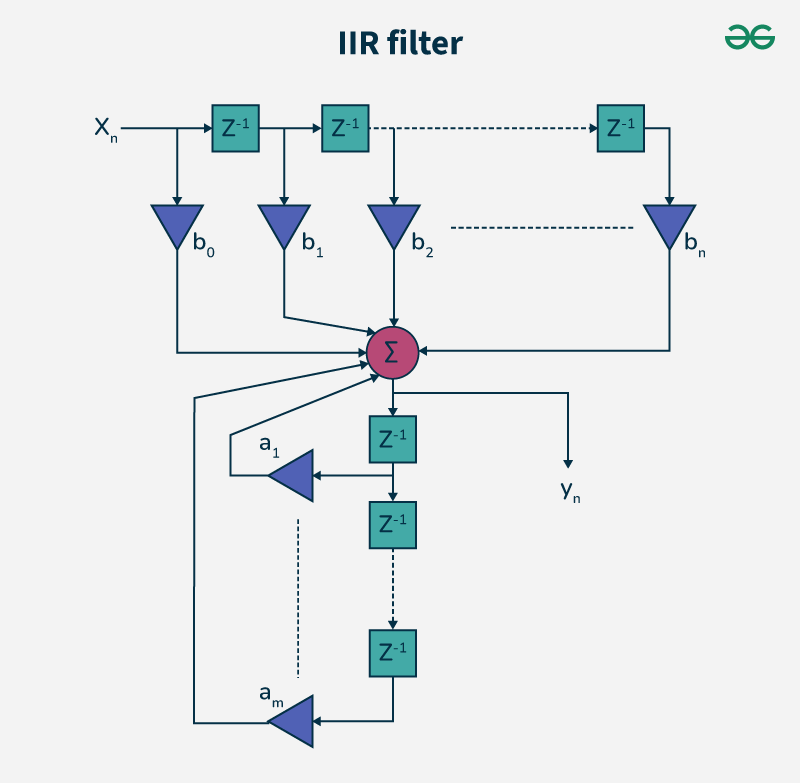
A digital filter whose impulse response theoretically continues indefinitely. This occurs because IIR filters use feedback, meaning the output depends on both previous inputs and previous outputs.
IIR filters can achieve the desired frequency response with lower filter order, making them computationally efficient. However, the presence of feedback can introduce stability issues and nonlinear phase distortion.
Many IIR filters are designed based on classical analog filter designs.