|
VOOZH | about |
|
VOOZH | about |
In today's world of communication, two primary technologies have had an important influence Which are Universal Mobile Telecommunications System(UMTS) and Code Division Multiple Access(CDMA).
Both have left a major impact on the path of mobile communication, providing enhanced call clarity, easier data transfer, and better coverage. It is important to understand the difference between these two.
Table of Content
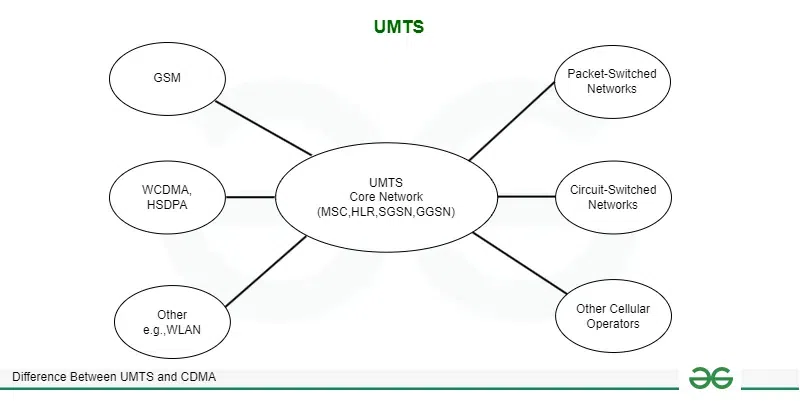
Universal Mobile Telecommunications System, represents a 3G wireless communication technology standardized by the 3rd Generation Partnership Project (3GPP). Employing WCDMA (Wideband Code Division Multiple Access) as its fundamental air interface technology, UMTS provides easy data transfer, multimedia support, and advanced mobile utilities.
UMTS is really very fast, which means if we are streaming online videos, or downloading apps, or playing any online game, there's no need to wait very long for them to load on your device. It also supports us in sharing memories in the form of pictures, video messages with our loved ones.
3GPP(3rd Generation Partnership Project) makes sure to standardize the UMTS everywhere, which means, even if you are in any part of the world, you will experience the same way of using internet as in your School, Home or travelling abroad.
WCDMA technology, divides the airwaves into different channels so that multiple different devices can use the internet without interfering with each other.
There are different types of UMTS, like WCDMA, HSPA, and HSPA+. Each one is faster and better.
UMTS functionality depends on the WCDMA air interface, which integrates frequency division duplexing (FDD) and time division duplexing (TDD) to use simultaneous data transmission and reception. Node Bs, functioning as base stations, establish communication with User Equipment (UE) - mobile devices - through dedicated channels enabled by soft handover mechanisms.
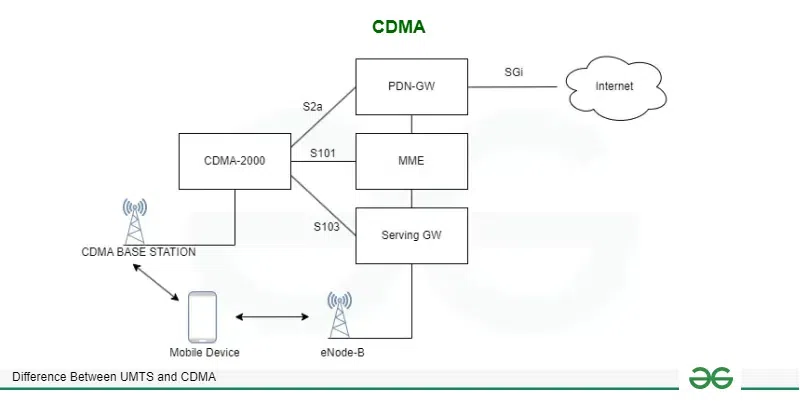
Code Division Multiple Access (CDMA) is a technology that allows our phones and various other devices to connect with cellular networks. CDMA allows devices to use the same frequency bands at the same time without interfering with each other.
CDMA uses unique codes for each piece of data, which enables it to spread data across entire frequency bands, unlike other technologies which provide each device its separate channel.
It allows devices to efficiently use the available bandwidth, which means, even if there are multiple devices on the same network, there will not be any slowness in the network because of traffic. CDMA is a digital technology, it converts the data into signals, and then transmit it over the network, allowing to achieve better call quality compared to analog technology. Different types of CDMA are CDMA2000 1x, CDMA2000 1xEV-DO, and CDMA2000 1xEV-DV. They give better stuff like data and voice.
CDMA uses spread spectrum technology, which assigns a unique code to encode the data of each user. This approach allows multiple users to exchange data simultaneously within the same frequency bands. The base station, also known as Node B, manages user communication by assigning specific codes to individual signals, which are then decoded by the intended recipients.
Parameter | UMTS | CDMA |
|---|---|---|
Air Interface | WCDMA (Wideband Code Division Multiple Access) | CDMA (Code Division Multiple Access) |
Bandwidth | Fixed | Variable |
Data Speed | Typically up to 384 kbps (HSPA+ can reach 42 Mbps) | Varies depending on CDMA standard (CDMA2000 1x can reach up to 307 kbps, EV-DO can reach up to 3.1 Mbps) |
Voice and Data Integration | Circuit-switched voice, packet-switched data | Simultaneous voice and data transmission |
Migration Path | Evolving towards LTE (Long-Term Evolution) and 5G | Legacy technology, transitioning to LTE or other newer standards |
Spectral Efficiency | Lower compared to CDMA | Higher compared to UMTS |
Handover Mechanism | Hard handover | Soft handover |
Given Below are some of the Advantages of UMTS and CDMA
Given Below are some of the Disadvantages of UMTS and CDMA
Given Below are some of the Applications of UMTS and CDMA
In conclusion, both UMTS and CDMA have played big roles in shaping modern telecom. UMTS has great voice quality and is globally standardized, while CDMA is efficient with spectra and can do voice and data together. Choosing between them depends on network needs, location, and future plans.