|
VOOZH | about |
|
VOOZH | about |
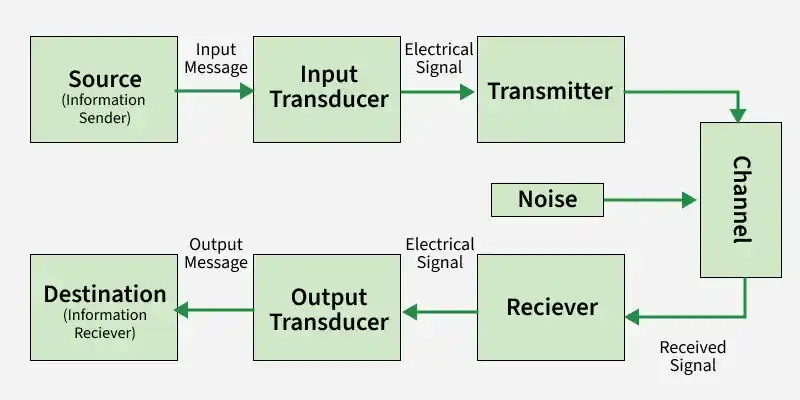
Communication system is made up of several elements. Each component plays a specific role in transmitting information from source to the destination and work together to ensure efficient and reliable communication. By studying these elements individually, it makes it easier to understand how the overall communication system works.
Originates a message such as a human voice, a television picture, an e-mail message, or data. If the data is non-electric (for example, human voice, e-mail text, or television video), an input transducer must convert it into an electric waveform known as the baseband signal or message signal via physical devices such as a microphone, computer keyboard, or CCD camera.
The transmitter modifies the baseband signal for efficient transmission. It consist of one or more subsystems, such as an analog to digital (A/D) converter, an encoder, and a modulator.
The channel is a medium of choice that can convey electric signals at the transmitter's output over a distance. A typical channel can be a pair of twisted copper wires (telephone and DSL), coaxial cable (television and internet), an optical fibre, or a radio link. Channels may be of two types.
During the process of transmission, the signal gets distorted due to noise introduced in the receiver. Noise is an unwanted signal that interferes with the required signal. Noise is always random in nature and may interfare with the signal at any point in a communication system. However, the noise has a greater effect on the signal in the channel.
• All guided channels, like twisted pair cable, coaxial cable, and optical fibre cable, have finite bandwidth.
• Among the available guided channels, optical fibre cable has the highest bandwidth capability.
The receiver's primary responsibility is to reconstruct the message signal in electrical form from the received distorted signal. This reproduction of the original signal is accomplished by a process known as demodulation or detection. Demodulation is reverse process of modulation carried out in the transmitter.
The destination is the final stage, which converts the electrical message signal into its original form. For example, in radio broadcasting, the destination is a loudspeaker that works as a transducer, i.e., it converts electrical signals into the form of the original sound signal. It consist of a demodulator, a decoder, and a digital to analog (D/A) converter.