|
VOOZH | about |
|
VOOZH | about |
The Hartley Oscillator was invented by Ralph Hartley in 1915 and is a fundamental circuit in RF applications. The Hartley oscillator is a tuned LC tank circuit constructed consisting of one capacitor, two inductors, and a transistor or vacuum tube serving as the amplifying element. Due to its adaptability, it can be used in a wide range of RF communication systems, including frequency synthesizers, signal generators, and local oscillators in radio transmitters and receivers. The Hartley oscillator is a primary source of RF circuit design because of its simplicity, efficiency, and ease of application. Thus, Hartley oscillators are widely used in industrial applications.
Table of Content
Hartley Oscillator is an oscillator that is used in radio receivers. It is a type of LC (Inductance- Capacitance) oscillator that is required to generate sinusoidal oscillations at the RF receivers. The center-tapped inductor of the Hartley oscillator allows it to generate a sinusoidal output waveform. The center tap provides the phase shift required for continuous oscillation by allowing feedback to flow from the inductor's center to the amplifier. The frequency of oscillations of a Hartley Oscillator can be modified by changing the values of the inductance and capacitance which are the important factors governing the oscillations of the oscillator.
Changes in temperature or time can cause electronic components to naturally drift in value, which can alter the frequency of the oscillator. Therefore, low temperature coefficient components are frequently used in high precision applications.
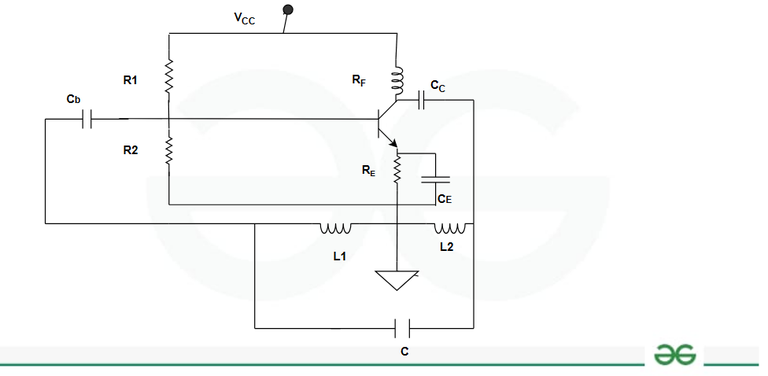
The foundation of a basic Hartley oscillator is an LC tank circuit, which is normally made up of a capacitor (C) and an inductor (L). The oscillating component of the circuit is formed by this tank circuit. By joining the tank circuit to the base or gate of a transistor—such as a field-effect or bipolar junction transistor—positive feedback is produced. By amplifying the signal from the tank circuit and returning it into the circuit, the transistor functions as an amplifier, maintaining oscillations. Proper biasing of the transistor is vital to ensure it performs in its active area.
The transistor and other parts must be powered by an appropriate power source. By connecting capacitors, the oscillator's output signal can be retrieved.
👁 Screenshot-2024-02-05-234801
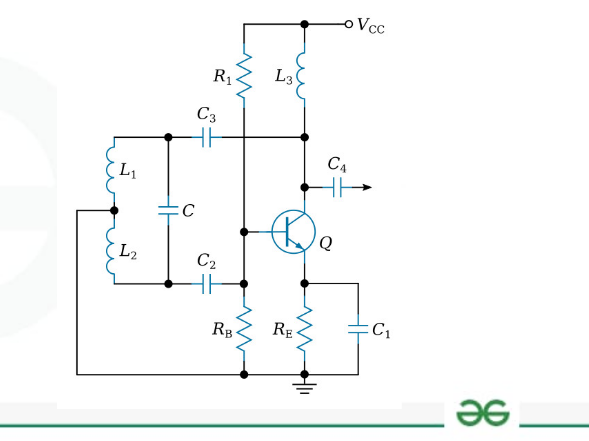
A shunt-fed Hartley oscillator is a type of electronic oscillator circuit used to produce high-frequency signals. The circuit for the resonant LC tank is made up of an inductor (coil) connected in parallel to a capacitor. Usually, a capacitor is used to shift the inductor in order to produce feedback that allows oscillations to continue. The inductor and capacitor values determine the circuit's resonant frequency, which is where self-sustaining oscillations occur when it is powered. Compared to other oscillator designs, the shunt-fed structure improves stability and frequency stability. shunt-supplied Because of their ease of use and effectiveness, Hartley oscillators are used in radio frequency (RF) circuits, signal generators, and communication systems.
1. Derive the expression for frequency of Hartley Oscillator.
(From basic circuit diagram of Hartley Oscillator given above)
Z1 = jωL1 + jωM and Z2 = jωL2 + jωM
Z3 = 1/ jωC = -j/ωC
Generalized equation of Oscillator: -
hie [ Z1 + Z2 + Z3] + Z1 Z2 (1 + hfe ) + Z1Z3 = 0 |
|---|
Substituting the values of Z1, Z2 and Z3 we get,
hie [jωL1 + jωM + jωL2 + jωM -j/ωC] + (jωL1 + jωM) (jωL2 + jωM) (1 + hfe ) + jωL1 + jωM -j/????C = 0
jω*hie [L1 + L2 + 2M - 1/ ω2 C] - ω2 [ L1 + M] [ L2 + M] [1 + hfe] + (L1 +M / C) = 0
To find ω (frequency) equate imaginary part = 0
hie /ω ( -1/C1 - 1/C2 + ω2 L) = 0
or ω2L = 1/C1 + 1/C2
ω = [1/L (1/C1 + 1/C2)]1/2
(ω = 2лf)
f = 1/ 2л [1/L (1/C1 + 1/C2)]1/2
2. Find the operating frequency of a Hartley Oscillator if L = 1mH and C1= 0.5mF and C2 = 0.2mF.
We know that operating frequency of a Hartley oscillator is given by the expression-
f = 1/ 2л [1/L (1/C1 + 1/C2)]1/2
∴ f = 1/ 2* 3.14 [ 1 / 1* 10-3 (1/ 0.5*10-3 + 1/0.2*10-3)
f = 1.146*106 Hz
Hartley Oscillator is constructed using op-amp, because it has many advantages over the Hartley Oscillator using BJT. The main advantage is the adjustment of output gain using the feedback resistors. The Hartley Oscillator constructed with BJT must have the output gain equal to or slightly greater than the ratio of L1/L2. Thus, it provides greater frequency stability to the output with lower output oscillations. Its working is same as that of BJT Hartley oscillator.
The frequency of oscillation of this type of oscillator is given as:
f = 1/ 2π (Leq C); Where Leq = L1 + L2 + 2M OR L1 + L2
The gain of the above Hartley Oscillator is given as:
Av = (L1 + M)/ (L2 + M) where M is the mutual inductance of the coils
A traditional LC oscillator circuit that produces sinusoidal waves at a particular frequency with simplicity, stability, and efficiency is the Hartley oscillator. It enables radio frequency applications by using an inductor and capacitor combination, frequently in a feedback loop with a transistor or operational amplifier. It can be tuned across a range of frequencies due to its versatile architecture, which makes it suitable for a variety of signal production activities and communication systems. The Hartley oscillator is still a mainstay in electronic engineering despite its simple design. It offers dependable oscillation with few components, which makes it the go-to option for many applications that need accurate frequency generation.