|
VOOZH | about |
|
VOOZH | about |
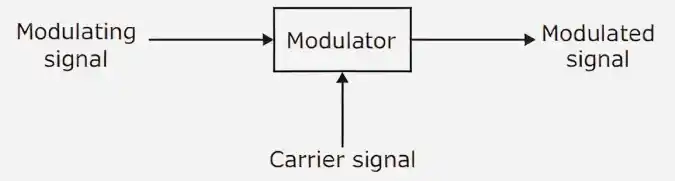
In the modulation process, two signals are used: the modulating signal ( baseband or information signal ) and the carrier signal ( high-frequency sinusoidal signal ). In this modulation process, a parameter of the carrier wave (such as amplitude, frequency, or phase) is varied according to the modulating signal. This modulated signal is then transmitted by the transmitter, and the receiver demodulates the received modulated signal and reconstructs the original information signal. The carrier wave actually acts as a carrier that carries the information signal (modulating signal) from the transmitter to the receiver.
Different modulation techniques are designed to suit different communication needs. Some focus on smoothly varying signals for broadcasting, while others handle discrete signals for digital systems. The choice of modulation depends on factors like signal type, bandwidth, noise resistance, and application.
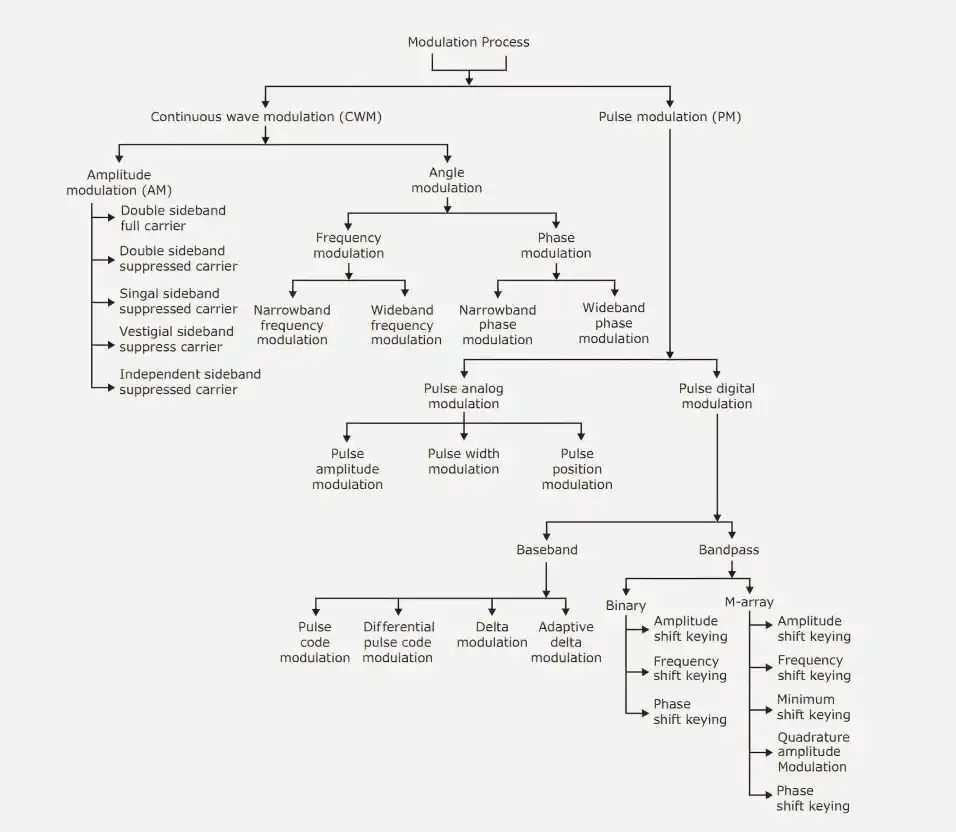
Type of modulation in which a continuous high-frequency carrier signal is used to transmit information. In this method, one of the parameters of the carrier wave is varied according to the message (baseband) signal.Continuous Wave Modulation are of two types
Features of CWM -:
Information signal is transmitted in the form of pulses instead of a continuous wave. It is widely used in digital communication systems for efficient and reliable data transmission. It involves varying a parameter of a pulse train (such as amplitude, width, or position) according to the message signal. PM is of two types and further classified
Type of pulse modulation in which the pulse parameters vary continuously according to the analog message signal. It is used to represent analog information in the form of pulses. It is a continuous-time signal is sampled and transmitted as a sequence of pulses, where one of the pulse characteristics changes in proportion to the input signal. These are classified -:
Type of modulation in which analog signals are converted into digital form and then transmitted as a sequence of binary pulses. It is widely used in modern communication systems due to its high reliability and noise immunity. Input analog signal is sampled, quantized, and encoded into digital form (0s and 1s), which is then transmitted as pulses. These are of two types -:
Digital signal is transmitted directly without modulation.
Types
Digital signal is first modulated onto a high-frequency carrier before transmission. Original signal is modulated onto a high-frequency carrier signal, resulting in a bandpass signal whose frequency lies between . Further its classified into binary and M - array.
Types of Bandpass