 |
VOOZH | about |
|
VOOZH | about |
In this article, we will understand the nodal analysis with solved examples. We will discuss nodes and their types. We will discuss the procedure for nodal analysis along with some rules. We will also discuss the super node. Then we will see how nodal analysis is different from mesh analysis. Later in the article, we will discuss the advantages, disadvantages, and applications.
Table of Content
Nodal analysis is a type of circuit analysis in electrical networks. It analyses the circuit using the node voltages. A node is a point in a circuit where two or more branches or elements of a circuit network meet. The potential difference between nodes is used to find various parameters of the circuit. It applies to both the planar and non-planar networks, unlike mesh analysis. KCL is the main law that is used in the nodal analysis along with it KVL and Ohm's law are also used.
, where (Z) represents impedance.
There are two types of nodes used in nodal analysis.
It is the node that is used as a reference point for all other nodes. It provides a standard point from which measurements, comparisons and evaluations are made. There are different types of reference node based on their function and Connection
Types of Reference Node
It is the node that has a definite voltage assigned to it. Unlike reference nodes, which serve as common points of reference for measurements and comparisons, non-reference nodes have predetermined voltages associated with them. These voltages may be established by power sources, voltage dividers, or other circuit components.
In the above diagram V1,V2,V3 are the non-reference nodes and the ground is taken as reference nodes. The current from nodes shown is how we write the KCL equations.
Given below are Procedure and Rules for applying Nodal Analysis
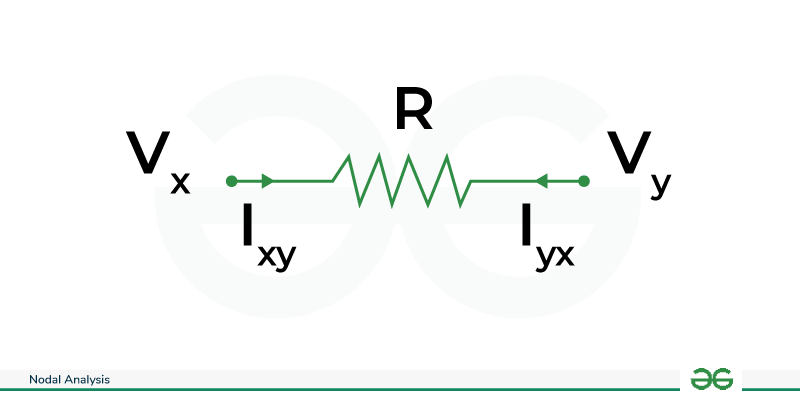
Following are the steps that need to be followed for applying nodal analysis to a circuit network.
Ixy = (Vx-Vy)/R
Iyx = (Vy-Vx)/R
Ixy = -Iyx
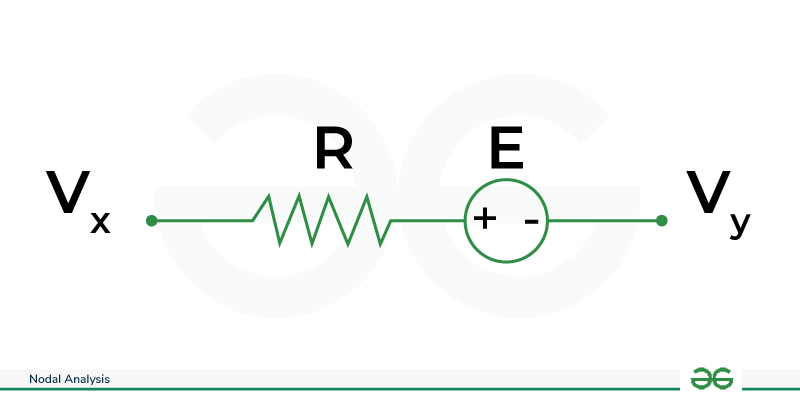
Using KVL,
Vx + IxyR + E + Vy = 0
Ixy = {(Vx - Vy) - E}/R
Ixy = I or Iyx = -I
Depending on the direction of current
Construct a matrix equation in nodal analysis: A matrix equation in node analysis is built by following these key steps generally :
1. Nodes around the circuit are located and voltages allotted to each node(usually referred to a reference node).
2. On all nodes except for the reference node apply Kirchhoff's Current Law (KCL) to obtain the equations in terms of the node voltages.
3. The currents are expressed in terms of node voltages by the use of Ohm's Law (V =IR) and component relationships.
4. The format of a matrix Ax = b shall be used to arrange the equations whereby A is referred to as the coefficient matrix, x is the vector containing nodal voltages, and b as the source terms vector.
As an example, consider a simple electric circuit with two nodes and two voltage sources. Suppose the node voltages are represented by V1 and V2. Based on KCL as well as component relationships, the circuit equations appearing as follows can be derived:
For instance at node 1 :
( ‐V1+V2)/R1 + (V1-Vsource1)/R2 = 0
At node 2 :
(-V2+V1)/R1 +V2/R3 =0.
We can rearrange these formulas and present them in a matrix form:
[ (1/R1 + 1/R2) -1/R1 ] [ V1 ] [ Vsource1/R2 ]
[ -1/R1 (1/R1 + 1/R3) ] [ V2 ] = [ 0 ]
This stands for the matrix weighing in node analysis of this circuit. Circuits’ components and the way they are connected are what the coefficients in this matrix emerge from.
When it comes to nonlinear circuits in nodal analysis, things get a bit more involved than linear circuits. The current-voltage relationship is not linear, so Ohm’s Law (V = IR) doesn’t apply straight up.
To do nodal analysis on nonlinear circuits, you usually:
1. Guess the node voltages to start with : Guess the node voltages first. This is important for iterative methods used in nonlinear equations.
2. Write down the Kirchhoff’s Current Law (KCL) equations : Apply KCL at each node as usual, but instead of using Ohm’s Law directly, express the currents in terms of the nonlinear component equations (e.g., diode equation, transistor model).
3. Linearize the equations : Nonlinear equations are linearized around the operating point. That means approximating the nonlinear functions by linear functions near the operating point.
4. Iterative solution : Since it’s nonlinear, you’ll likely need to use iterative methods like Newton-Raphson or Gauss-Seidel to solve the equations iteratively until it converges.
5. Update node voltages : Update node voltages after each iteration until convergence criteria met.
6. Converged Check : Monitor that process to see the results are accurate.
By following these steps, you can do nodal analysis on nonlinear circuits, with the nonlinear voltage-current relationships in the components.
Node Voltage Method : It is based on Kirchhoff's Current Law (KCL) and Ohm's Law. It involves selecting any one reference node(usually ground) in the circuit and assigning voltages to all other nodes which relative to the reference node.
KCL Equations : It is depends on applying KCL at each non-reference node in the circuit. By adding current flowing into or out of each node, you can create number of equations that describe the circuit behavior.
System Equations : Nodal analysis results in a system of equations that can be solved to determine the node voltages. The number of equations is equal to the number of non-reference nodes minus 1 (e=N-1).
Efficiency : It is very efficient for circuits which have many nodes and some few voltage sources. It is used to simplify complex circuits into a set of equations that can be solved simultaneously.
Accuracy : It is provides accuracy in results for voltage distribution in a circuit, and making it a valuable tool for design circuit and analysis, when it is applied correctly.
By understanding all these features, engineers and students to analyze the behavior of any electric circuit effectively.
Q. Using nodal analysis find the value of K which will cause Vy to be zero
Using KCL at node x,
(Vx-6)*1 + Vx*4 + (Vx-Vy)*2 = 0
Vy = 0
4Vx - 24 + Vx + 2Vx = 0
Vx = 24/7V -(1)
KCL at node y,
(Vy-Vx)*2 + (Vy-kVx)*3 = 2
Substituting value of Vy and Vx
∴ (-24/7)*2 - k*(24/7)*3 = 2
-12 - 8k = 14
k = -3.25
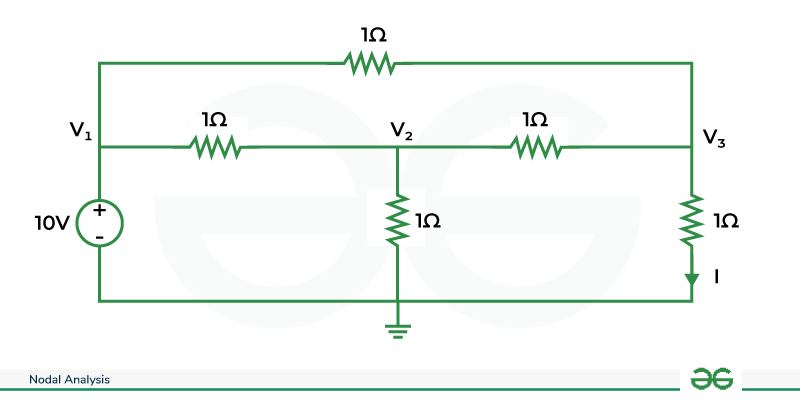
Q. Using nodal analysis find I(With Voltage source)
We find the voltage of V1,
V1 - 0 = 10 ; V1 = 10
KCL at node 2,
(V2-V1)*1 + V2*1 + (V2-V3)*1 = 0
3V2 - V3 = 10
KCL at node 3,
(V3- V1)*1 + (V3-V2)*1 + V3*1 = 0
-V2 + 3V3 = 10
Solving two equations we get,
V3 = 5V
I = 5A
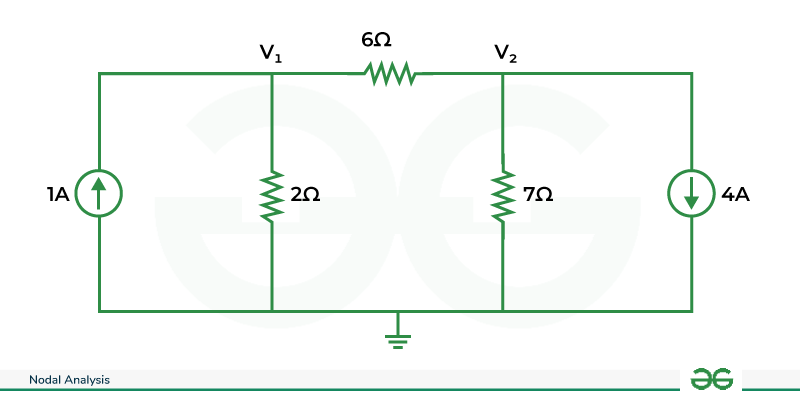
Question .Find V1 and V2 using nodal analysis(With current Source)
Applying KCL at node 1,
V1*2 + (V1-V2)*6 = 1
4V1 - V2 = 6
Applying KCL at node 2,
V2*7 + (V2-V1)*6 + 4 = 0
13V2 + 168 = 7V1
Solving two equations we get,
V1 = -2V
V2 = -14V
Super node is special condition of nodes. When a voltage source is present between two non-reference node then it is called as super node. KVL and KCL are both applied to the super node to solve the equations. The procedure remains same as normal nodal analysis but after writing the current equations of different nodes they are added together to define the super node equation and KVL for the super node is applied for solving the equations and finding the node voltages.
Q. Using nodal analysis find V1 and V2
As the Voltage source is between two non-reference nodes then this a super node.
KCL at node 1, -2 + V1*2 + i + (V1-V2)*10 = 0 -(1)
KCL at node 2, (V2-V1)*10 - i + V2*4 + 7 = 0 -(2)
Adding equation 1 and 2 for writing the super node equation
-2 + V1*2 + V2*4 + 7 = 0
2V1 + V2 = -20 -(3)
By KVL on super node we get,
V2 - V1 = 2 -(4)
Solving equation 3 and 4 we get,
3V1 = -22
V1 = -7.33V
V2 = -5.33V
When doing nodal analysis on a circuit with a current source you need to include the current source in the node voltage equations. Here’s how
1. Find the Current Source : Where is the current source connected to? Unlike voltage sources, current sources don’t affect the node voltages but affect the current into or out of the node. 2. KCL Equations: When writing KCL equations for nodes connected to a current source, include the current source in the equation. The current source is part of the total current into or out of the node.
3. Look to the Direction : Look at the current source direction. If it’s coming into the node, the current source term in the KCL equation will be positive, if it’s leaving the node, it will be negative.
4. Solve the Equations : Now solve the KCL equations with the current sources. Use matrices or software to do this easily.
By including the current source in the nodal analysis equations, you can analyze circuits with current sources and other components.
When doing nodal analysis in a circuit with voltage sources you need to consider the effect of these sources on the node voltages. Here’s how you can do nodal analysis with voltage sources:
1. Add Voltage Sources : When setting up nodal analysis equations voltage sources are treated differently from current sources. Voltage sources affect the node voltages directly and must be included in the equations.
2. Account for Voltage Source Polarities : Pay attention to the polarity of the voltage sources. Whether a voltage source is connected from a node to the reference node or vice versa the voltage source term in the nodal equation will have a + or - sign respectively.
3. Add Voltage Source Terms : When writing the KCL equations for each node add the terms related to the voltage sources. These terms represent the contribution of the voltage sources to the nodal equations.
4. Solve the Equations : Now solve the system of equations derived from KCL making sure to account for the voltage sources in each node equation. This will give you the node voltages.
By including voltage sources in the nodal analysis you can analyze the circuit fully, including the voltage sources and other circuit elements.
Here are some more points to note when using nodal analysis with current sources and voltage sources:
Nodal Analysis with Current Sources:
Nodal Analysis with Voltage Sources:
Voltage sources are in the potential difference between nodes and node voltages. They count. Knowing that will nodal analyze circuits with current sources and voltage sources.
Mesh Analysis | Nodal Analysis |
|---|---|
It is done through meshes | Nodes are used for analyzing |
KVL was the main law being used | KCL was the main law being used |
Mesh currents were found to find other variables | No voltages were found to find other variables |
Applicable to only planar network | Applicable to both planar and non-planar network. |
Used for circuit with more current sources | Used for circuit with more voltage sources. |
In conclusion, nodal analysis is a systematic approach of solving complex circuits using node voltages. It uses KCL, KVL and ohm's law for forming the equations. When a voltage source is present between two non-reference nodes then the node is known as super node. It is used for designing and optimizing circuits and also for power and control systems. It is versatile to use as it is applicable to AC, DC, Planar and non-planar circuits. It also have some limitations like for non-linear networks it becomes difficult to solve the circuits. Although having limitation it is still widely used for solving circuit networks.




.png)