|
VOOZH | about |
|
VOOZH | about |
Electrical engineering widely uses different theorems and laws to simplify the circuits involved in this field. One such theorem is known as Norton's Theorem which is used for analysing linear circuits in electrical engineering. In this article, we will study what is Norton's Theorem, what is the statement of this theorem, and what the circuit implementation of this theorem looks like. We will also study the step-by-step Procedure for applying Norton's theorem to our circuit and see how it can determine IN or ISC.
Once we have successfully discussed the advantages and applications of this theorem, we will proceed to see the limitations of this theorem. Some solved examples have been solved for a better understanding of the theorem. The article concludes with some frequently asked questions that readers can refer to.
Table of Content
Norton's theorem is a popular theorem used for simplifying linear circuits that use multiple independent and dependent sources. It is used to replace circuit elements by Norton’s current source which is in parallel with Norton’s resistance. Basic circuit equations are then written to find the current in different elements of the circuit. It is important to note that the theorem does not apply to non-linear circuits since these circuits don't follow Ohm's law.
Let us look at the official statement of Norton's Theorem
Norton's theorem states that any linear circuit can be simplified to an equivalent circuit consisting of a single current source and parallel resistance that is connected to a load.
Now we will study the meaning of this statement through some circuit diagrams.
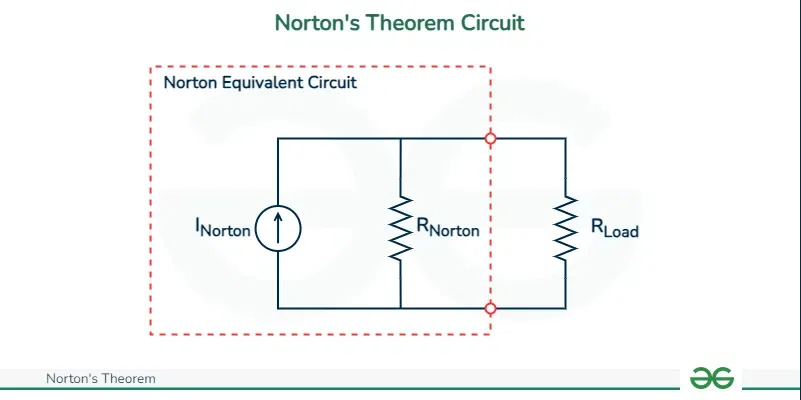
Here is the circuit diagram for Norton's Theorem
Inorton: Norton's current source Rnorton: Norton's resistance
This circuit is a general simplification of a complex circuit which is done using Norton's Theorem. If you carefully observe, the circuit has been reduced to have one current source and one resistance known as Norton's current source and Norton's resistance. This new circuit is used for calculating the voltage and current developed across the load resistance. Note that the equivalent circuit will depend on the type of load and the circuit elements. The basic circuit has been made by short circuiting the voltage sources and open circuiting all the independent current elements which are then replaced by Norton's equivalent of these values. The steps for determining the current and voltage after the equivalent circuit is made have been explained below.
Here are the steps to be followed for applying Norton's Theorem
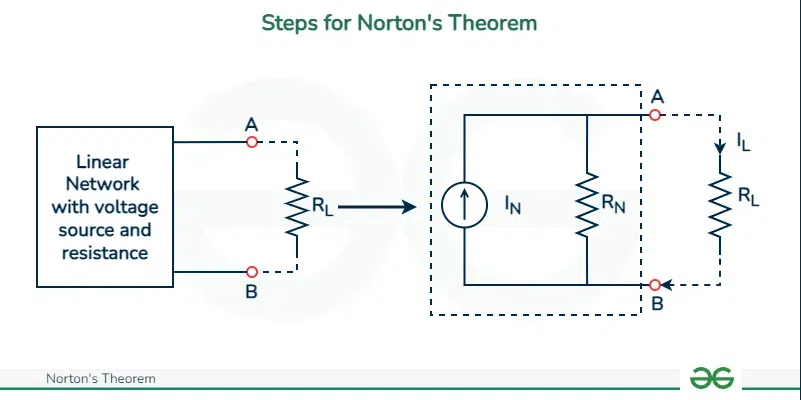
Step 1: Observe all the voltage sources and short them resulting in plain wires. After that observe all the current sources and open-circuit them which will give you all the internal resistances of the circuit.
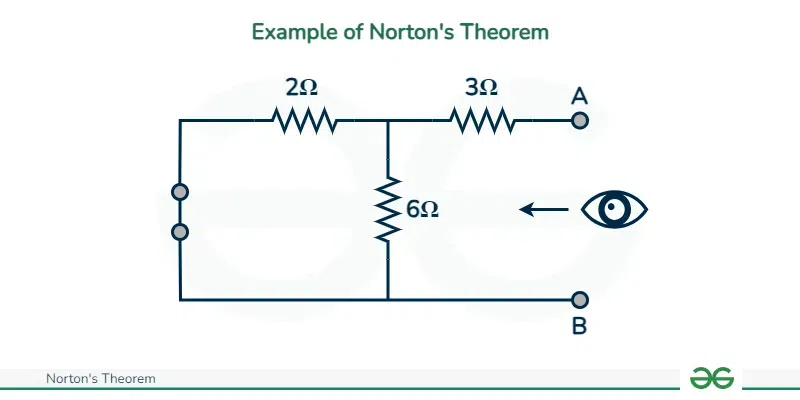
Step 2: We consider a network shown above to apply Norton's theorem. We will short circuit all the voltages. The circuit after short circuit has been given and we can calculate current IN across the terminals AB
Calculating IN: The whole circuit is replaced by an equivalent resistance RL to replace the short circuit. Now since we replaced the shorted element with Norton's equivalent, the short circuit current ISC will be equal to the Norton current IN. The formula for calculating the Norton's current has been explained in the later section.
Calculating ISC: The final circuit network is displayed in the figure and the left side of terminal AB is replaced by Thevenin’s equivalent resistance RTH. Let us see the formula that will be used for calculating the values of Isc, IN and thevenin voltage. The formula for the Norton's current or short circuit current will be given by
Isc= IN= Vth/ Rth
The derivation will be shown in the later parts.
From our previous derivations, we can write down the formula as
VTh= R2/(R1+R2). V
and RTh= R3+ (R1 .R2)/(R1+R2)
Now, we can calculate the short circuit current as
ISC= VTh/ RTh
When Norton's theorem is applied to any general circuit, the current source is in parallel with resistance and we can write the current across the load as
IL= IN. RN/(RN+RL)
Let us see some advantages of Norton's Theorem
Let us see some limitations of Norton's Theorem
Let us see some Applications of Norton's Theorem
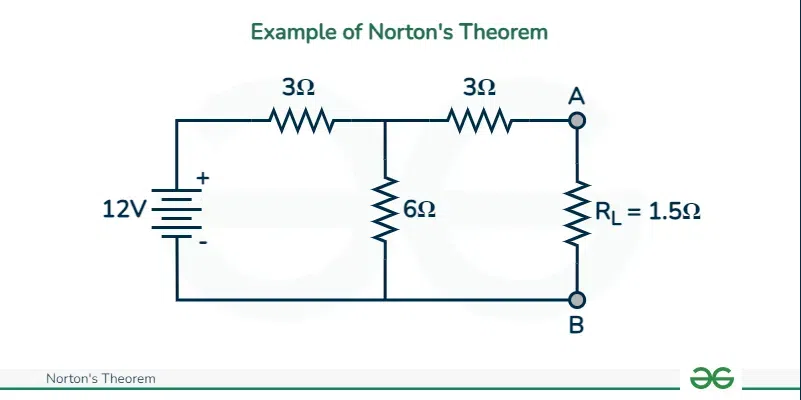
Q.Solve the value of current and voltage across the load branch in the given circuit using Norton's Theorem.
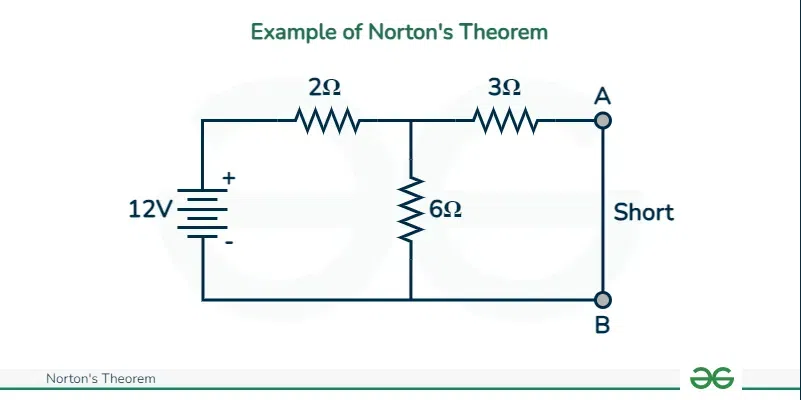
We will calculate Norton's resistance by shorting the load resistance branch. The circuit will now look like this
The total resistance for the given circuit is
Req= 2 + 3×6/(3+6)
∴ Req= 4 ohm
∴ RT= 4 ohm
We will calculate current using ohm's law
ITh= V/RTh
∴ Ith = 12/4 = 3A
Using current divider rule, we will calculate the current across the load element
Isc= IN
∴ Isc= 3×6/(3+6)
∴ Isc= 2A
Now we will calculate the Norton's resistance by open circuiting the current sources. The 12 V voltage will become 0 and be replaced by a short. Here is the circuit
The equivalent voltage will be given by
Req= 3 + 6×2/(2+6)
∴ Req= 3 + 1.5
∴ Req= 4.5 ohm
We will calculate thevenin voltage by applying Norton's resistance across the current source. Therefore, using ohms law
IL = In x [Rn ÷ (Rn+ RL)]
∴ IL= 2A x (4.5Ω /( 4.5Ω + 1.5Ω))
∴ IL= 1.5A
We can give voltage across load resistance by
VL = IL x RL
∴ VL = 1.5A x 1.5Ω
∴ VL= 2.25V
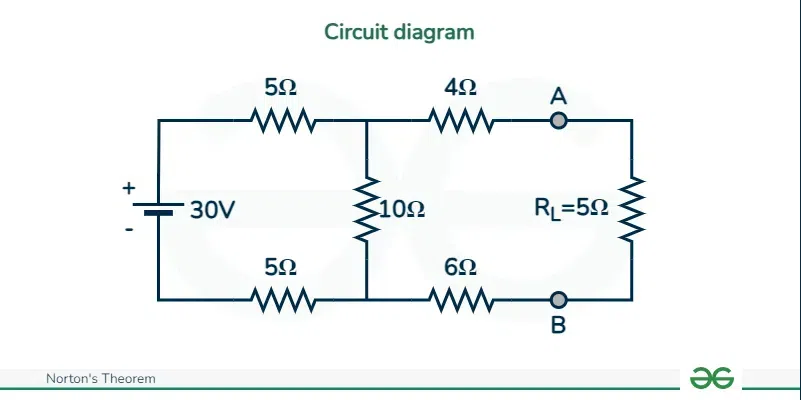
Q.Solve the value of current across the load branch in the given circuit using Norton's Theorem.
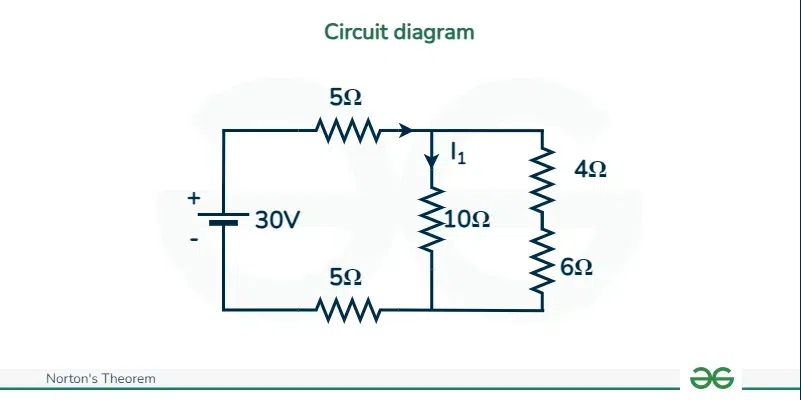
We will calculate Norton's resistance by shorting the load resistance branch. The circuit will now look like this after removing 5 ohm resistance.
Let us calculate the equivalent resistance of the circuit using series and parallel method.
R = (5+5)Ω+(10Ω||(4+6)Ω)
∴ R =10+10×10/(10+10)
∴ R =10+5=15Ω
The total current can be calculated from ohm's law
I=V/R
∴ I=30/15=2A
The Norton's current can be calculated by current divider rule
Isc= IN= I×10/(10+4+6)
∴ IN= 2×(10/20)=1A
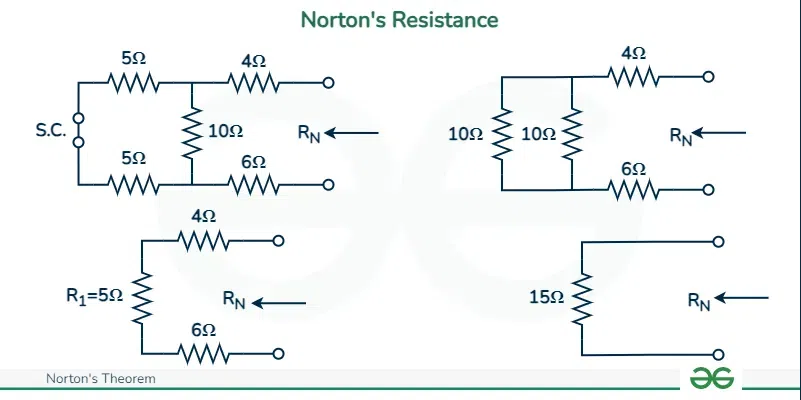
Now we need to calculate Norton's resistance so we short circuit the voltage source, the circuit will look like
R1=10Ω||10Ω
∴ R1 =10×10/(10+10)=5Ω
∴ Rn=RAB=4+R1+6
∴ R1= 4+5+6 = 15Ω
Now we will make Norton’s equivalent circuit by adding Norton's equivalents in the circuit.
RL=5Ω
∴ IL=IN.RN/(RN+RL)
∴ IL=1×15/(15+5) ∴ IL= 15/20=0.75
We have seen how we can use Norton's Theorem to simplify the linear circuits and find the current distribution in the circuit. The derivation of Norton's voltage and resistance has been explained and some solved examples have been provided to build better concepts. We have seen how Norton's Theorem is a useful tool that finds its application in fields like circuit analysis. Despite the advantages offered by Norton's Theorem, there are some limitations associated with it which have been discussed briefly. Frequently asked questions have been provided below.