|
VOOZH | about |
|
VOOZH | about |
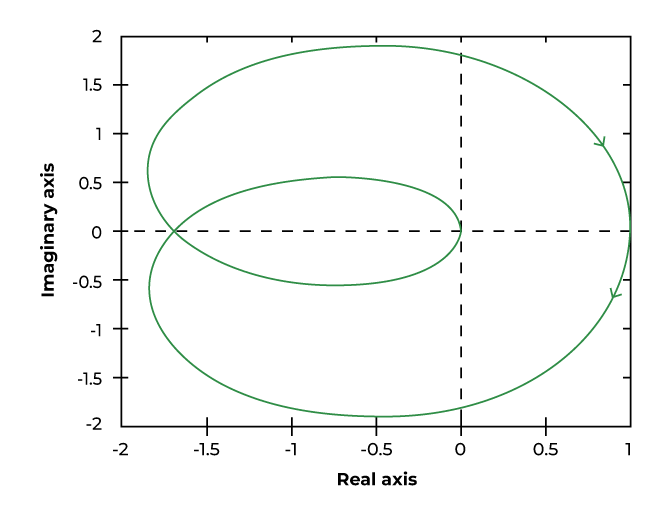
A Nyquist plot is a graphical representation used in control engineering. It is used to analyze the stability and frequency response of a system. The plot represents the complex transfer function of a system in a complex plane. The x-axis represents the real part of the complex numbers and the y-axis represents the imaginary part. Each point on the Nyquist plot reflects the complex value of the transfer function at that frequency.
It is used to determine the stability of a control system. This criterion works on the principle of argument. It is useful for feedback control system analysis and is expressed in terms of frequency domain plot. It is applicable for minimum and non-minimum phase systems.
According to the Nyquist Stability Criterion the number of encirclement of the point (-1, 0) is equal to the P-Z times of the closed loop transfer function. The equation for stability analysis is given below:
N = Z - P ------ (equation 1)
Where,
P = open loop pole of the system on right hand side (RHP)
Z = close loop zero of the system on right hand side (RHP)
N = number of encirclement around (-1,0)
Note: 'N' is negative for anticlockwise encirclement around (-1,0) and positive for clockwise encirclement around (-1,0).
N (encirclements) | Condition | Stability |
|---|---|---|
0 (no encirclement) | Z = P = 0 $ Z = P | Marginally stable |
N > 0 (clockwise encirclement) | P = 0, Z ≠0 & Z > P | Unstable |
N < 0 (anti-clockwise encirclements) | Z = 0, P ≠0 & P > Z | Stable |
It states that if in a transfer function, there are 'P' poles and 'Z' zeros enclosed in s-plane contour, then the corresponding GH plane contour will encircle the origin 'Z-P' times as seen in equation 1.
Important terminologies of Nyquist Plot are mentioned below:
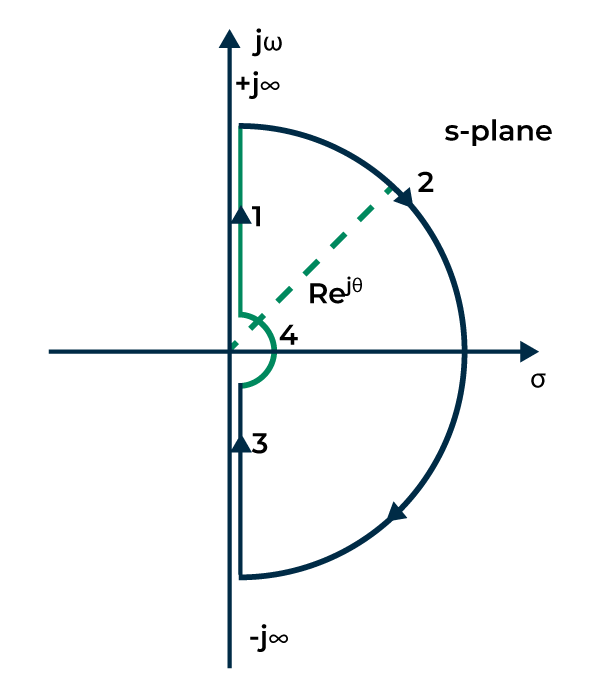
The Nyquist Path or Contour is a closed contour on the right side of the s-plane. To enclose the entire RHS of the plane, a large semicircle lane is drawn with a diameter along the 'j' axis and center at the source. The semicircle radius is simply treated as Nyquist Encirclement. The Nyquist Contour is shown in the figure below:
In the above plot, marked points are denoting:
Point 1 is denoting s = jω
Point 2 is denoting s = where, θ = +90o to -90o
Point 3 is denoting s = -jω
Point 2 is denoting s = where, θ = -90o to +90o
It is a point, if it is found in the curve, is known to be encircled by a line.
Mapping is the process of transforming a point in the s-plane into a point in the F(s) plane, and F(s) is the result of mapping.
It is the frequency at which the Nyquist plot has unity magnitude. It is denoted by 'ωgc'.
It is the frequency at which point the Nyquist plot crosses the negative real axis is called the phase cross-over frequency and it is denoted with 'ωpc'.
The phase margin indicates how much more phase shift we may put in the open loop transfer function before our system becomes unstable. It can be calculated from the phase at the gain cross-over frequency.
The gain margin is the amount of open loop gain that can be increased before our system becomes unstable. It can be calculated from the gain at the phase cross-over frequency.
Procedure to draw Nyquist Plot:

1. Draw Polar Plot
2. Draw Inverse polar Plot
3. Draw and map using Nyquist Contour
- Determine the transfer function of the system.
- Calculate the complex transfer function value by putting s= jω, where 'ω' is angular frequency and 'j' is the imaginary unit.
- Determine the magnitude and phase of the complex transfer function.
- Plot the points in the polar coordinate for each frequency point.
- Connect all the points to create a smooth Nyquist curve. The curve represents the change in magnitude and phase with frequency.
- Calculate the number of encirclements around the point (-1,0). Each encirclement represents the value of 'N'. The stability can be calculated using Nyquist Stability Criteria as discussed above.
The nyquist plot helps in analysis of the stability of a control system. It tells whether the system is stable, unstable or marginally stable. The stability is analyzed using various parameters which are as follows:
It is the frequency at which point the Nyquist plot crosses the negative real axis is called the phase cross-over frequency and it is denoted with 'ωpc'.
The stability of the control system based on the relationships between the two frequencies i.e., phase cross-over and gain cross-over is given below:
ωpc > ωgc ->System is stable
ωpc < ωgc ->System is unstable
ωpc = ωgc ->System is marginally stable
The phase margin indicates how much more phase shift we may put in the open loop transfer function before our system becomes unstable. It can be calculated from the phase at the gain cross-over frequency.
Phase Margin (PM) = 180∘+∠G(jω)H(jω)∣ω=ωgc
The stability of the control system based on the relationships between the two margins i.e., gain margin and phase margin is given below:
GM > 1 and PM is positive -> System is stable
GM < 1 and PM is negative ->System is unstable
GM = 1 and PM is 0o ->System is marginally stable
It is the frequency at which the Nyquist plot has unity magnitude. It is denoted by 'ωgc'.
The gain margin is the amount of open loop gain that can be increased before our system becomes unstable. It can be calculated from the gain at the phase cross-over frequency.
Gain Margin (GM):
Let us understand the above concept with the help of an example.
PM = 180∘+∠G(jω)H(jω)∣ω=ωgc
ωgc = Frequency at which magnitude of G(s)H(s) is equal to 1.
G(jω)H(jω) =
|G(jω)H(jω)| = 1
= 1
On solving the quadratic equation we will get:
ωgc = (we will neglect the negative term inside the root)
ωgc will now become =
ωgc = 0.786 rad/sec
Now finding the phase at gain crossover frequency
∠G(jω)H(jω)∣ω=ωgc = - tan-1 (ωgc)
∠G(jω)H(jω)∣ω=ωgc = - tan-1 (0.786)
∠G(jω)H(jω)∣ω=ωgc = -90o - 38.16o
∠G(jω)H(jω)∣ω=ωgc = -128.16
PM = 180 - 128.16
PM = 51.84o
G(s)H(s) =
Also determine the value of 'k' for which the system is stable.
Step 1: Identify the poles and zeros
There are 3 poles and no zeros
Poles: 0, -2, -10
G(s)H(s) =
Step 2: Mapping of all the 4 section as seen in the given image
The value of ω in the region (1) is s = jω. Replacing the transfer function with s = jω
G(jω)H(jω) =
G(jω)H(jω) =
G(jω)H(jω) = ----- equation 1
Now keeping the imaginary term 0 to find the phase crossover frequency.
ω(1 - 0.05ω2) = 0
1 - 0.05ω2 = 0
ω = 4.472 = phase crossover frequency
Putting the value of frequency in the real part of the equation 1.
G(jω)H(jω) =
G(jω)H(jω) =
G(jω)H(jω) = -0.00417K
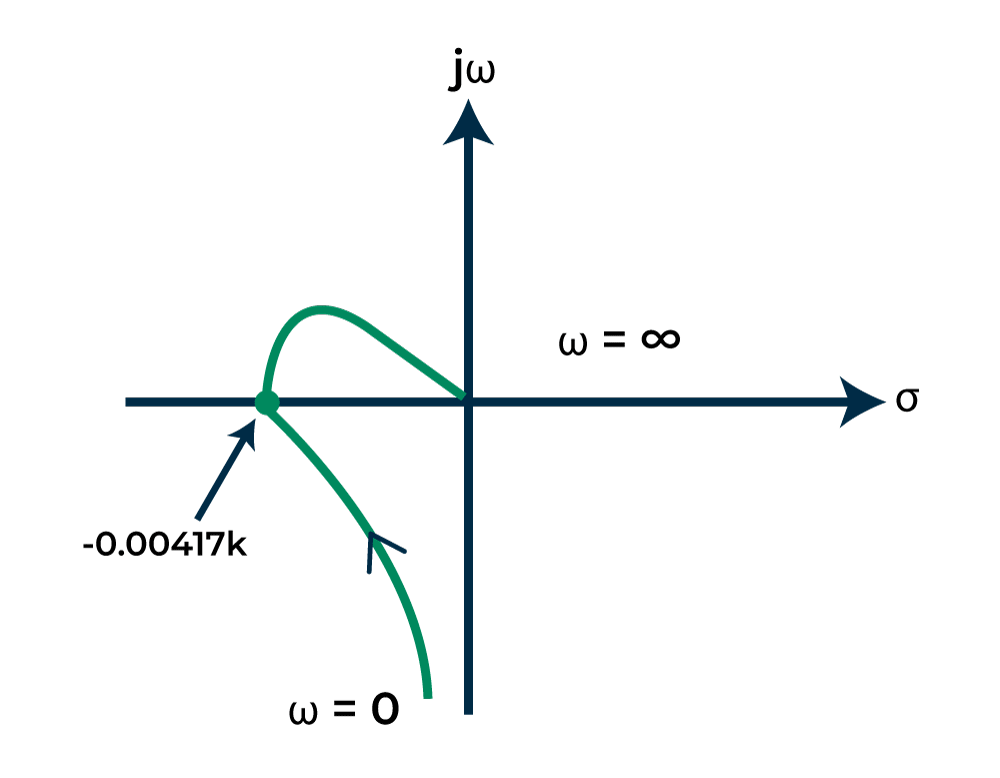
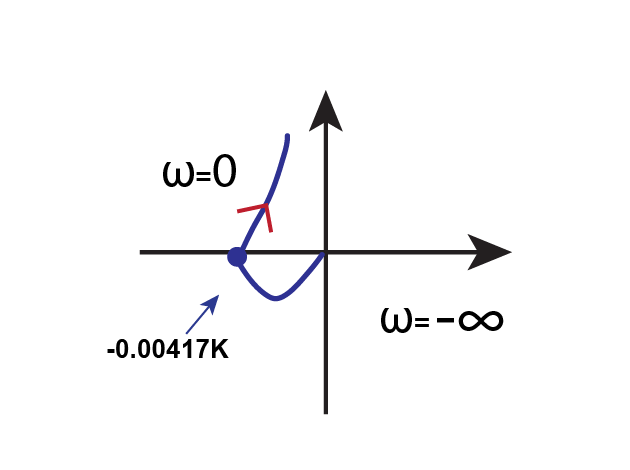
The polar plot will start at -90 degrees and crosses the x axis at point -0.00417K as given below:
Step 3: Mapping the region 2 whose equation is given by: s = where, θ = +90o to -90o
If the transfer function is in the form G(s)H(s) = , then assume that (1 + sT) is equal to sT. It is given by:
G(s)H(s) =
G(s)H(s) =
G(s)H(s) =
Let s =
G(s)H(s) =
At , G(s)H(s) =
At , G(s)H(s) =
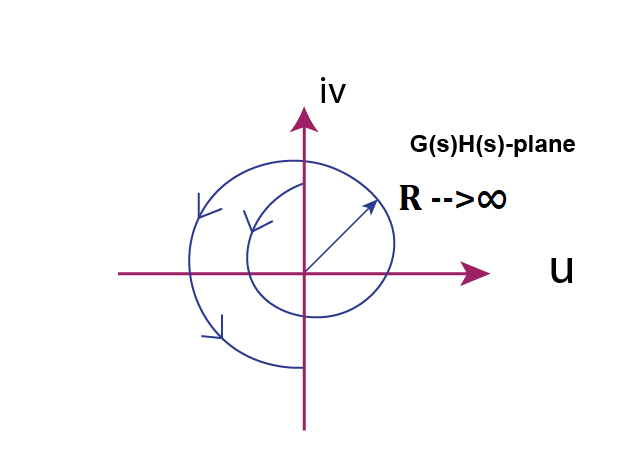
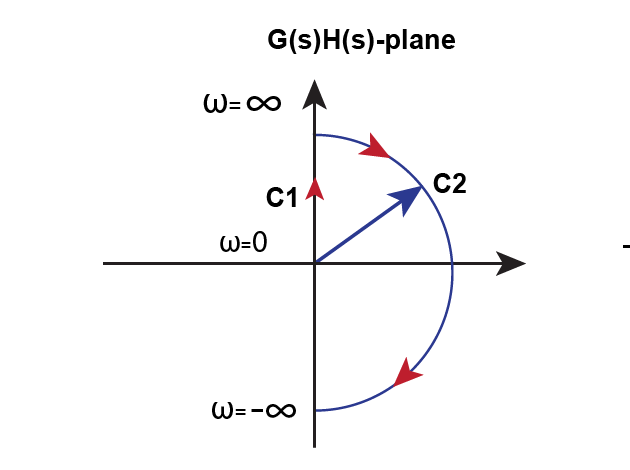
Thus, the region 2 varies from -270 degrees to 270 degrees. It is represented below:
Step 4: Now map the region 3 of the nyquist contour. The region 3 is simple inverse of region 1. Thus the graph will mirror image of region 1 graph which is shown below:
Step 5: Mapping the region 4 whose equation is given by: s = ,where, θ = -90o to +90o
If the transfer function is in the form G(s)H(s) = , then assume that (1 + sT) is equal to 1. It is given by:
G(s)H(s) =
G(s)H(s) =
Let s = s =
G(s)H(s) = ∞
At , G(s)H(s) = ∞
At , G(s)H(s) = ∞
So the graph will be circular arc of infinite radius as seen in the given image.
Step 6: Now we will perform the stability analysis. To find the value of 'k', we will check when our contour will pass through the point (-1+j0)
-0.00417K = -1
K = 1/0.00417
K = 240
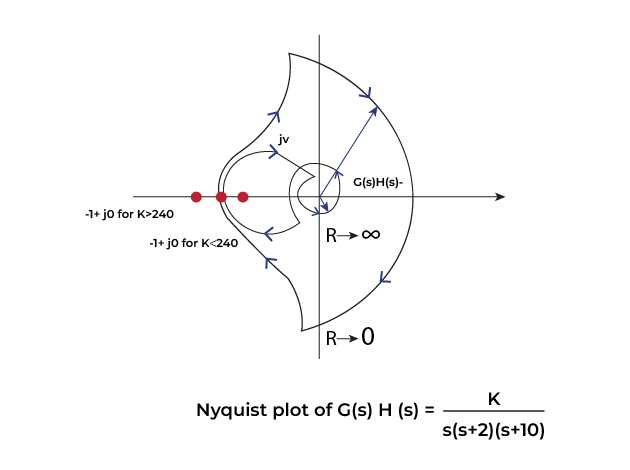
Step 7: Final Nyquist Plot is shown below. It as been plotted by combining the mapping of all the four regions.
Now we will check foe which value of 'k', the system is stable.
Case 1: If k< 240
The point -1+j0 is not encircled. This means that there are no poles on the right half of the plane. This means the system is stable for k less than 240.
Case 2: k>240
The point -1+j0 is encircled two times in the clockwise direction. This means that Z>P and hence the system is unstable.
Stability condition: 0 < K < 240