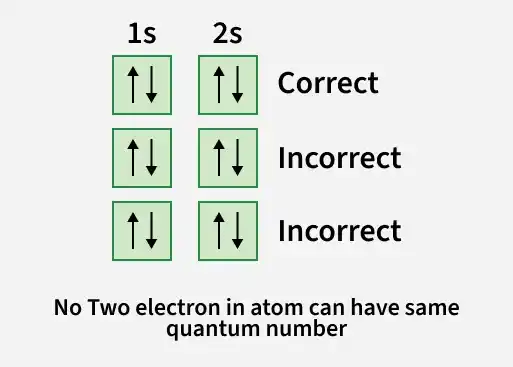
The Pauli Exclusion Principle helps explain the arrangement of electrons in orbitals of an atom. According to this principle, no two electrons in an atom can have the same set of four quantum numbers. This means that each electron in an atom must have a unique combination of quantum numbers that describes its energy, shape of orbital, orientation, and spin.
Helium has two electrons. Both electrons occupy the 1s orbital.
1s 2
According to the Pauli Exclusion Principle:
One electron has spin
The other electron has spin
Thus, the two electrons in the same orbital have opposite spins, which satisfies the Pauli Exclusion Principle.
Pauli Exclusion Principle in Chemistry
The Pauli Exclusion Principle is an important rule that explains how electrons are arranged in the orbitals of an atom.
The four quantum numbers (n, l, ml, ms ) describe the energy level, shape, orientation, and spin of an electron.
Since each electron must have a different combination of these quantum numbers, it ensures that electrons are distributed properly in different orbitals.
As a result of this principle, an orbital can contain a maximum of two electrons only, and these electrons must have opposite spins.
The spin quantum number of electrons in the same orbital will be:
ms = ms =
The Pauli Exclusion Principle plays an important role in determining the electronic configuration of elements, the structure of atoms, and the arrangement of elements in the periodic table.
Mathematical Representation
The Pauli Exclusion Principle can be explained mathematically using the four quantum numbers that describe the state of an electron in an atom.
These quantum numbers are: n, l, ml , ms
where:
n=principal quantum number (energy level)
l=azimuthal quantum number (shape of orbital)
ml=magnetic quantum number (orientation of orbital)
ms=spin quantum number
Example:
Consider the helium atom, which has two electrons.
Electronic configuration:
1s 2
For the first electron in the 1s orbital:
n = 1 , l = 0 , ml = 0 , ms =
For the second electron in the same orbital:
n = 1 , l = 0 , ml = 0 , ms =
Here the first three quantum numbers are the same, but the spin quantum number is different, which satisfies the Pauli Exclusion Principle.
Examples of Pauli Exclusion Principle
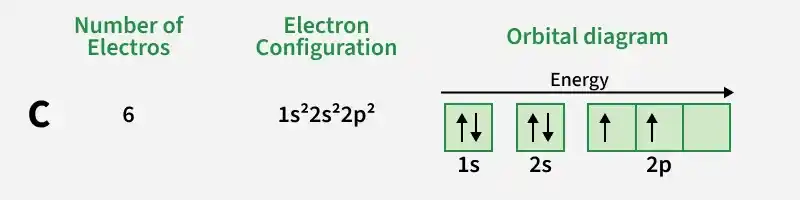
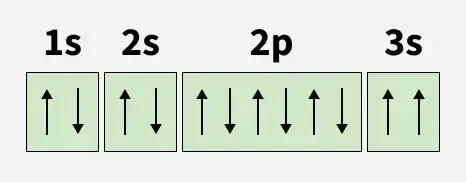
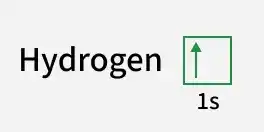
The following examples illustrate how electrons occupy orbitals according to the Pauli Exclusion Principle.
Since there is only one electron, the Pauli Exclusion Principle is automatically satisfied because no other electron is present with the same quantum numbers.
Applications of Pauli Exclusion Principle
The Pauli Exclusion Principle has various practical applications in different fields of science and technology. Several important applications are:
It helps explain how electrons are arranged in atoms and why elements show different chemical properties.
According to this principle, an orbital can contain a maximum of two electrons with opposite spins, which helps in determining the electronic configuration of atoms.
This principle also explains the structure and arrangement of elements in the periodic table, because the distribution of electrons in different orbitals leads to the periodic repetition of chemical properties.
It also helps in understanding the maximum number of electrons that can occupy an orbital.
In addition, the Pauli Exclusion Principle plays an important role in maintaining the stability of atoms by ensuring that electrons are distributed properly in different orbitals.
The arrangement of electrons based on this principle also helps explain the chemical behaviour, valency, and bonding of elements.