|
VOOZH | about |
|
VOOZH | about |
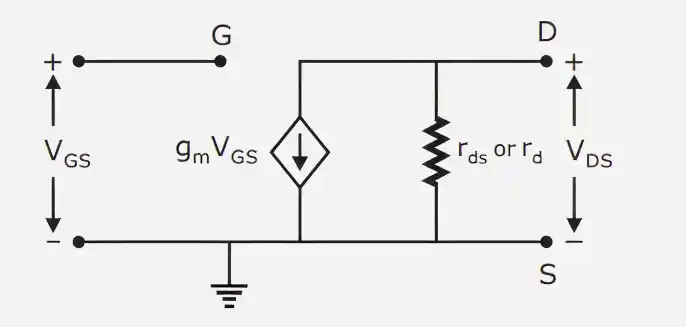
An equivalent circuit used to examine how MOSFET amplifiers behave for small input signals is called the small signal model of a MOSFET. The MOSFET is modeled as a linear model around its functioning point (Q-point) rather than dealing with nonlinear properties.
By describing the MOSFET using linear components like regulated sources and resistances, this model aids in streamlining the study of amplifier circuits.
The following gives the small signal drain current:
where:
Since the gate is insulated from the channel, no current flows through the gate terminal:
This is represented as an open circuit between gate and source in the small signal model.
The performance of the small signal model depends on two important parameters:
Defined as the rate of change of drain current with respect to gate-to-source voltage.
For a MOSFET operating in saturation region:
where:
Let:
where:
Then,
Differentiating with respect to
Using the relation:
we get:
Thus, transconductance depends on the drain current and device parameters.
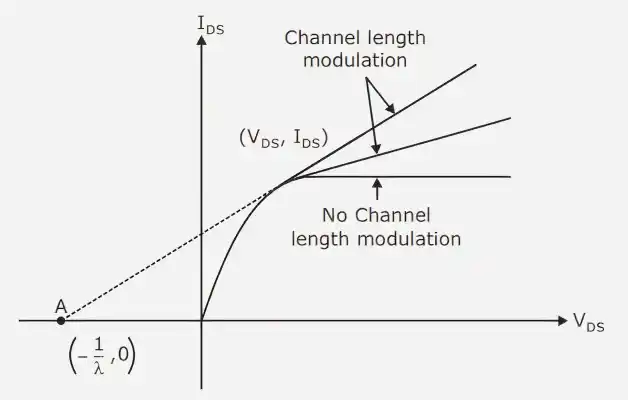
The reciprocal of the slope of the drain characteristics in the saturation region.
Due to channel length modulation, the drain current slightly increases with even in saturation.
Including this effect:
where λ is the channel length modulation parameter.
Differentiating:
Therefore:
Thus, dynamic drain resistance is inversely proportional to both the drain current and the channel length modulation parameter.