|
VOOZH | about |
|
VOOZH | about |
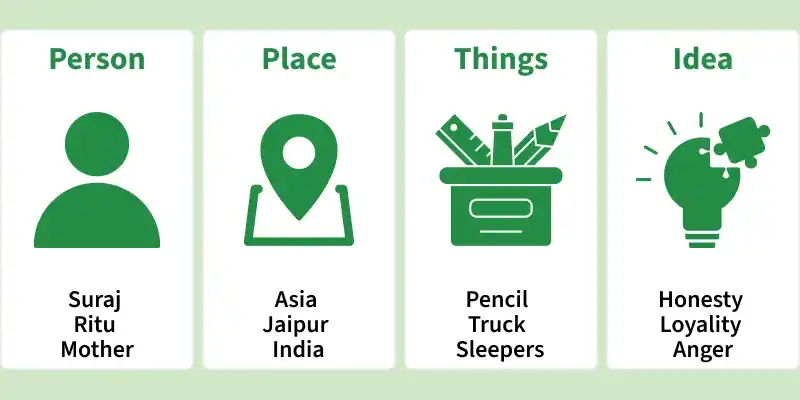
A noun is a word that names a person, place, thing, or idea. It is a basic and important part of English grammar because it helps us clearly identify what we are talking about in a sentence.
Examples:
- Place- Goa, Taj Mahal, Sea, River, Planet, Farmhouse, Tourist place, etc.
- Person- John, Biographer, Cardiologist, Cameramen, Actress, Politicians, etc.
- Things- Grains, Rocks, Trees, Forest, Paper, Glass, Metals, Plastic, etc.
- Ideas- Revolution, Resolution, Invention, Conclusion, Argument, etc.
Nouns can perform different roles in a sentence. They can act as a subject, object, or complement. The subject tells who or what performs the action, and the verb tells what action is performed.
The subject of a sentence is the noun or pronoun that acts as an action of the verb.
For Example, in this sentence "The lion chased the goat,"
"lion" is the subject of the verb "chased."
Nouns and pronouns act as a role of objects in a sentence, and both can also be direct and indirect objects in a sentence.
For Example, in this sentence "Raghav is a brilliant student"
Raghav is a Subjective Noun and Student is an objective Noun.
Noun or Pronoun as a direct object receives the action of the verb.
For Example, in this sentence "He gave the keys to her mother,"
"keys" are the direct object of the verb "gave."
Noun or Pronoun as an indirect object is indirectly affected by the action of the verb, usually placed before the direct object.
For Example, in this sentence "He gave flowers to his mother,"
"mother" is the indirect object of the verb "gave."
An object complement is a word or phrase that follows a direct object and describes or renames it.
For Example, in this sentence "I painted the room green."
Here, “green” is the object complement because it describes the direct object “the room.”
A subject complement is a noun, pronoun, or adjective that follows a linking verb and describes or renames the subject.
For Example, in this sentence "The cookies taste delicious."
In this sentence, "delicious" is used as a subject complement because it follows the linking verb "taste" and describes the subject "
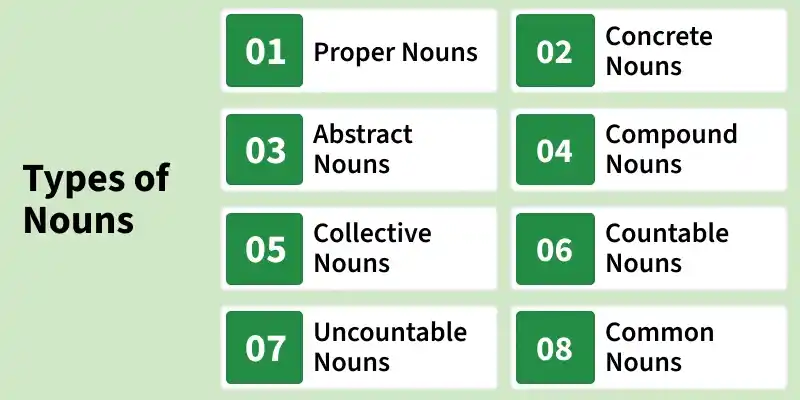
The following are the classification of Noun on different basis:
| Noun on different Basis | Types of Nouns | Examples |
|---|---|---|
| Type of Noun | Proper Noun, Common Noun, Collective Noun, Material Noun, Abstract Noun | Paris, city, team, water, love |
| Number | Singular Noun, Plural Noun | cat, cats, book, books |
| Function | Subject Noun, Object Noun, Possessive Noun | The dog barks (subject), She loves music (object), John's car (possessive) |
| Countability | Countable Noun, Uncountable Noun | book, water, ideas |
| Concreteness | Concrete Noun, Abstract Noun | tree, happiness, love |
| Specificity | Proper Noun, Common Noun | Paris, city, person |
| Composition | Compound Noun | toothpaste, bedroom |
The following are the different types of noun:
A Proper Noun is the name of a specific person, place, organization, brand, or thing. It refers to a particular entity and therefore always begins with a capital letter.
Examples:
Facts:
- It’s always always begin with a capital letter.
- We never use a/an before it, but “the” may be used with some names (e.g., the Ganga, the Himalayas, the United States).
- It has genders: Masculine, Feminine, Neuter.
A Common Noun is the general name of a person, place, animal, thing, or idea. It refers to a class or group rather than a specific name.
Examples:
Facts:
- Common nouns are divided into countable and uncountable noun.
- We always use a/ an before singular countable noun
Collective Noun denotes the collection of people, things, or animals considered as a single unit.
Examples:
1. Collective nouns for groups of animals:
A Material Noun refers to a material or substance that is used to make things. It denotes the base features of the materials.
Examples:
Facts:
- We never use a/an before it because it is uncountable
- We never make the plural of it by adding s/es
An Abstract Noun refers to a quality, idea, feeling, state, or concept that cannot be perceived through the five senses. It represents something intangible, meaning it cannot be seen, touched, heard, smelled, or tasted.
Examples:
Facts:
- Abstract nouns are usually uncountable.
- They generally do not take plural forms.
- Articles like a/an may sometimes be used when referring to a specific instance.
- Abstract nouns can be made from the conversion of verbs and adjectives
Singular Nouns are those Nouns that denote a single or one person, one place, or one thing.
Examples:
Facts:
- We use a/an before the Singular Noun.
- We can make the plural of it by adding s/es
A Plural Noun is a noun that indicates multiple People, Places, Animals, or Things. They can be easily made Plural by adding easily s, es or making changes in the spelling of a Singular Noun.
Examples:
Facts:
- It’s always written in uppercase
- We never use a/an before it
- It has genders: Masculine, Feminine, Neuter
A Compound Noun is simply made up of two or more word that comes together to form a noun.
Examples:
Facts:
- It is not necessary that both words are Nouns.
- It is formed with the help of more than one part of speech.
Countable Nouns are those nouns that can be easily counted. These nouns can be singular or plural.
Examples:
Facts:
- We can use words like some, any, a few, many, and a number of, with countable Nouns.
- It can be singular and plural too.
- It can be preceded by the indefinite article a or an.
- It can also be preceded by a number.
Uncountable Noun are those Nouns that can't be counted. These nouns are always in singular form but can't be counted.
Examples:
A possessive noun is a noun that shows ownership or possession of something. It is formed by adding an apostrophe + "s" to the noun.
Examples:
Facts:
- Possessive nouns are formed by adding an apostrophe and the letter "s" to the noun, or just an apostrophe if the noun is already plural and ends in "s".
- Possessive nouns can be singular or plural, and they can indicate possession by one person or thing or by multiple people or things.
- Possessive nouns can be used to indicate a relationship between two nouns, such as "the dog's ball" (showing that the dog possesses the ball)
- Do not use an apostrophe with possessive pronouns such as "its", "hers", "yours", "theirs", "ours", and "mine".
A concrete noun is a noun that refers to a physical object that can be perceived through the five senses. These senses are sight, hearing, touch, taste, and smell.
Examples:
A Noun Phrase is a group of words that functions as a noun in a sentence. It may act as a subject, object, or complement. A noun phrase usually consists of a noun and words that modify or describe it.
Common elements used in noun phrases include:
Examples:
1. “The red sports car”
The noun phrase “the red sports car” acts as the subject in the sentence:
The red sports car is fast.2. “The little girl with curly hair”
The noun phrase “the little girl with curly hair” acts as the subject in the sentence:
The little girl with curly hair is singing a song.3. “My favorite book”
The noun phrase “my favorite book” acts as the object in the sentence:
I am reading my favorite book.4. “The city of Paris”
The noun phrase “the city of Paris” acts as the subject in the sentence:
The city of Paris is known for its art and culture.
Proper Noun | Common Noun |
|---|---|
| Proper Nouns include Specific People, Places, or Things. | Common Noun means generic place, person, or things. |
| Proper Nouns are Specific. | Common Nouns are Non-specific. |
| Proper Noun is often capitalized. | Common Nouns are usually not capitalized. |
| Example: Japan, Salman, Satluj River, Parker Pen, etc. | Example: River, Grandfather, Tree, Pen, Pencil, etc. |
Nouns can also be used in other ways. Some of the most common multifunctionality of nouns can be seen when a noun is used as a verb and a noun is used as an adjective.
Nouns can also be used a verb in sentences, this is also called verbing or denominalization. You can use nouns as verbs with slight changes in spelling.
Examples:
- I used the hammer to drive the nail into the wood. (hammer used as a noun)
- The carpenter hammered the nails into the wood. (hammered used as a verb)
- I poured a glass of water for my thirsty dog. (water used as a noun)
- The farmer watered the crops to help them grow. (watered used as a verb)
Nouns can also be used as Adjectives to describe other nouns, this is also called adjectival use or attributive use of nouns.
Examples:
- The student eagerly absorbed the information presented in class. (Student used as a noun)
- The student council met to discuss new ideas.(Student used as Adjective)
- The musician performed a mesmerizing melody that filled the room with sound. (musician used as a noun)
- The musician community gathered for the annual festival. (musician used as Adjective)