|
VOOZH | about |
|
VOOZH | about |
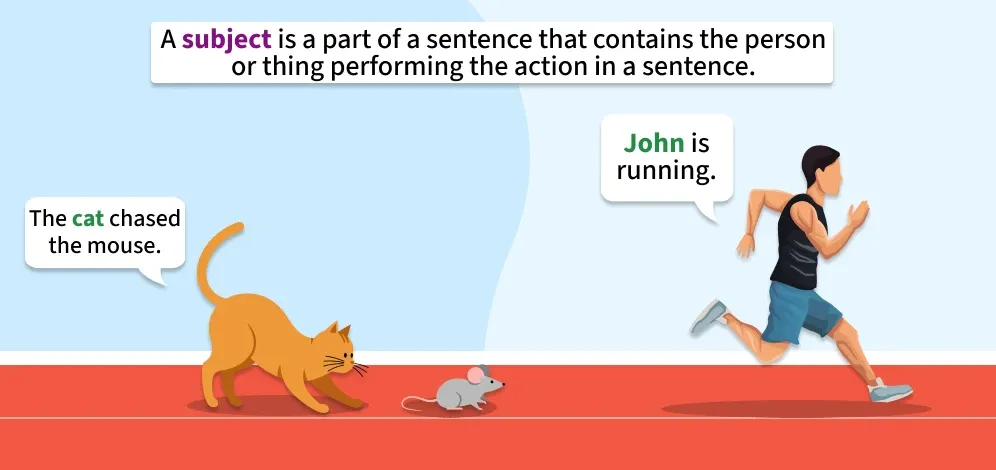
A subject is the noun or pronoun that a sentence is about. It either performs the action of the verb or is being described.
- The cat chased the mouse. → Subject: cat
- John is running. → Subject: John
Learn the Grammar - English Grammar
This is the main noun or pronoun that performs the action described by the verb.
Example: In the sentence "The cat is sleeping on the couch," the simple subject is "cat."
This includes the simple subject and all of the words that modify it.
Example: In the sentence "The fluffy white cat is sleeping on the couch," the complete subject is "The fluffy white cat."
This is a subject made up of two or more simple subjects that are joined by a conjunction (such as "and" or "or").
Example: In the sentence "The fluffy white cat is sleeping on the couch," the complete subject is "The fluffy white cat."
This is a subject that does not refer to a specific person or thing, such as "everyone," "nobody," or "something."
Example: In the sentence "Everyone is welcome at the party," the indefinite subject is "everyone."
This is a subject that refers to a group of people or things as a single unit.
Example: In the sentence "The team is practicing today," the collective subject is "team."
This is a subject that refers to an idea, concept, or quality rather than a concrete person or thing.
Example: In the sentence "Friendship is important," the abstract subject is "friendship."
In English grammar, the subject is the noun or pronoun that performs the action described by the verb in a sentence. The subject is usually placed at the beginning of the sentence and is the focus of the sentence.
Example:
- The cat is sleeping on the couch. (The subject is "cat.")
- She is going to the store. (The subject is "she.")
- The boys are playing soccer. (The subject is "boys.")
In English, the subject is usually a noun or pronoun, but it can also be a noun phrase (a group of words that functions as a noun) or a clause (a group of words that contains a subject and a verb).
Example:
- Noun phrase: "The small brown cat that lives next door slept on the couch." ("The small brown cat that lives next door" is the subject of the sentence.)
- Clause: "Who slept on the couch?" ("Who" is the subject of the clause and the sentence.)
The subject is an important part of a sentence because it tells us who or what is acting. It is often accompanied by a verb and may also be modified by adjectives or other modifiers.
Example:
- The fluffy white cat is sleeping on the couch. (The subject is "cat," and it is modified by the adjectives "fluffy" and "white.")
- She, the talented dancer, is going to the store. (The subject is "she," and it is modified by the noun phrase "the talented dancer.")
Step 1: Find the verb first
Ask yourself: What is happening in the sentence?
Once you find the verb, the subject is the noun or pronoun that is linked to that action.
Step 2: Check whether the sentence is active or passive
Step 3: Identify the words that modify the subject
Adjectives and articles often come before the subject.
They help form the complete subject, but the main noun is the simple subject.
Example: The small black cat hissed.
→ Complete subject: The small black cat
→ Simple subject: cat
Step 4: Look for compound subjects
If two or more subjects are joined by a conjunction (like and, or, or), include all of them.
Example: Riya and Meera are studying.
→ Compound subject: Riya and Meera
Q 1. Which of the following sentences has a subject and a verb?
A. The cat chased the mouse.
B. A fluffy white kitten.
C. Across the street.
D. It is raining today.
Q 2. In the sentence "The cat chased the mouse," what is the subject?
A. The cat
B. The
C. Mouse
D. Chased
Q 3. In the sentence "She is singing a song," what is the verb?
A. She
B. Is
C. Singing
D. Song
Q 4. In the sentence "The sun is shining brightly," what is the subject?
A. The sun
B. Is
C. Shining
D. brightly
Q 5. In the sentence "He is playing soccer," what is the verb?
A. He
B. Is
C. Playing
D. Soccer
Answers:
1. A
2. A
3. C
4. A
5. C