|
VOOZH | about |
|
VOOZH | about |
A Multiplexer (MUX) and a Demultiplexer (DEMUX) are essential digital circuits in communication systems, performing opposite functions. A multiplexer combines multiple input signals into a single output, while a demultiplexer takes a single input signal and routes it to one of many output lines.
In this article, we’ll explore the differences between a multiplexer and a demultiplexer, their advantages, disadvantages, and applications.
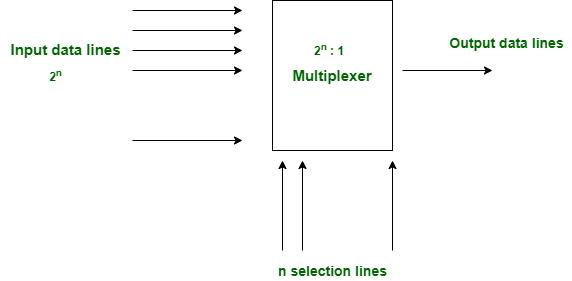
A multiplexer is a combinational circuit with multiple data inputs and a single output, determined by control or select lines. Often referred to as MUX, it requires log2(N)log2(N) selection lines for NN input lines, or equivalently, nn selection lines for 2n2n input lines.
Multiplexers are also known as:
They are mainly used to increase the amount of data that can be sent over a network within a certain amount of time and bandwidth
Below is the Block Diagram of the Multiplexer, It will have 2n Input lines and will select output based on the Select line.
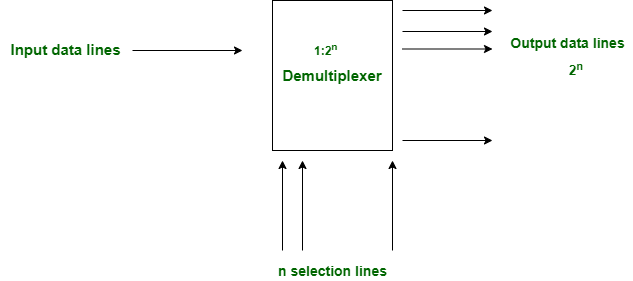
👁 MultiplexerDemultiplexer is the opposite of multiplexer. It is also termed as DEMUX. It takes input from one source and also converts the data to transmit towards various sources. The demultiplexer has one data input line. The demultiplexer has several control lines (also known as select lines). These lines determine to which output the input data should be sent. The number of control lines determines the number of output lines.
Given below is the block diagram of the Demultiplexer, It will have one Input line and will give 2n output lines.
👁 Demultiplexer| Multiplexer(MUX) | Demultiplexer(DEMUX) |
|---|---|
| Multiplexer processes the digital information from various sources into a single source. | Demultiplexer receives digital information from a single source and converts it into several sources |
| It is known as Data Selector | It is known as Data Distributor |
| Multiplexer is a digital switch | Demultiplexer is a digital circuit |
| It follows combinational logic type | It also follows combinational logic type |
| It has 2n input data lines | It has single input line |
| It has a single output data line. | It has 2n output data lines |
Efficiently uses bandwidth by combining many signals into a single line for transmission. | Divides a single signal into several parts, so bandwidth is less efficiently used. |
Needs control lines to select which input signal to send to the output. | Needs control lines to determine which output line should receive the input signal. |
| It works on many to one operational principle | It works on one to many operational principle. |
May consume more power due to the need for control logic and multiple input connections. | Typically uses less power, especially when splitting a single signal to multiple destinations. |
| In time division Multiplexing, multiplexer is used at the transmitter end. | In time division Multiplexing, demultiplexer is used at the receiver end. |
In summary, a multiplexer combines multiple signals for efficient data transmission, while a demultiplexer splits a single signal for distribution. Both circuits have unique advantages and disadvantages, with their use depending on system requirements like speed, cost, and simplicity.