|
VOOZH | about |
|
VOOZH | about |
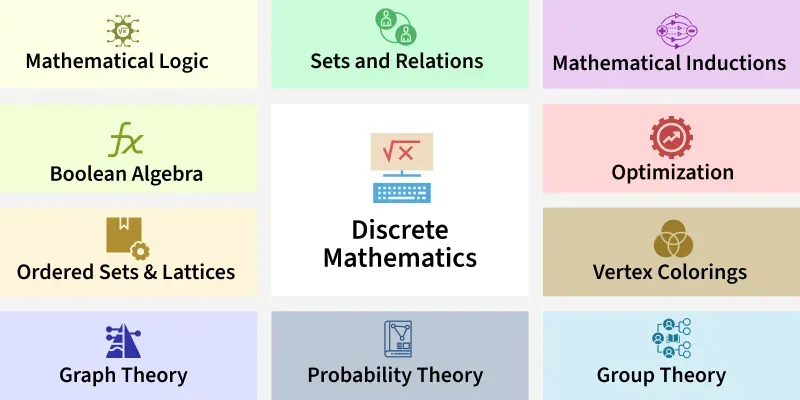
Discrete Mathematics is a branch of mathematics that is concerned with "discrete" mathematical structures instead of "continuous" ones. Discrete mathematical structures include objects with distinct values, like graphs, integers, logic-based statements, etc.
To explore these concepts in detail, we begin with the following core topics.
Learn propositional and predicate logic, equivalences, proofs, and rules of inference for logical reasoning.
Understand set theory, operations, relations, functions, and equivalence relations with real-world applications.
Explore counting techniques, permutations, combinations, generating functions, and probability concepts.
Study Boolean functions, algebraic theorems, properties, and methods for minimizing Boolean expressions.
Learn linear programming, the simplex algorithm, and PERT for solving optimization problems.
Understand partially ordered sets, Hasse diagrams, and lattice theory in mathematical structures.
Dive into probability axioms, conditional probability, and common distributions like Poisson, normal, and exponential.
Explore graph types, algorithms (like Dijkstra’s and DFS), and applications in problem-solving and optimization.
Study Eulerian and Hamiltonian graphs, including algorithms and problems like the Traveling Salesman Problem.
Learn about matching in graphs, approximation algorithms, and optimization techniques.
Explore graph colorings, chromatic numbers, and algorithms like Greedy Coloring for graph theory.
Understand the basics of groups, subgroups, isomorphisms, and structures like rings and fields.
Access last-minute notes and quizzes to reinforce your learning in discrete mathematics.