|
VOOZH | about |
|
VOOZH | about |
Understanding how to represent relations in graphs and matrices is fundamental in engineering mathematics. These representations are not only crucial for theoretical understanding but also have significant practical applications in various fields of engineering, computer science, and data analysis. This article will explore different ways to represent relations using graphs and matrices, their properties, and applications in engineering.
Table of Content
A relation is a connection or association between elements of two sets. In mathematical terms, if we have two sets A and B, a relation R from A to B is a subset of the Cartesian product A x B.
Read More: Relations in Maths
Graphs provide a visual way to represent relations. There are different types of graphs used for this purpose, including directed graphs (digraphs) and undirected graphs. Here's a detailed look at these representations:
A directed graph consists of nodes or vertices connected by directed edges or arcs. Let R is relation from set A to set B defined as (a,b) ? R, then in directed graph-it is represented as edge(an arrow from a to b) between (a,b).
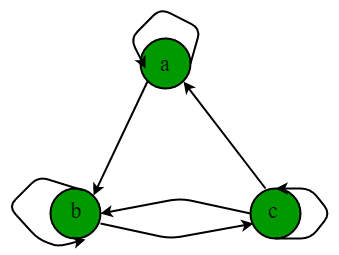
The directed graph of relation R = {(a,a),(a,b),(b,b),(b,c),(c,c),(c,b),(c,a)} is represented as:
👁 Image
Since, there is loop at every node, it is reflexive but it is neither symmetric nor antisymmetric as there is an edge from a to b but no opposite edge from b to a and also directed edge from b to c in both directions. R is not transitive as there is an edge from a to b and b to c but no edge from a to c.
In an undirected graph, edges have no direction. This type of representation is used when the relation is symmetric, meaning if a is related to b, then b is also related to a.
If the relation R on set A = {1,2,3} is such that R={(1,2),(2,3)}, the undirected graph will have vertices 1, 2, and 3, with edges between 1 and 2, and 2 and 3.
Suppose R is a relation from set A to B and S is a relation from set B to C, the combination of both the relations is the relation which consists of ordered pairs (a,c) where a ∈ A and c ∈ C and there exist an element b ∈ B for which (a,b) ∈ R and (b,c) ∈ S. This is represented as RoS.
A relation R is defined as (a,b) ? R from set A to set B, then the inverse relation is defined as (b,a) ? R from set B to set A. Inverse Relation is represented as R-1
R-1 = {(b,a) | (a,b) ? R}.
Let R be a relation from set A to B, then the complementary Relation is defined as {(a,b) } where (a,b) is not. R.
Matrices provide an algebraic way to represent relations. The relation matrix is a two-dimensional array where the rows represent elements of set A and the columns represent elements of set B. If there is a relation between ai ∈ A and bj ∈ B, then the entry mij in the matrix is 1; otherwise, it is 0.
Relations and their representations are widely used in engineering for various purposes:
Graphs and matrices are extensively used in network analysis, including communication networks, transportation networks, and electrical grids. They help in understanding the connectivity and flow of information or resources.
In control systems engineering, state transition graphs and matrices represent system states and transitions, aiding in the design and analysis of control strategies.
In computer science, graphs and matrices are fundamental in designing algorithms for searching, sorting, and optimization problems.
Relations form the basis of relational databases, where tables (matrices) are used to store and manage data efficiently.
Problem 1:
Problem 2: Given the set A={1,2,3,4,5} and the relation R={(1,2),(2,3),(3,4),(4,5)}, represent this relation using a graph and an adjacency matrix. Check if the relation is reflexive, symmetric, or transitive.
Problem 3:
Problem 4:
Problem 5: For the set C={a,b,c}, a relation T is given as T={(a,b),(b,a),(b,c)}. Create the corresponding graph and adjacency matrix. Verify if the relation is symmetric and transitive.
Problem 6: .
Problem 7:
Problem 8:
Problem 9: For the set H={a,b,c,d}, a relation Y is defined as Y={(a,a),(b,b),(c,c),(d,d)}. Create the corresponding graph and matrix. Determine the properties of this relation.
Problem 10: .
Understanding the representation of relations in graphs and matrices is crucial for various fields of engineering and computer science. These representations provide a clear and structured way to visualize and analyze connections between elements, aiding in the development of efficient solutions to complex problems.