|
VOOZH | about |
|
VOOZH | about |
A system of linear equations is a set of two or more linear equations involving the same set of variables. Each equation represents a straight line or a plane, and the solution to the system is the set of values for the variables that satisfy all equations simultaneously. This system can have one solution (consistent and independent), no solution (inconsistent), or infinitely many solutions (dependent).
Here is a simple example of a system of linear equations:
A system of linear equations consists of multiple linear equations involving the same set of variables. It can be represented as follows:
This represents a system of n linear equations in n variables x1, x2, x3,…., xn.
Where,
These equations can be written in matrix form as AX = B, where:
Solving the system involves finding the values of x1, x2, x3,…., xn that satisfy all equations simultaneously.
The solution of these systems depends on the rank of the coefficient matrix A and the rank of the augmented matrix [A :B].
1) System of Homogeneous linear equations AX = 0
Since a homogeneous system always has at least one solution (X = 0), it is always consistent.
Example of Homogeneous System in three variable:
x + y - z = 0
x + y + z = 0
x - y + 2z = 0
2) System of Non-Homogeneous linear equations AX = B
Example of Non - Homogeneous System in three variable
x + y - 2z = 6
x - 6y + z = 9
2x - y + 2z = 2
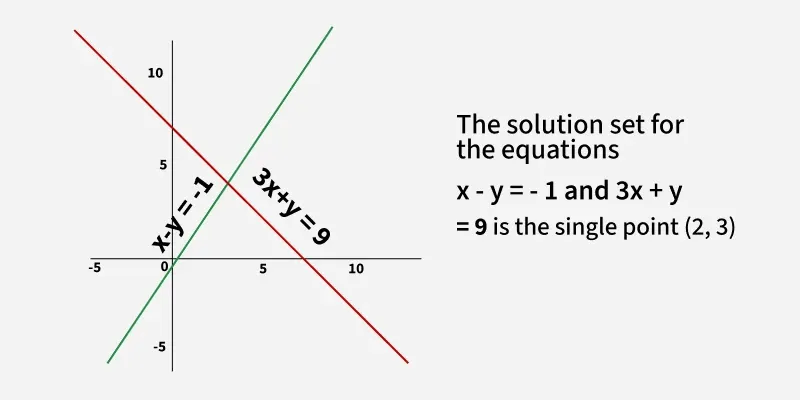
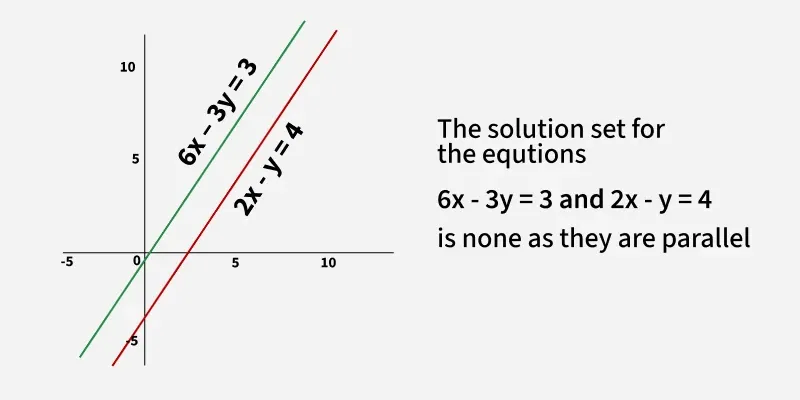
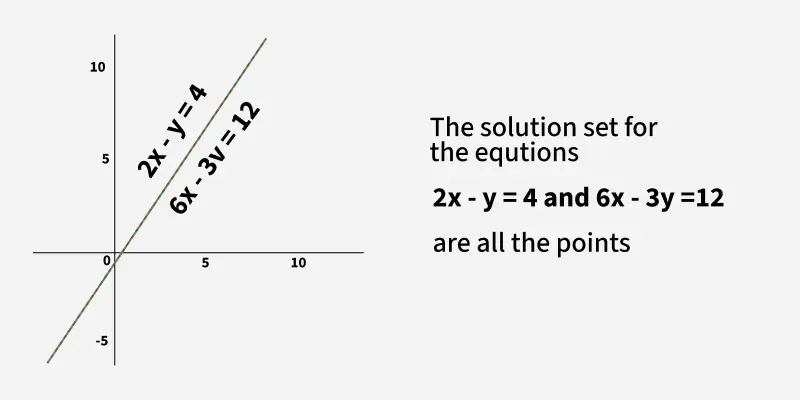
For a system of two linear equations with two variables (x and y), solving the system involves finding the point of intersection of the two lines represented by the equations on the xy-plane. There are three possibilities:
1) The lines intersect at one point: This point is the unique solution to the system.
2) The lines are parallel: They never intersect, so there is no solution. The system is called inconsistent.
3) The lines are coincident: They are the same line, so every point on the line is a solution. There are infinitely many solutions.
The solution set to a system of two linear equations in two variables can be a single point, the empty set (no solution) or an infinite set of points (a line).
The method of solving a system of linear equation are broadly classified into direct methods, which give the exact solution in a finite number of steps(like Gaussian elimination) and indirect(iterative) method that are as follow:
Direct methods provide an exact solution to the system of linear equations in a finite number of steps. They are typically preferred for smaller systems or when an exact solution is needed.
Indirect methods (also called iterative methods) are generally used for solving larger systems where direct methods may be computationally expensive or inefficient. These methods generate approximations to the solution, and the accuracy improves as the iterations progress.
Systems of linear equations are widely used in various engineering disciplines:
Question 1: What is the type of system for the equation AX = 0?
Question 2: Which method involves using determinants to solve a system of linear equations?
Question 3: What is the geometric interpretation when two lines are coincident?
Question 4: What type of methods are used for larger systems of equations where direct methods may be inefficient?
Answer :
- Homogeneous
- Cramer's Rule
- Infinite solutions
- Indirect methods