|
VOOZH | about |
|
VOOZH | about |
Mean, Variance and Standard Deviation are fundamental concepts in statistics and engineering mathematics, essential for analyzing and interpreting data. These measures provide insights into data's central tendency, dispersion, and spread, which are crucial for making informed decisions in various engineering fields.
Here, we will discuss the definitions, formulas, and applications of mean, variance, and standard deviation in engineering, along with solved examples.
Mean, variance, and standard deviation are all fundamental concepts in statistics, and they help to describe the distribution and spread of data.
Table of Content
The mean also known as the average, is a measure of the central tendency of a dataset. It is calculated by summing up all the values in the dataset and dividing them by the number of values. It is denoted by the symbol μ.
Mean Formula
For a dataset with n values x1, x2, x3, ......., xn the mean μ is given by:
μ =
Example: Find the mean (average) of the following dataset: {4, 8, 6, 5, 3, 7}
μ = 4 + 8 + 6 + 5 + 3 + 7 / 6
= 33/6
= 5.5
Variance measures the dispersion of a dataset, indicating how much the values differ from the mean. It is the average of the squared differences from the mean.
Variance Formula
For a dataset with n values x1, x2, x3, ......., xn the mean σ2 is given by:
σ2 =
Example: Find the variance of the following dataset {4, 8, 6, 5, 3, 7} with mean = 5.5.
σ2 = (4 - 5.5)2 + (8 - 5.5)2 + (6−5.5)2 + (5−5.5)2 + (3−5.5)2 + (7- 5.5)2 / 6
σ2 = 17.5/6 = 2.92
Standard deviation is the square root of the variance, providing a measure of the spread of the dataset in the same units as the data.
Standard Deviation Formula
For a dataset with n values x1, x2, x3, ......., xn the mean σ is given by:
σ = =
Example: Find the standard deviation of the following dataset {4, 8, 6, 5, 3, 7}, with variance σ2 = 2.92.
To find the standard deviation of the dataset {4, 8, 6, 5, 3, 7} with a given variance of σ² = 2.92, we use the following formula:
σ = √σ2Given that the variance σ2 = 2.92, we can calculate the standard deviation σ:
σ = 2.92 = 1.71So, the standard deviation is 1.71.
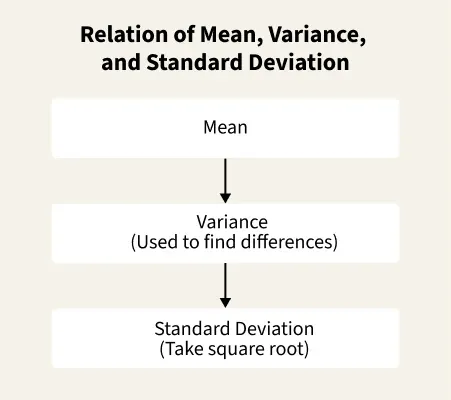
The mean is the average of all numbers in a dataset and shows the center of the data. Once we have the mean, we can find the variance, which tells us how spread out the numbers are from the mean.
To calculate variance, we look at how far each number is from the mean, square those differences, and then find their average. Since variance is in squared units, we take the square root of it to get the standard deviation, which tells us the spread in the same units as the original data. So, the mean helps us find the variance, and the variance helps us find the standard deviation.
Example: The dataset below represents the scores of 5 students in a quiz: {5, 7, 9, 11, 13}
Solution:
Step 1: Calculate the Mean
Mean = 5 + 7 + 9 + 11 + 13 /5
= 45 / 5 = 9.Step 2: Calculate the Variance
Subtract the mean from each number, square the result, and find the average:
(5 - 9)² + (7 - 9)² + (9 - 9)² + (11 - 9)² + (13 - 9)
= 16 + 4 + 0 + 4 + 16
= 40
Then, divide by 5: 40 / 5 = 8.Step 3: Calculate the Standard Deviation
- Take the square root of the variance: √8 = 2.83.
- So, the standard deviation is 2.83.
Question 1. Consider the data set: 4, 8, 6, 5, 3, 9.
Solution:
Step 1: Calculate the Mean
- Add up all the numbers: 4 + 8 + 6 + 5 + 3 + 9 = 35.
- Divide by the number of values (6): 35 / 6 = 5.83.
- So, the mean is 5.83.
Step 2: Calculate the Variance
Subtract the mean from each number, square the result, and find the average:
- (4 - 5.83)² + (8 - 5.83)² + (6 - 5.83)² + (5 - 5.83)² + (3 - 5.83)² + (9 - 5.83)²
- = 3.35 + 4.68 + 0.03 + 0.69 + 8.00 + 10.03 = 26.78.
- Then, divide by 6: 26.78 / 6 = 4.80.
- So, the variance is 4.80.
Step 3: Calculate the Standard Deviation
- Take the square root of the variance: √4.80 = 2.19.
- So, the standard deviation is 2.19.
Question 2. Consider the dataset: 2, 4, 6, 8, 10.
Solution:
Step 1: Calculate the Mean
- Add up all the numbers: 2 + 4 + 6 + 8 + 10 = 30.
- Divide by the number of values (5): 30 / 5 = 6.
- So, the mean is 6.
Step 2: Calculate the Variance
- Subtract the mean from each number, square the result, and find the average:(2−6)2+(4−6)2+(6−6)2+(8−6)2+(10−6)2=(−4)2+(−2)2+02+22+42=16+4+0+4+16=40.
- Then, divide by the number of values (5): 40 / 5 = 8.
- So, the variance is 8.
Step 3: Calculate the Standard Deviation
- Take the square root of the variance: √8 ≈ 2.83.
- So, the standard deviation is approximately 2.83.
Question 3. Consider the dataset: 3, 7, 7, 19, 24.
Solution:
Step 1: Calculate the Mean
- Add up all the numbers: 3 + 7 + 7 + 19 + 24 = 60.
- Divide by the number of values (5): 60 / 5 = 12.
- So, the mean is 12.
Step 2: Calculate the Variance
- Subtract the mean from each number, square the result, and find the average:(3−12)2+(7−12)2+(7−12)2+(19−12)2+(24−12)2=(−9)2+(−5)2+(−5)2+72+122=81+25+25+49+144=324.
- Then, divide by the number of values (5): 324 / 5 = 64.8.
- So, the variance is 64.8.
Step 3: Calculate the Standard Deviation
- Take the square root of the variance: √64.8 ≈ 8.05.
- So, the standard deviation is approximately 8.05.
Question 4. Consider the dataset: 5, 10, 15, 20, 25.
Step 1: Calculate the Mean
- Add up all the numbers: 5 + 10 + 15 + 20 + 25 = 75.
- Divide by the number of values (5): 75 / 5 = 15.
- So, the mean is 15.
Step 2: Calculate the Variance
- Subtract the mean from each number, square the result, and find the average:(5−15)2+(10−15)2+(15−15)2+(20−15)2+(25−15)2=(−10)2+(−5)2+02+52+102=100+25+0+25+100=250.
- Then, divide by the number of values (5): 250 / 5 = 50.
- So, the variance is 50.
Step 3: Calculate the Standard Deviation
- Take the square root of the variance: √50 ≈ 7.07.
- So, the standard deviation is approximately 7.07.
Question 5. Consider the dataset: 11, 13, 15, 17, 19.
Solution:
Step 1: Calculate the Mean
- Add up all the numbers: 11 + 13 + 15 + 17 + 19 = 75.
- Divide by the number of values (5): 75 / 5 = 15.
- So, the mean is 15.
Step 2: Calculate the Variance
- Subtract the mean from each number, square the result, and find the average:(11−15)2+(13−15)2+(15−15)2+(17−15)2+(19−15)2=(−4)2+(−2)2+02+22+42=16+4+0+4+16=40.
- Then, divide by the number of values (5): 40 / 5 = 8.
- So, the variance is 8.
Step 3: Calculate the Standard Deviation
- Take the square root of the variance: √8 ≈ 2.83.
- So, the standard deviation is approximately 2.83.
Question 1: Find the mean, variance, and standard deviation for the dataset: 10, 15, 20, 25, 30.
Question 2: Calculate the mean, variance, and standard deviation for: 5, 10, 15, 20, 25.
Question 3: Determine the mean, variance, and standard deviation for: 4, 6, 8, 10, 12, 14.
Question 4: Find the mean, variance, and standard deviation for the dataset: 1, 4, 9, 16, 25.
Question 5: Calculate the mean, variance, and standard deviation for: 3, 6, 9, 12, 15.
Question 6: Determine the mean, variance, and standard deviation for: 8, 16, 24, 32, 40.
Question 4: Find the mean, variance, and standard deviation for the dataset: 2, 4, 6, 8, 10, 12.
Question 8: Calculate the mean, variance, and standard deviation for: 11, 22, 33, 44, 55.
Question 9: Determine the mean, variance, and standard deviation for: 7, 14, 21, 28, 35.
Question 10: Find the mean, variance, and standard deviation for the dataset: 13, 26, 39, 52, 65.
Answer Key: Mean, Variance, and Standard deviation
Ans 1: 20, 50, 7.07
Ans 2: 15, 50, 7.07
Ans 3: 9, 14, 3.74
Ans 4: 11, 92.8, 9.63
Ans 5: 9, 18, 4.24
Ans 6: 24, 128, 11.31
Ans 7: 7, 14, 3.74
Ans 8: 33, 308, 17.55
Ans 9: 21, 98, 9.90
Ans 10: 39, 338, 18.38
Related Articles:
Mean, variance, and standard deviation are key statistical measures that provide insights into the central tendency, dispersion, and spread of a dataset. These concepts are crucial in various fields, including engineering, finance, and data analysis, helping to understand and interpret data effectively.