|
VOOZH | about |
|
VOOZH | about |
LU decomposition or factorization of a matrix is the factorization of a given square matrix into two triangular matrices, one upper triangular matrix and one lower triangular matrix, such that the product of these two matrices gives the original matrix. It is a fundamental technique in linear algebra used to solve systems of linear equations, invert matrices, and compute determinants. Computers usually solve square systems of linear equations using LU decomposition.
LU decomposition breaks a matrix into two simpler matrices: one with numbers below the diagonal (L) and one above the diagonal (U). This makes solving equations, finding inverses and calculating determinants easier.
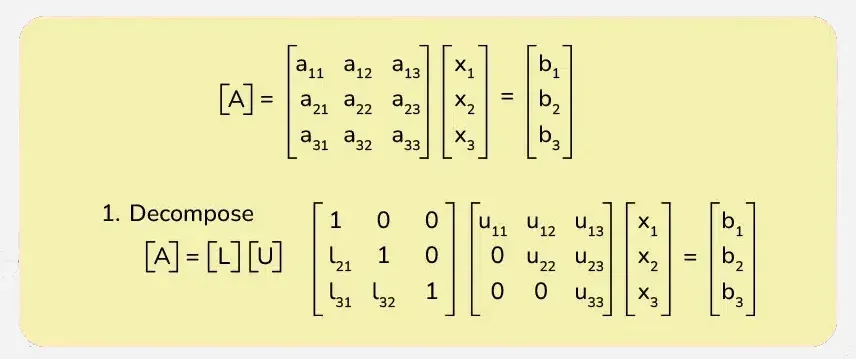
LU Decomposition expresses a given square matrix A as the product of two matrices:
Mathematically, A can be written as
A = L × U
Example: Given matrix :
Start with Gaussian elimination:
Subtract times the first row from the second row.
Find L :
Verify:Thus, LU decomposition gives:
LU Decomposition Method
To factor any square matrix into two triangular matrices, i.e., one is a lower triangular matrix and the other is an upper triangular matrix, we can use the following steps.
Start with a square matrix A: Given a square matrix A of size n ×n, the goal is to factor it into the product of two matrices: A = L×U, where:
Gaussian Elimination: Apply Gaussian elimination to convert matrix A into upper triangular form U. This step involves row operations to eliminate elements below the diagonal, resulting in an upper triangular matrix.
Track the Row Operations: As you perform row operations, keep track of the multipliers used to eliminate the elements below the diagonal. These multipliers form the entries of the lower triangular matrix L.
Extract the Matrices L and U:
Check the Result: Verify that the product of L and U yields the original matrix A: A = L × U. This confirms the correctness of the LU Decomposition.
Solve the following system of equations using the LU Decomposition method:
Solution:
Here, we have A = and
such that A X = C. Now, we first consider
and convert it to row echelon form using the Gauss-Jordan Elimination Method. So, by doing
we get
Now, by doing
We get
(Remember to always keep the' – ' sign in between, replace the ' + ' sign with two ' – ' signs)
Hence, we get L = and U =
Notice that in the L matrix,
is from (1), is from (2), and is from (3)
Now, we assume Z
and solve L Z = C,
So, we have
Solving, we get, and
Now, we solve U X = Z
Therefore, we get
Thus, the solution to the given system of linear equations is
and hence the matrix X =
Problem 1: Perform LU decomposition for the matrix A and find the matrices L and U, given the matrix :
Problem 2: Perform LU decomposition and express it as A=LUA = LUA=LU, where L is a lower triangular matrix and U is an upper triangular matrix :
Problem 3: Perform LU decomposition and express A=LU. Since A is diagonal, what do you observe about L and U, given the matrix :
Problem 4: Given the matrix A = perform LU decomposition on this matrix. What special considerations need to be taken when performing LU decomposition with matrices containing many zeros?