|
VOOZH | about |
|
VOOZH | about |
Cauchy's Mean Value Theorem provides a relation between the change of two functions over a fixed interval with their derivative. It is a special case of the Lagrange Mean Value Theorem. It is also called the Extended Mean Value Theorem or the Second Mean Value Theorem.
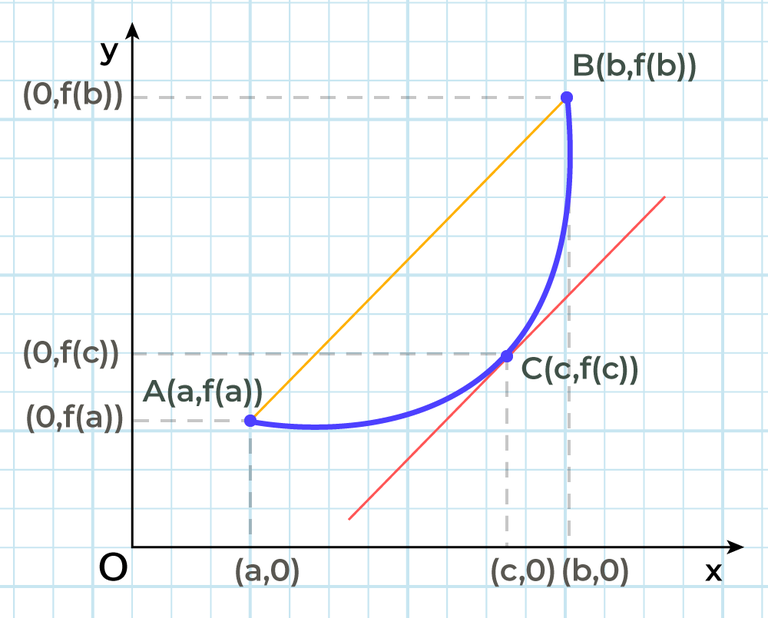
According to the theorem, if a function passes through two points given as [a, f(a)] and [b, f(b)] then there exist a point through which tangent on the curve passes which is parallel to the secant passing through the two given points.
For the function f(x) continuous over [a, b] and differentiable over (a, b), there exists a point c in the interval (a, b) such that
The image for the Mean Value Theorem is added below:
Cauchy's Mean Value Theorem states that, for any two functions, f(x) and g(x) satisfying the following conditions,
Then there exists a point c in the open interval a < c < b such that,
Example: Consider and g(x)= x over the interval [1 , 3].
Applying CMVT:
So, c = 2 satisfies the theorem.
Cauchy's mean value theorem is easily proved using the Rolle's Mean Value Theorem. Cauchy's mean value theorem states that, for any two function f(x) and g(x) continuous on [a, b] and differentiable on (a, b) there exist a point in the interval (a, b) such that,
Now, let's take the auxiliary function F(x) such that,
F(x) = f(x) + P×g(x)...(i)
In the above equation, P is chosen such that F(x) always satisfies the Rolle's Theorem in [a, b], Now by definition of Rolle's theorem,
F(a) = F(b)
⇒ f(a) + P×g(a) = f(b) + P×g(b)
⇒ f(b) - f(a) = P{g(b) - g(a)}
⇒
In eq.(i)
As, F(x) satisfies Rolles Theorem, F(c) = 0 where, c ϵ (a, b)
⇒
⇒
Thus, Cauchy's Theorem is proved.
There are few limitations of the Cauchy's Mean Value Theorem that are,
Various applications of Cauchy's Mean Value theorem are,
Example 1: Find 'c' of Cauchy’s Mean Value Theorem for the functions f(x) = 3x2 + 4x + 5 and g(x) = x2 - x + 25 in the interval [1, 2]
Solution:
Given,
- f(x) = 3x2 + 4x + 5
- g(x) = x2 - x + 25
f(x) and g(x) are polynomial functions and thus,
- f(x), g(x) are continuous in the closed interval
- f(x), g(x) are differentiable in the open interval a < x < b, i.e. x ϵ (1, 2)
And g'(x) = 2x - 1, is not equal to 0 in the interval
Thus, Cauchy's Mean value theorem is applicable on f(x) and g(x)
- f(x) = 3x2 + 4x + 5
- g(x) = x2 - x + 25
Differentiating f(x) and g(x) with respect to x
- f'(x) = 6x + 4
- g'(x) = 2x - 1
Now,
f(a) = f(1) = 12,
f(b) = f(2) = 25,
g(a) = g(1) = 25,
g(b) = g(2) = 27,
f'(c) = 6c + 4, and g'(c) = 2c - 1Using Cauchy Mean Value Theorem,
⇒
⇒
⇒
⇒
⇒
⇒
⇒
Example 2: Find 'c' of Cauchy’s Mean Value Theorem for the functions f(x) = 2.ln x and g(x) = x2 - 1 in the interval [2, 3]
Solution:
Given,
- f(x) = 2.ln x
- g(x) = x2
f(x) is a polynomial functions and g(x) is a polynomial function both are continuous and differentiable on the given interval
- f(x), g(x) are continuous in the closed interval
- f(x), g(x) are differentiable in the open interval a < x < b, i.e.
And g'(x) = 2x, is not equal to zero(0) in the interval x ϵ [1, 2]
Thus, Cauchy's Mean value theorem is applicable on f(x) and g(x)
- f(x) = 2.ln x
- g(x) = x2
Differentiating f(x) and g(x) with respect to x
- f'(x) = 2/x
- g'(x) = 2x
Now,f(a) = f(2) = 2. ln 2
f(b) = f(3) = 2. ln 3
g(a) = g(2) = 4
g(b) = g(3) = 9
f'(c) = 2/c
g'(c) = 2cUsing Cauchy Mean Value Theorem,
⇒
⇒ 1/c2 = 2(ln 3 - ln 2)/5
⇒ 1/c2 = 2(ln 3/2)/5
⇒
⇒
⇒
1. Let f(x) = x2 + 3x and g(x) = x + 1. Find the point ccc in the interval [1, 4] that satisfies Cauchy’s Mean Value Theorem.
2. Given f(x) = sin(x) and g(x) = cos(x), find c in the interval where Cauchy’s Mean Value Theorem applies.
3. For f(x) = ex and g(x) = x, determine the point c in the interval [1, 3] where Cauchy’s Mean Value Theorem holds.
4. For f(x) = x3 and g(x) = x, find c in the interval [0, 2] where Cauchy’s Mean Value Theorem applies.
5. Given f(x) = tan(x) and g(x) = x, determine the point c in the interval [0,π/4] where Cauchy’s Mean Value Theorem is satisfied.