|
VOOZH | about |
|
VOOZH | about |
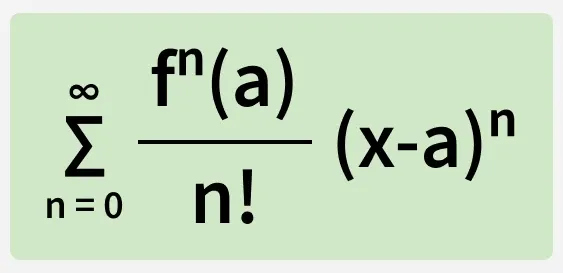
A Taylor series represents a function as an infinite sum of terms, calculated from the values of its derivatives at a single point.
Taylor series expansion of the real and composite function f(x) whose differentiation exists in a closed neighborhood is,
where,
Taylor Series in terms of sigma notation is,
Taylor's series formula is used to find the value of any function around a particular value. Suppose we have to find the value of the real and composite function f(x) at point a, such that the differentiation of the function is defined in the closed neighborhood of the function
The statement for the Taylor Series Theorem is
For a real or complex-valued function f(x) which is differentiable on the neighbourhood of a number the Taylor series is,
where f n (a) = nth derivative of f
We know that power series is defined as,
(i)where, 0 ≤ n < ∞
for x = 0
f(x) = aoThe differentiation of the function f(x) from eq (i) is,
(ii)substituting x = 0 in f'(x)
f'(0) = a1Differentiating eq (ii) again,
substituting x = 0 in f''(x)
f''(0) = 2a2
similarly,Now substituting all these values in eq(i)
Generalizing the function f(x) we get,
Now taking x =a,
Substituting the value of bn in a generalized form of f(x)
This proves the Taylor Series.
Let's take the function f(x) = sin x
f’(x) = cos x
f’’(x) = -sin x
f’’’(x) = -cos x
f’’’’(x) = sin x
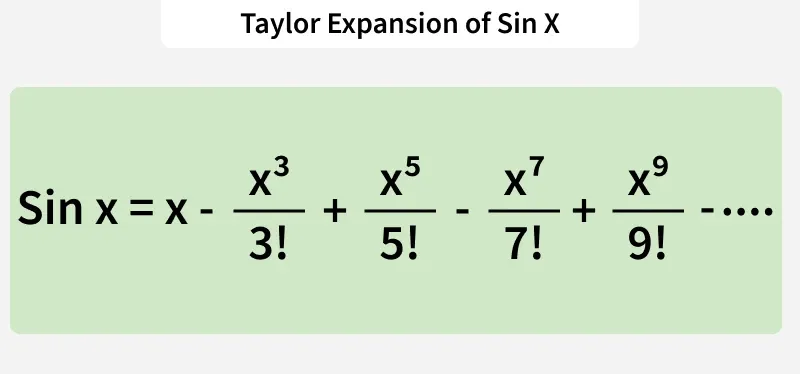
Taylor series for sin x at x = 0 is,
Let's take the function f(x) = cos x
f’(x) = -sin x
f’’(x) = -cos x
f’’’(x) = sin x
f’’’’(x) = -cos x
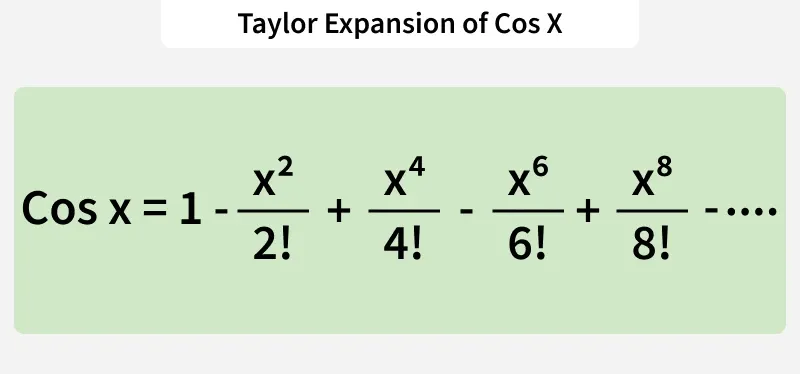
Taylor series for cos x at x = 0 is,
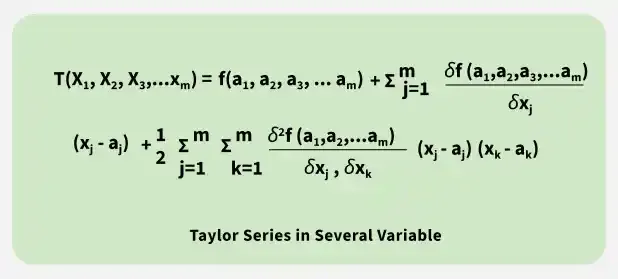
Taylor series can also be represented for the function of several variables. The general form of the Taylor series in several variables is,
We know that the Taylor series is,
If the Taylor series is centred at x = 0, i.e. the value of f(x) is found at x = 0 then this series is called the Maclaurin Series.
Then the Maclaurin Series is,
This above series is known as the Maclaurin series.
Example: Maclaurin series of ex is,
The Taylor series has a wide range of applications in engineering, including:
Example 1: Find the expansion for the function, f(x) = x3 centred at a = 2 using the Taylor Series Formula.
Solution:
We know that Taylor Series Formula is
Given function, f(x) = x3
Centered at a = 2
f'(x) = 3x2
f''(x) = 6x
f'''(x) = 6
f''''(x) = 0Now the Taylor Series expansion of f(x) = x3 is,
f(x) = 8 + 12(x-2) + 6(x-2)2 + (x-2)3 + 0
f(x) = (x-2)3 + 6(x-2)2 + 12x - 16
Example 2: Find the expansion for the function, f(x) = 4x centred at a = 1 using the Taylor Series Formula.
Solution:
Given function, f(x) = 4x
Centered at a = 1
f'(x) = 4
f''(x) = 0Now the Taylor Series expansion of f(x) = 4x is,
f(x) = 4 + 4(x-1) + 0
f(x) = 4x
Example 3: Find the Taylor series expansion for function, f(x) = sin x, centred at .
Solution:
f(x) = sin x
Derivatives of the six x are,
f(x) = sin (x)
f'(x) = cos (x)
f''(x) = -sin (x)
f'''(x) = -cos (x)Now,
Putting x=πtaylor series is
Example 4: Taylor Series for ex around x = 0
Solution:
The Taylor Series for ex around x = 0 is:
Let's use this to approximate e0.5 up to the 4th term:
≈ 1 + 0.5 + 0.125 + 0.0208333 + 0.0026042
≈ 1.6484375
The actual value of e0.5 is approximately 1.6487212, so our approximation is quite close.
Example 5: Taylor Series for up to the 4th term
Solution:
The Taylor Series for sin(x) around x = 0 is:
Let's use this to approximate sin(π/6) up to the 4th term:
≈ 0.5236 - 0.0023 + 0.0000 - 0.0000
≈ 0.5213
The actual value of is 0.5, so our approximation is quite good.
Question 1: Write the first four terms of the Taylor Series for cos(x) around x = 0.
Question 2: Use the Taylor Series for ex to approximate e0.3 up to the third term.
Question 3: What is the Taylor Series for ln(1+x) around x = 0? Write the first three terms.
Question 4: Approximate √(1+x) near x = 0 using the first three terms of its Taylor Series.
Question 5: Find the Taylor Series for 1/(1-x) around x = 0 and write the first four terms.
Question 6: Use the Taylor Series for sin(x) to approximate sin(π/4) up to the third term.
Question 7: Write the first three terms of the Taylor Series for tan(x) around x = 0.
Question 8: Approximate cos(0.1) using the first four terms of its Taylor Series.
Question 9: Find the Taylor Series for arctan(x) around x = 0 and write the first three terms.
Question 10: Use the Taylor Series for ex to estimate the value of e to three decimal places.