|
VOOZH | about |
|
VOOZH | about |
Implicit Differentiation is the process of differentiation in which we differentiate the implicit function without converting it into an explicit function. For example, we need to find the slope of a circle with an origin at 0 and a radius r. Its equation is given as x2 + y2 = r2.
Now, to find the slope we need to find the dy/dx of the given function, so without implicit differentiation, we have to convert this function into an explicit function i.e., y = ∓√(r2 - x2) . The explicit function of this is comparatively hard to differentiate. Thus, we need to learn the implicit differentiation by which this can be very easily differentiated.
👁 Implicit Differentiation vs Explicit DifferentiationTable of Content
There are some prerequisite concepts that we need to know before learning Implicit Differentiation, these prerequisites are as follows:
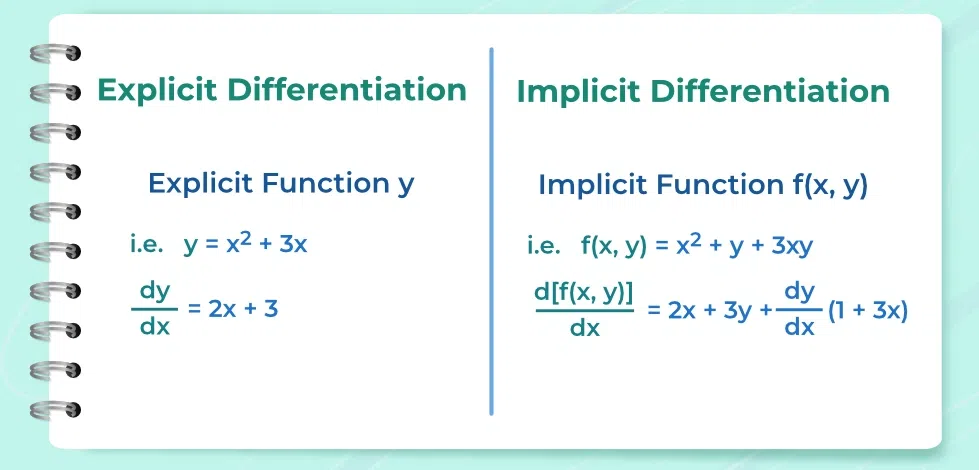
When a function is not defined explicitly in terms of a single independent variable, is called implicit function. For example, y + x2 = 5, x2 + y2 = r2, etc.
When a function is defined in terms of a single independent variable explicitly such as y = f(x), then the function is called the explicit function. For example, y = x2, y = 3x+7, y = sin x, etc.
Note: Here we took only 2 variables x and y to define the implicit function. But you can have any number of variables.
The following steps need to be followed to differentiate any implicit function.
Step 1: Follow the rules of differentiation to differentiate both sides of the equation with respect to x.
Step 2: Use the chain rule to differentiate expressions involving y.
Step 3: Solve the equation for dy/dx.
Let's consider an example for better understanding.
Example: Differentiate x2 + y2 = r2.
Solution:
Given equation: x2 + y2 = r2
Step 1: Differentiate both sides wrt to x and follow the rules of differentiation.
d/dx{x2 + y2} = d/dx(r2)Step 2: Using the chain rule
2x + 2y(dy/dx) = 0Step 3: Simplify the equation
2y(dy/dx) = -2x
⇒ dy/dx = -x/yThus, dy/dx = -x/y
Implicit differentiation is very useful in finding derivatives of Inverse trigonometric Functions.
Let us consider y = sin-1(x) and we need to find its derivative,
Take sin both sides of the equation,
sin y = sin(sin-1(x)
⇒ sin y = x
Differentiating the above equation w.r.t x, we get
d/dx(sin y) = d/dx (x)
⇒ cos y(dy/dx) = 1
⇒ dy/dx = 1/(cos y)
Now, sin(y) = x
⇒ x2 = sin2(y)
⇒ x2 + cos2(y) = 1
⇒ cos2(y) = 1 - x2
⇒ cos(y) =
Substituting the value, we get
dy/dx = 1/(cos y)
dy/dx = 1/√(1 - x2)
Implicit Differentiation and Explicit Differentiation are the two methods of differentiation that are used in calculus. The differences between them are explained in the table below,
Implicit Differentiation | Explicit Differentiation |
|---|---|
Used to find the derivative of a function that cannot be easily solved for y | Used to find the derivative of a function that can be easily solved for y |
Does not require the function to be expressed in terms of y | Requires the function to be expressed in terms of y |
Treats y as an implicit function of x | Treats y as an explicit function of x |
Involves taking the derivative of both sides of the equation with respect to x | Involves directly differentiating the function with respect to x |
Involves the chain rule and product rule to differentiate the function | Involves the power rule, product rule, quotient rule, and chain rule to differentiate the function |
Often used when solving equations that involve multiple variables or when finding higher-order derivatives | Often used when finding the slope of a tangent line or the instantaneous rate of change of a function |
Read More,
Example 1: Find the derivative of y + x + 5 = 0.
Solution:
Using Explicit Differentiation
y + x + 5 = 0
⇒ y = -(x + 5)Using Implicit Differentiation
y + x + 5 = 0
Differentiating both sides wrt x
Isolate dy/dx
Example 2: Find the derivative of y5 - y = x.
Solution:
y5 - y = x
Differentiating the above equation with respect to x, we get
Example 3: Find the derivative of 10x4 - 18xy2 + 10y3 = 48.
Solution:
Given, 10x4 - 18xy2 + 10y3 = 48
Differentiating both sides w.r.t x
⇒Keeping all the terms involving dy/dx on left and rest terms on right side of equation
⇒Dividing both sides by 2
⇒Finally Isolate dy/dx
⇒For the term xy2 we used the Product Rule: (f.g)’ = f.g’ + f’.g
Example 4: Find the derivative of x4 + 2y2 = 8.
Solution:
Given, x4 + 2y2 = 8
Also Check; Implicit Differentiation Advance Examples.