|
VOOZH | about |
|
VOOZH | about |
Differentiation is the mathematical process of determining the finding of a function, which represents the rate at which the function’s value changes with respect to its independent variable. The derivative, denoted as , provides a precise measure of the function’s instantaneous rate of change.
This operation forms the basis of differential calculus, with specific formulas and rules applicable to algebraic, trigonometric, exponential, logarithmic, and inverse trigonometric functions.
The derivative of 𝑓(x) at x is defined as the limit as h approaches 0:
Mathematically,
This limit represents the instantaneous rate of change of y with respect to x or the slope of the tangent line to the curve y = 𝑓(x) at the point (x, 𝑓(x)).
Differentiation formulas are used to find the differentiation of the various functions. The first principal formula states that, for any function 𝑓(x) its derivative with respect to x is,
The differentiation formulas for some elementary functions are:
| Function (y) | Differentiation Formula (dy/dx) |
|---|---|
| c (constant) | 0 |
| xn (power) | nxn-1 |
| ln x (logarithmic) | 1/x |
| ex(exponent) | ex |
| ax (exponent) | ax ln a |
Derivatives of the trigonometric functions are:
| Function (y) | Derivative (dy/dx) |
|---|---|
| sin x | cos x |
| cos x | -sin x |
| tan x | sec² x |
| sec x | sec x · tan x |
| cosec x | -cosec x · cot x |
| cot x | -csc² x |
The differentiation formulas for the Inverse trigonometric functions are:
| Function (y) | Differentiation Formula (dy/dx) |
|---|---|
| sin⁻¹ x | 1/√(1 - x²) |
| cos⁻¹ x | -1/√(1 - x²) |
| tan⁻¹ x | 1/(1 + x²) |
| sec⁻¹ x | 1/(|x|·√(x² - 1)) |
| csc⁻¹ x | -1/(|x|·√(x² - 1)) |
| cot⁻¹ x | -1/(1 + x²) |
Let's discuss the Differentials of Hyperbolic functions.
| Function (y) | Differentiation Formula (dy/dx) |
|---|---|
| sinh x | cosh x |
| cosh x | sinh x |
| tanh x | sech² x |
| sech x | -sech x · tanh x |
| cosech x | -cosech x · coth x |
| coth x | -csch² x |
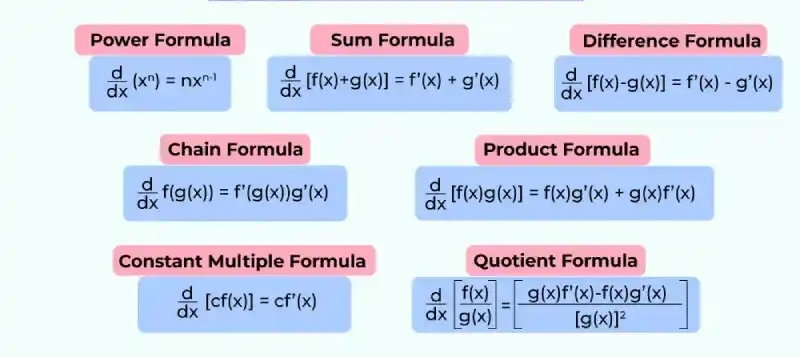
Various rules of finding the derivative of functions have been given below:
| Rules | Function Form (y) | Differentiation Formula (dy/dx) |
|---|---|---|
| Sum Rule | u(x) ± v(x) | du/dx ± dv/dx |
| Product Rule | u(x) × v(x) | u dv/dx + v du/dx |
| Quotient Rule | u(x) ÷ v(x) | (v du/dx - u dv/dx) / v² |
| Chain Rule | f(g(x)) | f'[g(x)] g'(x) |
| Constant Rule | k f(x), k ≠ 0 | k d/dx f(x) |
If we have two parametric functions x = 𝑓(t), y = g(t), where t is the parameter, then the differentiation of parametric functions is as follows,
As dy/dt = g'(t) and dx/dt = 𝑓'(t) then dy/dx is given by:
If y is related to x but can not conveniently expressed in the form y = 𝑓(x) but can be expressed in the form 𝑓(x,y) = 0, then we say that y is an implicit function of x. In the case of implicit function dy/dx can be found by following steps.
(a) Differentiate each term of 𝑓(x, y) = 0 with respect to x.
(b) Collect the terms containing dy/dx on one side and the terms not involving dy/dx on the other side.
(c) Express dy/dx as a function of x or y or both.
Example: Find the differentiation of x2 + y2 + 4xy = 0
Solution:
x2 + y2 + 4xy = 0
Differentiating with respect to x,
2x + 2ydy/dx + 4(xdy/dx + y) = 0
⇒ 2x + 4y + 2dy/dx(y + 2x) = 0
⇒ x + 2y + dy/dx(y + 2x) = 0
⇒ dy/dx(y + 2x) = -(x + 2y)
⇒ dy/dx = -(x + 2y)/(y + 2x)
Higher order differentiation is nothing, but the differentiation of a function more than one time suppose we have a function y = 𝑓(x) then its differential in higher order is calculated as,
First Derivative =
Second Derivative =
Third Derivative =
....
....
....nth Derivative =
This can be understood using the example added below,
Example: Find the second-order derivative of 𝑓(x) = 4x4 + 3x3 + 2x2 + x + 1
Solution:
𝑓(x) = 4x4 + 3x3 + 2x2 + x + 1
Differentiating with respect to x,
𝑓'(x) = 4(4x3) + 3(3x2) + 2(2x) + 1 + 0
⇒ 𝑓'(x) = 16x3 + 9x2 + 4x + 1For second-order derivative differentiating with respect to x,
𝑓''(x) = 16(3x2) + 9(2x) + 4 + 0
⇒ 𝑓''(x) = 48x2 + 18x + 4This is the required second-order derivative.
Example 1: Find the differentiation of y = 4x3 + 7x2 + 11x + 12
Solution:
Given, y = 4x3 + 7x2 + 11x + 12
Differentiating with respect to x,
dy/dx = 4(3x2) + 7(2x) + 11(1) + 0
⇒ dy/dx = 12x2 + 14x + 11
This is the required differentiation
Example 2: Find the differentiation of y = cos(log x)
Solution:
Given, y = cos(log x)
Differentiating with respect to x,
dy/dx = d/dx{cos (log x)}
⇒ dy/dx = -sin (log x).{d/dx(log x)}
⇒ dy/dx = -sin (log x).(1/x)This is the required differentiation
Problem 1: Find the derivative of the function f(x) = 3x2 + 5x - 2.
Problem 2: Determine the derivative of g(x) = 1/x.
Problem 3: Find the derivative of .
Problem 4: Determine the derivative of y(x) = e2x.
Problem 5: Find the derivative of .