|
VOOZH | about |
|
VOOZH | about |
Planar graphs and graph coloring are important concepts in graph theory, which studies graphs and their properties. A planar graph is a graph that can be drawn on a plane without any edges crossing each other.
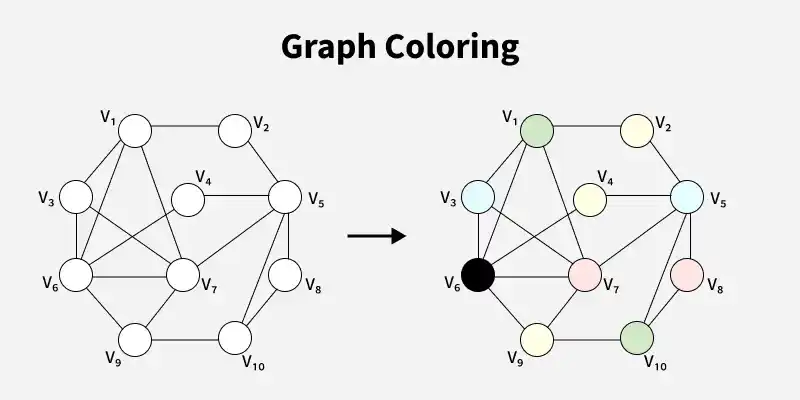
Graph coloring is the process of assigning colors to vertices so that no two adjacent vertices have the same color. These concepts are widely used in computer science, engineering, networking, scheduling, and map coloring problems.
A planar graph is a graph that can be embedded in the plane such that no edges intersect except at their endpoints. In other words, it can be drawn on a flat surface without any edges crossing.
Graph coloring is the assignment of colors to vertices of a graph such that no two adjacent vertices share the same color. The minimum number of colors required to color a graph is called its chromatic number.
Graph coloring and planar graphs have various applications in engineering, computer science, communication systems, scheduling, map coloring, and circuit design.
Example 1: Determine if the following graph is planar and find its chromatic number.
Graph: K4 (Complete graph with 4 vertices)
Solution:
K4 is planar because it can be drawn without any edges crossing.
Chromatic number: 4 (each vertex connects to every other vertex).
Example 2: Determine if K3,3 is planar.
Solution:
K3,3 is not planar as it cannot be drawn without edges crossing (Kuratowski's Theorem).
Example 3: Given a planar graph with 6 vertices and 9 edges, find the number of faces.
Solution:
Using Euler's formula:
V−E+F=2 ⟹ 6−9+F=2 ⟹ F=5
Example 4: Find the chromatic number of a cycle graph with an odd number of vertices, say 5.
Solution:
For an odd cycle, the chromatic number is 3.
Example 5: Find the chromatic number of a bipartite graph.
Solution:
A bipartite graph is 2-colorable.
Example 6: Determine if the Petersen graph is planar.
Solution:
The Petersen graph is not planar.
Example 7: Find the chromatic number of the following planar graph: C5∪C3.
Solution:
Each cycle has a chromatic number of 3, so the combined graph has a chromatic number of 3.
Example 8: Verify Euler's formula for a graph with 8 vertices, 12 edges, and 6 faces.
Solution:
8−12+6=2(Holds true)
Example 9: Determine if the following graph is planar and find its chromatic number. Graph: K2,3
Solution:
K2,3 is planar.
Chromatic number: 2 (bipartite graph).
1. Determine if K4 is planar and find its chromatic number.
2. Given a planar graph with 10 vertices and 15 edges, find the number of faces.
3. Find the chromatic number of a star graph Sn with n leaves.
4. Prove that a tree is 2-colorable.
5. Given a planar graph with 12 vertices and 18 edges, determine if Euler’s formula holds.
6. Find the chromatic number of a wheel graph Wn with n spokes.
7. Determine if the dodecahedron graph is planar.
8. Given a graph G with V vertices and E edges, if G is planar and E = 3V − 6, find the number of faces.
9. Find the chromatic number of a complete bipartite graph Km,n.
10. Determine if the graph C4 ∪ K2 is planar and find its chromatic number.
Practicing the following questions will help you test your knowledge. All questions have been asked in GATE in previous years or in GATE Mock Tests. It is highly recommended that you practice them.