|
VOOZH | about |
|
VOOZH | about |
The Normal Distribution (also called the Gaussian or Bell-shaped Distribution) is one of the most commonly used probability distributions in statistics. It is symmetric around the mean and forms the characteristic bell-shaped curve.
It can be observed in the above image that the distribution is symmetric about its center which is the mean (0 in this case). This makes the probability of events at equal deviations from the mean equally probable. The density is highly centered around the mean which translates to lower probabilities for values away from the mean.
The PDF of the normal distribution gives the likelihood of a continuous random variable taking a specific value. The formula is:
where:
To simplify this formula, we use the z-score, which tells us how many standard deviations a value is from the mean:
A larger z-score means the value is farther from the mean, giving a smaller probability due to the negative exponent. Values near the mean have higher probabilities.
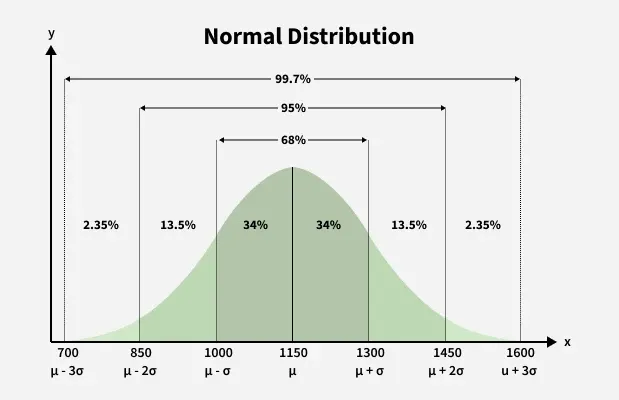
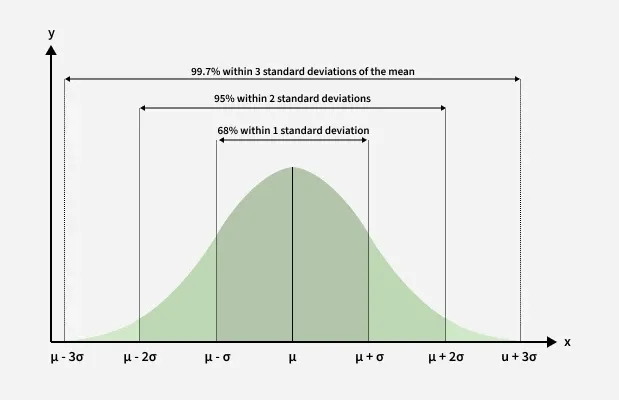
This behavior follows the 68–95–99.7 rule:
The figure given below shows this rule:
The expectation or expected value of a random variable gives us a measure of the "center" of the distribution. For a normally distributed random variable with parameters (mean) and (variance), the expectation is calculated by integrating the product of the random variable and its probability density function (PDF) over all possible values.
Mathematically, the expected value is:
For the normal distribution, the formula becomes:
We can simplify this by breaking it into two parts:
Thus we find:
This tells us that the expected value of a normal distribution is simply the mean .
The variance of a normal distribution is the square of the standard deviation denoted as . It measures how spread out the values of the distribution are from the mean.
The standard deviation is simply the square root of the variance:
In the General Normal Distribution, if the Mean is set to 0 and the Standard Deviation is set to 1 then resulting distribution is called the Standard Normal Distribution. The formula for the Probability Density Function (PDF) of the standard normal distribution is:
where:
The Standard Normal Distribution is symmetric around the mean and its PDF defines the shape of the bell curve.
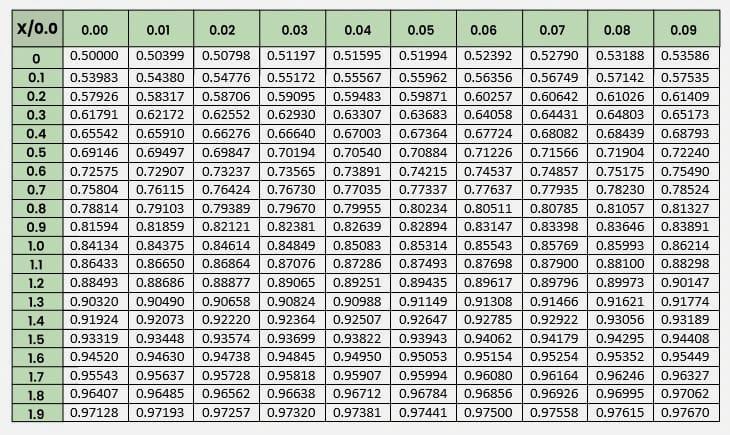
1. The Cumulative Distribution Function (CDF) of the normal distribution does not have a closed-form expression. As a result, precomputed values from standard normal tables are used to find cumulative probabilities. These tables specifically provide cumulative probabilities for the standard normal distribution.
2. For a general normal distribution, the first step is to standardize the distribution by converting it into a z-score. Once standardized, the cumulative probability is calculated using the standard normal distribution tables.
3. This process has two key benefits:
This is consistent with the 68–95–99.7 rule, which states that 99.7% of values lie within ±3 standard deviations of the mean. Therefore, probabilities beyond x = μ+ 3σ become extremely small and are treated as approximately zero
Problem: Suppose that the current measurements in a strip of wire are assumed to follow a normal distribution with a mean of 10 milliamperes and a variance of four milliamperes 2 . What is the probability that a measurement exceeds 13 milliamperes?
1. Let X denote the current in milliamperes. We are tasked with finding P (X > 13).
2. Standardize X by converting it to a z-score:
3. Now P(X > 13) becomes equivalent to P(Z > 1.5) in the standard normal distribution.
4. From the standard normal table, find the value of
5. So
Thus the probability that the current exceeds 13 milliamperes is approximately 0.06681 or 6.7%.
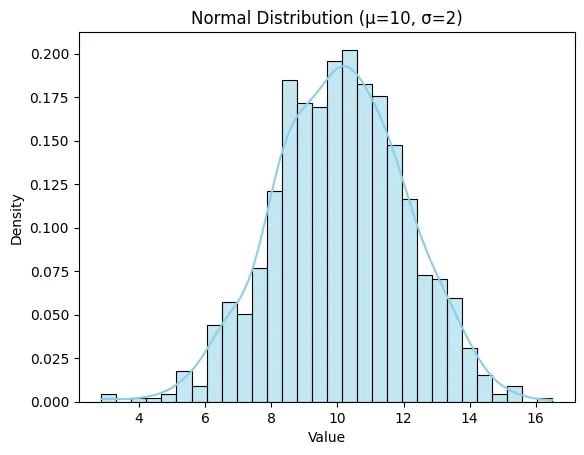
Here we will be using Numpy, Matplotlib and Seaborn libraries for the implementation.
Output:
The normal distribution is incredibly versatile and is used across a variety of fields:
Mastering the Standard Normal Distribution helps in the deeper understanding of probability which enables more accurate data interpretation and decision-making.