|
VOOZH | about |
|
VOOZH | about |
Boolean Algebra is a branch of mathematics used to represent and simplify logical expressions in digital electronics and computer systems. It provides a set of rules and laws that help in analyzing, designing, and simplifying digital circuits efficiently.
Boolean Addition is a basic operation in Boolean Algebra that follows the logic of the OR operation. It gives the output 1 (true) when at least one input is 1, and gives 0 (false) only when all inputs are 0. It is represented using the “+” symbol, such as A + B or A' + C'.
Boolean Multiplication is a basic operation in Boolean Algebra that follows the logic of the AND operation. It gives the output 1 (true) only when all inputs are 1, and gives 0 (false) if any input is 0. It is represented using the “.” symbol, such as A.B. or A.D.E.
Boolean Algebra uses binary values 0 and 1 along with basic logical operations such as AND, OR, and NOT to represent and simplify logical expressions. These laws and properties help reduce the complexity of digital circuits, making them easier and more efficient to design and implement.
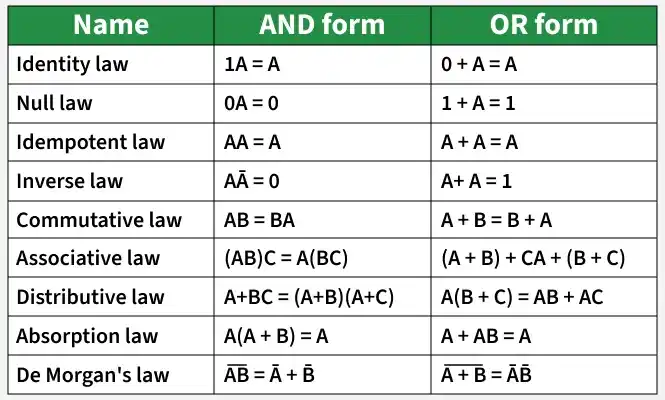
The major laws of Boolean Algebra are discussed below.
a variable ANDed with 0 gives 0, while a variable ORed with 1 gives 1, i.e.,
A.0 = 0
A + 1 = 1
In this law variable remains unchanged it is ORed with '0' or ANDed with '1', i.e.,
A.1 = A
A + 0 = A
A variable remains unchanged when it is ORed or ANDed with itself, i.e.,
A + A = A
A.A = A
In this Law if a complement is added to a variable it gives one, if a variable is multiplied with its complement it results in '0', i.e.,
A + A' = 1
A.A' = 0
A variable with two negations, its symbol gets cancelled out and original variable is obtained, i.e.,
((A)')'=A
A variable order does not matter in this law, i.e.,
A + B = B + A
A.B = B.A
The order of operation does not matter if the priority of variables are the same like '*' and '/', i.e.,
A+(B+C) = (A+B)+C
A.(B.C) = (A.B).C
This law governs the opening up of brackets, i.e.,
A.(B+C) = (A.B)+(A.C)
(A+B)(A+C) = A + BC
The absorption law consists of two dual statements:
X.(X+Y)=X
X+XY=X
In De Morgan law, the operation of an AND or OR logic circuit is unchanged if all inputs are inverted, the operator is changed from AND to OR, and the output is inverted, i.e.,
(A.B)' = A' + B'
(A+B)' = A'.B'
Consensus theorem
AB + A'C + BC = AB + A'C
Question 1: Simplify A . B + A . B'.
Solution:
A . B + A . B' = A . (B + B')
= A . (1)
= A
Question 2: Simplify A + A' . B.
Solution:
A + A' . B = (A + A') . (A + B)
= (1) . (A + B)
= A + B
Question 3: Simplify (A + B) . (A + B') + (B . B').
Solution:
(A + B) . (A + B') + (B . B') = (A + B) . (A + B') + (0)
A + (B . B')
= A + (0)
= A
Question 4: Simplify A . (B + C) + A' . (B + C)
Solution:
A . (B + C) + A' . (B + C) = (A + A') . (B + C)
= 1 . (B + C)
= B + C
Question 5: Simplify A + B . A' + C . C'
Solution:
A + B . A' + C . C' = A + B . A' + 0
= A + B
Question 1: Simplify A + A.B
Question 2: Simplify (A.B) + (A.B') + (B.B')
Question 3: Simplify A + B + A'.B
Question 4: Simplify (A.B) + (A.B') + (A'.B)
Question 5: Simplify A + B + A.B