|
VOOZH | about |
|
VOOZH | about |
In Solidity, the term "bytes" refers to a dynamically-sized byte array. Solidity provides two types of byte arrays: fixed-size arrays (called "bytesN", where N is a number between 1 and 32) and dynamic arrays (simply called "bytes").
Endianness refers to the order in which bytes are stored in memory. Solidity follows the little-endian format, where the least significant byte (LSB) is stored at the lowest address, and the most significant byte (MSB) is stored at the highest address. Solidity stores bytes in contiguous memory slots, with each slot being 32 bytes wide. This arrangement allows efficient memory access and alignment.
Suppose we want to store the number 0x12345678 in a bytes4 data type. In the little-endian format, the least significant byte (LSB) comes first, and the most significant byte (MSB) comes last. Thus, the byte representation of this number would be:
0x78 0x56 0x34 0x12
Example:
Output:
In the EndiannessExample contract, we store the number 0x12345678 in a bytes4 data type called number. The getIndividualBytes function returns each byte of the number as a tuple.
Fixed-size byte arrays have a specified length, ranging from 1 to 32 bytes. The notation "bytesN" is used to represent these arrays, where "N" is an integer representing the length of the array. These arrays are useful when you know the exact size of the data you are working with.
Example:
Explanation:
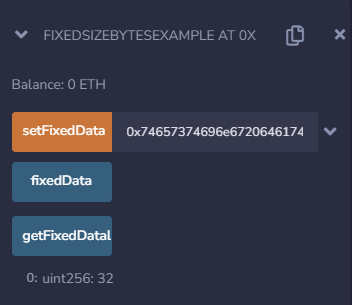
Output:
Dynamic byte arrays do not have a fixed length, and their size can be changed during runtime. These arrays are simply represented by the "bytes" keyword.
Example:
Explanation:
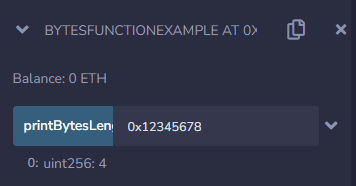
Output:
Bitwise operations in Solidity are operations that manipulate individual bits in binary numbers. Solidity is a high-level programming language designed for implementing smart contracts on blockchain platforms like Ethereum. It supports various bitwise operations, including AND, OR, XOR, NOT, and bit shifts.
Here's a brief overview of each operation:
This operation compares each bit of the first number to the corresponding bit of the second number. If both bits are 1, the corresponding result bit is set to 1; otherwise, the result bit is set to 0.
uint256 a = 5; // binary: 101
uint256 b = 3; // binary: 011
uint256 result = a & b; // binary: 001, decimal: 1
This operation compares each bit of the first number to the corresponding bit of the second number. If either bit is 1, the corresponding result bit is set to 1; otherwise, the result bit is set to 0.
uint256 a = 5; // binary: 101
uint256 b = 3; // binary: 011
uint256 result = a | b; // binary: 111, decimal: 7
This operation compares each bit of the first number to the corresponding bit of the second number. If the bits are different, the corresponding result bit is set to 1; otherwise, the result bit is set to 0.
uint256 a = 5; // binary: 101
uint256 b = 3; // binary: 011
uint256 result = a ^ b; // binary: 110, decimal: 6
This is a unary operation that inverts the bits of its operand. If the bit is 1, it is changed to 0; if it is 0, it is changed to 1.
uint256 a = 5; // binary: 000...101 (256 bits)
uint256 result = ~a; // binary: 111...010 (256 bits), decimal: (2^256 - 1) - 5
This operation shifts the bits of a number to the left by a specified number of positions, filling the vacated positions with 0s.
uint256 a = 5; // binary: 101
uint256 result = a << 1; // binary: 1010, decimal: 10
This operation shifts the bits of a number to the right by a specified number of positions, discarding the shifted bits.
uint256 a = 5; // binary: 101
uint256 result = a >> 1; // binary: 010, decimal: 2
Example:
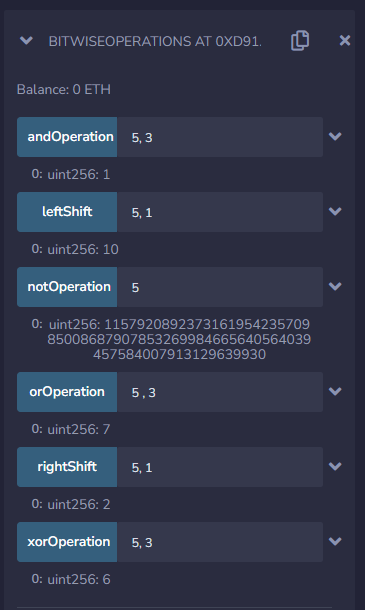
Output:
In Solidity, an array of bytes is used to store a dynamic sequence of bytes. This can be useful for storing data that does not have a fixed size or structure, such as raw data or arbitrary messages.
An array of bytes is declared using the syntax bytes or bytesX, where X is a number indicating the size of the array. The maximum size of the array is 2^256-1.
Syntax:
bytes memory byteArray; // declare an empty array of bytes
bytes1 byte1Array; // declare an array of 1 byte
bytes2 byte2Array; // declare an array of 2 bytes
bytes32 byte32Array; // declare an array of 32 bytes
To initialize an array of bytes with some data, you can use the hex notation to represent the bytes in hexadecimal format.
Example:
bytes memory byteArray = hex"deadbeef";
In the above example, an array of bytes is declared and initialized with the value 0xdeadbeef.
Input:
a: 0x68656c6c6f (hex representation of "hello")
b: 0x20776f726c64 (hex representation of " world")
Output:
result: 0x68656c6c6f20776f726c64 (hex representation of "hello world")
You can use bytes as function arguments in Solidity. When you pass a bytes argument, you can manipulate and work with the byte data within the function.
Example:
Output:
An Ethereum address is 20 bytes long, and you can convert it to a bytes20 type or vice versa. To convert an address to bytes20, you can use an explicit typecast.
Example:
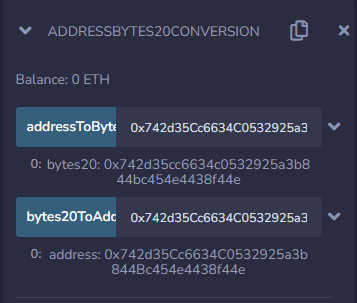
Output:
Aside from the basic operations, you can perform more advanced operations with byte arrays. these are a few examples:
Example:
Output: