|
VOOZH | about |
|
VOOZH | about |
Global variables in Solidity are predefined variables available in any function or contract. These variables reveal blockchain, contract, and transaction data. Some common global variables in Solidity:
| Variable | Type | Description |
|---|---|---|
| msg.sender | address | The address of the account that sent the current transaction. |
| msg.value | uint | The amount of Ether sent with the current transaction. |
| block.coinbase | address | The address of the miner who mined the current block. |
| block.difficulty | uint | The difficulty of the current block. |
| block.gaslimit | uint | The maximum amount of gas that can be used in the current block. |
| block.number | uint | The number of the current block. |
| block.timestamp | uint | The timestamp of the current block. |
| now | uint | An alias for block.timestamp. |
| tx.origin | address | The address of the account that originally created the transaction (i.e., the sender of the first transaction in the call chain). |
| tx.gasprice | uint | The gas price (in Wei) of the current transaction. |
These variables are handy for getting blockchain and transaction information but use them carefully. Authentication and authorization should not utilize tx.origin since attackers may simply fake it. Use msg.sender instead.
Below is the Solidity program to implement global variables:
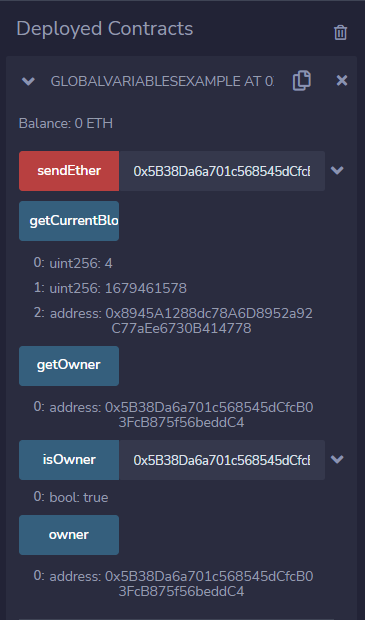
Explanation: This example defines the GlobalVariablesExample contract. The function Object() { [native code] } initializes the owner state variable to the contract's deployment address using the msg.sender global variable.
The contract specifies global variable functions:
Global variables may be used in Solidity contracts to make choices and execute logic.