|
VOOZH | about |
|
VOOZH | about |
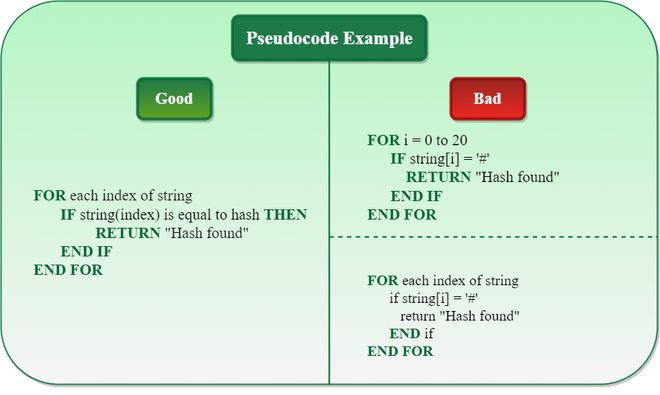
Pseudocode is a step-by-step description of an algorithm written in simple English using a code-like structure.
It is designed for human understanding, not for machine execution, and does not follow the syntax of any programming language.
Why Do We Need Pseudocode:
Before writing the pseudocode of any algorithm the following points must be kept in mind.
IF–ELSEFORWHILEBinary search is a searching algorithm that works only for sorted search space. It repeatedly divides the search space into half by using the fact that the search space is sorted and checking if the desired search result will be found in the left or right half.
Below is the pseudocode for Binary search.
BINARY_SEARCH(ARR, X, LOW, HIGH)
WHILE LOW ≤ HIGH
MID = (LOW + HIGH) / 2
IF ARR[MID] == X
RETURN MID
ELSE IF X > ARR[MID]
LOW = MID + 1
ELSE
HIGH = MID - 1
QuickSort is a Divide and Conquer algorithm. It picks an element as a pivot and partitions the given array around the picked pivot.
Say last element of array is picked as pivot then all elements smaller than pivot element are shifted on the left side of pivot and elements greater than pivot are shifted towards the right of pivot by swapping, the same algorithm is repeatedly followed for the left and right side of pivot until the whole array is sorted.
Below is the pseudocode for Quick sort
QUICKSORT(ARR, LOW, HIGH)
IF LOW < HIGH
PIVOT = PARTITION(ARR, LOW, HIGH)
QUICKSORT(ARR, LOW, PIVOT - 1)
QUICKSORT(ARR, PIVOT + 1, HIGH)
Here, LOW is the starting index and HIGH is the ending index.
Algorithm | Pseudocode |
|---|---|
An Algorithm is used to provide a solution to a particular problem in form of a well-defined step-based form. | A Pseudocode is a step-by-step description of an algorithm in code-like structure using plain English text. |
An algorithm only uses simple English words | Pseudocode also uses reserved keywords like if-else, for, while, etc. |
These are a sequence of steps of a solution to a problem | These are fake codes as the word pseudo means fake, using code like structure and plain English text |
There are no rules to writing algorithms | There are certain rules for writing pseudocode |
Algorithms can be considered pseudocode | Pseudocode cannot be considered an algorithm |
It is difficult to understand and interpret | It is easy to understand and interpret |
Flowchart | Pseudocode |
|---|---|
A Flowchart is pictorial representation of flow of an algorithm. | A Pseudocode is a step-by-step description of an algorithm in code like structure using plain English text. |
A Flowchart uses standard symbols for input, output decisions and start stop statements. Only uses different shapes like box, circle and arrow. | Pseudocode uses reserved keywords like if-else, for, while, etc. |
This is a way of visually representing data, these are nothing but the graphical representation of the algorithm for a better understanding of the code | These are fake codes as the word pseudo means fake, using code like structure but plain English text instead of programming language |
Flowcharts are good for documentation | Pseudocode is better suited for the purpose of understanding |
What will be the output of the following pseudocode?
Question 1) for i=0 to 4 step 1 do
If i==i++ + --i then do
display i
end-if
end-for
Answer: 0Question 2) Set Character c = '7'
switch(c)
case '1': display "One"
case '7': display "Seven"
case '2': display "Two"
default: display "Hello"
break
end-switch
Answer: SevenTwoHelloQuestion 3) Integer a, p
Set a = 5
a = a + 1
a = a * 2
a = a / 2
p = a / 5 + 6
print p
Answer: 7Question 4) Integer a, b, c
Set b = 40, a = 20, c = 20
a = a + c
c = c + a
a = a + c
c = c + a
Print a + b + c
Answer: 300Question 5) Integer a, b, c
Set a = 4, b = 3, c = 1
if (a >> (c - 1) && b << (c + 1))
a = a + c
Else
b = a <<< C
End if
Print a - b + c
Answer: 3
What will be the output of the following pseudocode?
Questions 1) What will be the output of the following pseudocode for a = 5, b = 1?
Integer funn(Integer a, Integer b)
if(b + a || a - b) && (b > a) && 1)
a = a+b+b-2
return 3-a
Else
return a-b+1
End if
return a + b
End function fun()
Answer: 5Questions 2) What will be the output of the following pseudocode for a = 5, b = 1?
Integer funn(Integer a, Integer b)
if((b mod a && a mod b) || (a ^ b > a))
a=a ^ b
Else
return a-b
End if
return a + b
End function funn()
Answer: 5Questions 3) What will be the output of the following pseudocode?
Integer a, b, c
Set a = 4, b = 4, c = 4
if (a & (b ^ b) & c)
a = a >> 1
End if
Print a + b + c
Answer: 12Questions 4) What will be the output of the following pseudocode for a = 10, b = 11?
Integer funn(Integer a, Integer b)
if(0)
return a - b - funn(-7, -1)
End if
a = a + a + a + a
return a
End function funn()
Answer: 40Questions 5) What will be the output of the following pseudocode for a = 5, b = 1?
Integer funn(Integer a, Integer b)
if(b + a || a - b) && (b > a) && 1)
a = a + b + b - 2
return 3 - a
Else
return a - b + 1
End if
return a + b
End function fun()
Answer: 5
What will be the output of the following pseudocode?
Question 1) What will be the output of the following pseudocode for a=8, b=1?
Integer funn(Integer a, Integer b)
If(a > b && a > 0)
Return a + b + funn (b-1, a-1)
End if
Return a + b
Answer: 16Question 2) What will be the output of the following pseudocode for p=7, q=2?
Integer funn(Integer p, Integer q)
if(p + q < 10)
Return 1 + funn(p + 1, q + 1)
Else
Return 2
End if
Answer: 3Question 3) What will be the output of the following pseudocode for a=2, b=7, c=7?
Integer funn(Integer a, Integer b, Integer c)
if ((b + a) < (a - b))
a = a + c
b = (10 + 10) + c
End if
Return a + b + c
Answer: 16Question 4) What will be the output of the following pseudocode?
String str1 = "err", str2 = "krr"
Print (count consonant(upper(reverse(str2) + reverse(str1))))
Answer: 5Question 5) What will be the output of the following pseudo code?
Integer a, b, c
Set a = 2, b = 11, c = 5
if ((4 + 5) < (6 + b))
b = c & a
End if
Print a + b + c
Answer: 7