|
VOOZH | about |
|
VOOZH | about |
In brief: Ukrainian long-range strike drones executed a multi-regional offensive across Russia overnight Saturday-Sunday. The strategic operation targeted the “Azot” chemical plant in Novomoskovsk – a facility supplying raw materials for Russian artillery shell explosives – sparking fires verified by NASA satellite tracking. Concurrently, separate drone strikes ignited a railway depot in Vyazma and compromised the “Temp” state reserve fuel storage complex in Rybinsk.
Ukrainian long-range strike drones executed a synchronized, multi-regional offensive overnight Saturday/Sunday, Exilenova+ and ASTRA Telegram channels reported.
The operation compromised a massive chemical plant supplying Russia’s ammunition factories, while simultaneously crippling railway and fuel storage networks supporting the Kremlin’s wartime logistics.
Follow our coverage of the war on the @Kyivpost_official.
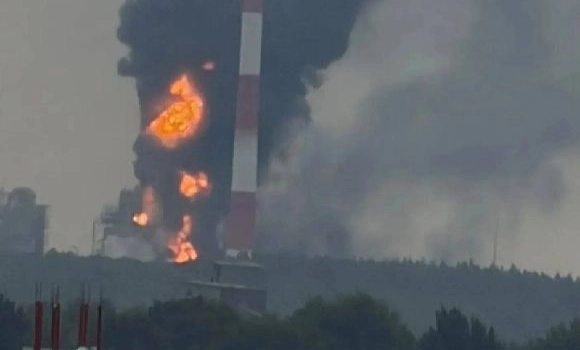
The primary target of the operation was the Novomoskovsk Aktsionernaya Kompaniya “Azot” chemical complex, located in Russia’s Tula Oblast. Regional Governor Dmitry Milyaev acknowledged the strike, claiming that “drone fragments” fell onto the territory of an unspecified industrial enterprise in Novomoskovsk.
However, independent open-source intelligence (OSINT) analysts from the ASTRA cross-referenced geolocation data from video footage of the blaze, confirming a fire at the Azot plant.
Owned by the Eurochem holding company, Azot is the largest domestic producer of ammonia and nitrogen fertilizers in Russia. Investigative data reveals that between 2022 and 2024, Eurochem’s specialized nitrogen plants shipped at least 38,000 tons of acetic acid and nearly 5,000 tons of nitric acid directly to the Sverdlov State Explosives Plant in Dzerzhinsk.
These chemical compounds are essential raw ingredients used to manufacture octogen (HMX) and hexogen (RDX) – the foundational high-explosive payloads packed into Russian heavy artillery shells.
As the chemical infrastructure burned in Tula, drones attacked transit links closer to the capital and along Western supply vectors.
In Smolensk region, precision strikes targeted the city of Vyazma, a transport nexus. Geolocated photographic evidence confirmed a fire erupting directly inside a railway depot located northeast of the central station.
Severing or damaging railway depot infrastructure directly impairs Russia’s ability to service and deploy the locomotive fleets required to move heavy military equipment toward the front lines.
Simultaneously, further north in Yaroslavl region, early morning drone attack struck the Federal Agency for State Reserves (Rosrezerv) “Temp” Combine in Rybinsk.
The “Temp” facility is fortified and utilized by the Russian state to hoard strategic fuel reserves for the military. The facility was previously breached by Ukrainian air assets on Dec. 31, 2025.
Following the June 14 strikes, a column of black smoke rose over Rybinsk, prompting Yaroslavl Governor Mikhail Yevrayev to order an immediate emergency closure of all highway traffic heading toward Moscow.
The multi-region bombardment represents an expansion of Ukraine’s strategy to degrade Russia’s industrial and logistics capability before reinforcements can reach the frontlin.
This latest wave follows a highly destructive joint operation by the SBU, HUR, and SSO against the Tamanneftegas marine terminal in Krasnodar Krai, which knocked out five fuel reservoirs and two marine loading arms, rendering southern Russia’s largest hydrocarbon export hub highly unstable.
By shifting the focus of long-range operations from southern export ports to mainland chemical factories and state fuel reserves, Ukrainian defense forces are bottlenecking both the fuel that moves the Russian army and the raw chemistry required to feed its artillery batteries.