|
VOOZH | about |
|
VOOZH | about |
18 min
read
Learn how to build a minimum viable product for ecommerce, test market demand fast, save costs, and grow your online store smartly
Real-World Experience with No-Code Tools: With over 320 apps built, we know firsthand what works—and what doesn't—when using no-code platforms like Glide, Bubble, FlutterFlow and Webflow.
Expert Team with 40+ Years of Combined Experience: Our team has deep technical knowledge, with experts who use no-code tools to solve real-world problems for clients every day, ensuring our advice is actionable and reliable.
Detailed Guides Based on Actual Projects: We don’t just talk about no-code; we use it daily to solve real business problems for our clients, from MVPs to complex automations.
Take a deeper look at our editorial guidelines
An eCommerce MVP is the simplest version of your online store that delivers core value to customers while allowing you to validate your business concept. It focuses on essential features that solve your target audience's primary problem without the bells and whistles of a fully developed platform.
Unlike a complete eCommerce website with extensive product catalogs, advanced filtering, and multiple payment options, an MVP narrows down to what truly matters. You're creating just enough functionality to start selling and collecting valuable user feedback.
The beauty of an eCommerce MVP lies in its efficiency. Rather than spending months building every feature you think customers might want, you focus on what they actually need. This saves you time and money, and prevents you from investing in features that might never get used.
At LowCode Agency, we've built over 330 apps and MVPs for businesses just like yours. Our team specializes in creating efficient, market-ready eCommerce MVPs that validate your concept without draining your resources.
We understand the unique challenges of eCommerce startups. Whether you need a streamlined product showcase, secure payment processing, or basic inventory management, our experts leverage no-code platforms like Bubble, FlutterFlow, Glide and Webflow to build your MVP in weeks, not months.
Our approach focuses on the features that truly matter to your customers. We'll help you identify your core value proposition and translate it into a functional eCommerce solution that lets you start selling and gathering valuable feedback quickly.
Building an MVP before launching a full-scale eCommerce store can save you thousands in development costs and months of wasted effort. Instead of investing heavily in a comprehensive platform with untested features, you can start with the essentials and scale based on actual customer needs.
Testing your product-market fit early gives you a crucial advantage in the competitive eCommerce landscape. Your MVP allows you to put your core offering in front of real customers, gather genuine feedback, and understand how people actually interact with your store before making major investments.
An MVP significantly reduces your business risk by validating your assumptions with real market data. You'll quickly discover if your pricing strategy works, if your product descriptions resonate with customers, and if your checkout process converts visitors into buyers.
With an eCommerce MVP, you can start generating revenue sooner while learning what your customers truly value. This approach creates a feedback loop that guides your future development priorities based on real user behavior rather than speculation.
Launching your eCommerce store with just the essential features lets you focus on what matters most: whether people actually want to buy your products. Your MVP eliminates unnecessary distractions, highlighting your core offering for easy evaluation and purchase by customers.
An MVP provides concrete proof of whether customers are willing to pay for your products. Instead of relying on surveys or focus groups where people might say they'd buy, you get definitive answers through actual purchases and real transaction data.
You'll gather authentic market feedback without the heavy investment of a full-scale launch. Customer behaviors, comments, questions, and pain points become immediately visible, giving you valuable insights that would otherwise cost thousands in market research.
This lean approach allows you to pivot quickly if needed. If certain products aren't selling or specific features aren't resonating with users, you can adjust your strategy based on real data rather than assumptions, saving both time and money in your eCommerce journey.
Your eCommerce MVP should focus on the essential features that enable customers to discover products and complete purchases. Here's what you should prioritize:
Remember, the goal isn't to build a feature-rich platform but to create a functional store that lets customers complete purchases while you gather invaluable feedback.
Start by clearly defining what makes your eCommerce offering unique. Are you solving a specific problem, offering better prices, or providing exclusive products? Your value proposition should answer why customers would choose your store over competitors.
This foundation will guide all your MVP decisions, from design to feature prioritization. Take time to articulate it in simple terms that resonate with your target audience and can be clearly communicated through your MVP.
Choose a focused selection of products to launch with rather than an extensive catalog. Pick items that best represent your brand and demonstrate your core value proposition to customers.
Limiting your initial offering makes your MVP more manageable and helps customers understand what you're all about. You can expand your catalog later based on actual purchasing data and customer feedback.
Choosing the right no-code platform for your eCommerce MVP can significantly impact your development timeline and capabilities. Here are the top options to consider:
Each platform offers different strengths, so select the one that best aligns with your specific business needs and target audience preferences.
Proper budget planning ensures you can bring your eCommerce MVP to market without overspending on non-essential features. Here's what you should consider:
Remember, the goal of your MVP budget isn't to minimize spending at all costs, but to maximize the return on your investment by focusing resources where they'll have the biggest impact on validating your business concept.
Customer feedback is the compass that guides your eCommerce MVP's evolution. Properly gathering and implementing user insights helps you refine your store to better meet customer needs:
Remember, the goal isn't to implement every suggestion but to identify patterns that reveal the highest-impact improvements. This focused approach ensures your MVP evolves in alignment with actual customer needs rather than assumptions.
Creating a successful eCommerce MVP requires finding the spot between simplicity and functionality. Here's how to strike that balance:
The most successful eCommerce MVPs focus relentlessly on the core shopping experience while resisting feature creep. By staying disciplined about additions and letting actual customer behavior guide your development priorities, you'll build a store that truly meets market needs rather than your assumptions.
Even with the best intentions, entrepreneurs often stumble when creating their first eCommerce MVP. Here are the critical pitfalls to avoid:
Avoiding these common mistakes will help you create an eCommerce MVP that effectively validates your business concept while providing a solid foundation for future growth. Remember that the goal is learning efficiently, not building perfectly.
Tracking the right metrics helps you objectively evaluate your eCommerce MVP's performance and make data-driven improvements. Focus on these key indicators:
Remember that these metrics are interconnected, which means that improvements in one area often positively impact others. Establish a regular cadence for reviewing these numbers, and use them to guide your MVP refinement priorities rather than relying on assumptions or isolated customer feedback.
Ten is a perfect example of how a focused MVP can transform an industry. This marketplace platform connects event producers with qualified technicians, solving the painful problem of technical talent sourcing in event production. Instead of building every possible feature, the TEN MVP concentrated on three core functions: detailed requirement specification, a smart matching algorithm, and secure payment processing through Stripe Connect.
The results were impressive: a 40% decrease in administrative work for producers, 50% more efficient hiring, and 35% more bookings for technicians. This success came from solving a specific pain point rather than trying to address every aspect of event management at once.
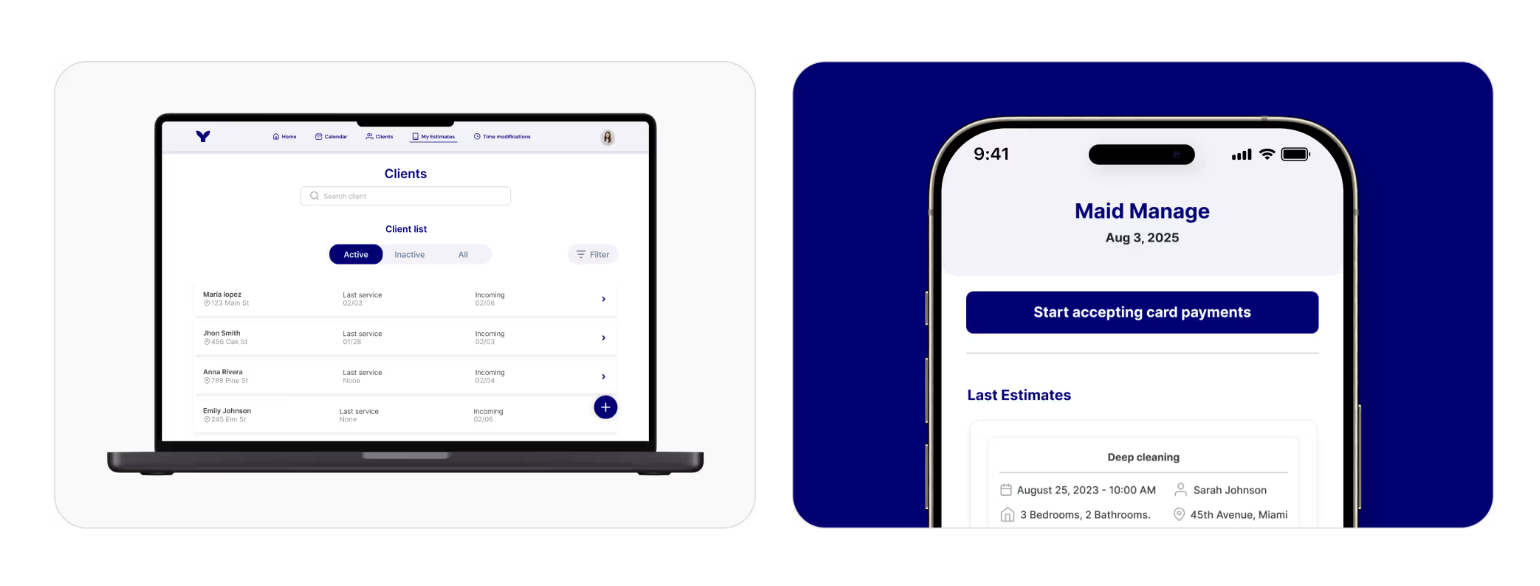
MaidManage offers another valuable lesson in MVP development. This platform helps cleaning professionals generate accurate service estimates and manage their clients. Rather than creating a comprehensive business management system, the MVP focused exclusively on streamlining the estimate-to-payment workflow. This targeted approach led to a 25% reduction in administrative time and 30% more accurate estimates.
Copious.Land demonstrates how an eCommerce MVP can transform property investing. The platform connects land investors with wholesale opportunities through a focused marketplace. By concentrating on location-based search, satellite imagery integration, and secure messaging between parties, the MVP delivered immediate value without trying to solve every real estate challenge. This focused approach increased successful property transactions by 40%.
These examples share a common thread: they all started with focus on solving one critical problem exceptionally well rather than attempting to address every industry challenge at once. This approach allowed them to validate their core value proposition quickly and iterate based on real user feedback.
Building an eCommerce MVP is the smartest way to bring your online store to life without risking significant time and resources on untested assumptions. This approach lets you validate your business concept with real customers while learning exactly what they value most about your offering.
The key to success lies in ruthless prioritization - focus exclusively on the features that enable the core shopping experience and resist the temptation to add capabilities just because competitors have them. Remember that Amazon started as a simple online bookstore before becoming the everything store.
Ready to turn your eCommerce idea into reality? LowCode Agency specializes in building efficient, market-ready MVPs that get you to launch faster and more affordably than traditional development.
Book a free discovery call today, and let's discuss how we can help you create an eCommerce MVP that validates your concept and sets the foundation for your success.
Last updated on
May 29, 2026
.
-
Custom Automation Solutions
Save Hours Every Week
We automate your daily operations, save you 100+ hours a month, and position your business to scale effortlessly.
Our AI — trained on 300+ shipped products — tells you what to build, what to skip, and what it'll actually cost. No fluff.
Assess My Idea"Working with LowCode Agency was the best decision I made in 2025"
Franklin Frith
CEO at HRM
An eCommerce MVP is the simplest version of your online store that includes only essential features needed to start selling. It focuses on core functionality like basic product listings, shopping cart, checkout process, and payment processing while eliminating nice-to-have features that can be added later based on customer feedback and actual usage data.
Starting with an MVP saves you time and money by testing your business concept before heavy investment. It helps validate market demand, collect real customer feedback, and identify which features actually matter to your audience. This approach reduces risk significantly and allows you to adapt quickly based on genuine market response rather than assumptions.
Essential features include a streamlined product catalog with clear images and descriptions, a simple shopping cart, secure checkout process, reliable payment processing, basic account management, order confirmation, and accessible customer support. Focus on creating a complete purchase journey without friction points rather than adding secondary features like wishlists or complex filtering.
An eCommerce MVP typically costs between $5,000-15,000 when built with no-code platforms, depending on complexity and customization needs. This includes platform fees, essential integrations, and professional development help. The investment is significantly lower than traditional development approaches, which can easily exceed $30,000 for basic functionality.
Your MVP is successful if it achieves your predefined goals, which typically include positive metrics like healthy conversion rates (1.5-3%), reasonable customer acquisition costs, repeat purchases, and minimal technical issues. More importantly, it should provide clear data about customer behavior and preferences that guide your next development priorities.
MVP
SaaS MVP Development | Your Roadmap to Rapid Launch
Learn how to build and launch your SaaS MVP fast. Get a clear, step-by-step roadmap to validate your idea and go to market with confidence
MVP
What Is MVP in Web Development? (How to Build One)
Start your web project right with an MVP. This guide explains what a web MVP is, how to build one, real examples, common mistakes, and development tips
MVP
7 MVP Case Studies: How We Helped Founders Validate Ideas with No-code
Want to launch fast? These 7 MVP case studies show how we helped founders validate ideas with no-code and build products in just 5 weeks. Learn more
MVP
Top 10 MVP Development Agencies (2026) | Top Rated
Find the best MVP agency for your startup. Our 2026 list features fast, trusted teams that help you launch and grow without breaking the bank
MVP
How to Prioritize and Identify Key Features for Your MVP
Learn to prioritize key features for your MVP, avoid common mistakes, and align with customer needs for a successful product launch
MVP
How to Build an MVP in 2026 (Minimum Viable Product Guide)
Learn how to build an MVP in 2026, from idea validation and core features to tools, costs, and common mistakes to avoid when launching fast.