|
VOOZH | about |
|
VOOZH | about |
15 min
read
Learn how to develop a successful Minimum Viable Product for your startup, reduce risks, save costs, and speed up market entry
By
Jesus Vargas
Updated on
May 29, 2026
.
Reviewed by
Real-World Experience with No-Code Tools: With over 320 apps built, we know firsthand what works—and what doesn't—when using no-code platforms like Glide, Bubble, FlutterFlow and Webflow.
Expert Team with 40+ Years of Combined Experience: Our team has deep technical knowledge, with experts who use no-code tools to solve real-world problems for clients every day, ensuring our advice is actionable and reliable.
Detailed Guides Based on Actual Projects: We don’t just talk about no-code; we use it daily to solve real business problems for our clients, from MVPs to complex automations.
Take a deeper look at our editorial guidelines
Are you watching competitors launch successful startups while your game-changing idea remains unrealized? You're not alone. Many entrepreneurs rush into full product development, only to discover their assumptions about user needs were inaccurate.
Launching a complete product without proper validation is one of the riskiest moves a startup can make. It demands significant time and resources, and if your core assumptions are wrong, you could lose everything you've invested. That's where a Minimum Viable Product (MVP) comes in as a strategic approach that helps validate your concept before making a major investment.
In this guide, you'll discover how to build an MVP that validates your concept without draining your resources. We'll walk you through proven strategies to test your ideas, gather valuable user feedback, and iterate effectively. By the end, you'll have a clear roadmap for developing an MVP that sets your startup on the path to success.
Think of an MVP as your startup's first market-ready version. But let’s not be confused; it’s not a rough prototype but a strategically purified product that delivers core value to users. It's the version that helps you validate your business idea without investing all your resources upfront.
We've seen firsthand how MVPs transform startup trajectories. Take RentFund, for instance. Instead of spending a year building a complex property management platform, we helped them launch an MVP focusing on essential features for landlords and tenants. Reduced payment processing time by 50% and achieved a $3M valuation within 4 weeks of launch.
But what makes MVPs particularly crucial for startups? They reduce both financial and market risks. You can test your core assumptions with real users while conserving resources for future development. Instead of guessing what features your users might want, you get actual data to guide your decisions and iterate based on feedback.
The best part? An MVP lets you adapt quickly based on market response. You can pivot, enhance or completely reimagine your product before making substantial investments. This flexibility is often the difference between a startup that scales and one that stalls.
Starting with an MVP lets you test your core assumptions in the real market without overcommitting resources. You can verify if your solution actually solves the pain points you've identified and if customers engage with it. This validation process helps you avoid building features that your market doesn't need or want, saving you from costly mistakes down the line.
Having a working MVP gives you a significant advantage when approaching investors. Instead of presenting theoretical projections, you can show real user engagement, initial traction, and concrete feedback. This tangible evidence of market interest makes your startup a more attractive investment opportunity and strengthens your negotiating position since your MVP works as a proof of concept.
By focusing on core functionalities first, you significantly reduce initial development time and costs. This lean approach allows you to enter the market faster and allocate resources more efficiently. Rather than spending months perfecting features that might not resonate with users, you can invest strategically in what matters most to your target audience.
An MVP allows your product to be in your users' hands quickly, providing invaluable insights for future development. This direct feedback helps you understand what features users actually value, what needs improvement, and what new functionalities they desire. It creates a clear roadmap for product development based on real user needs rather than assumptions.
We built a marketplace for sound engineers and event organizers with these benefits in mind. Instead of building a complex event staffing platform with numerous features, we helped our clients launch an MVP focused solely on connecting event producers with qualified technicians.
This focused approach led to a 40% improvement in hiring efficiency and provided clear direction for future development based on actual user needs. The success of their MVP not only validated their concept but also helped them identify which features to prioritize in subsequent iterations.
Clearly explain the specific problem you are solving and identify the individuals who are experiencing this issue. Don't attempt to reach everyone; having a well-defined target audience helps you create a more focused solution.
Common mistake: Many founders try to solve multiple problems at once, which weakens their MVP's effectiveness.
Analyze existing solutions in the market to understand what's working and what's missing for your specific, defined audience. Your differentiator should address a clear gap or pain point that competitors haven't addressed or solved effectively.
Common mistake: Getting discouraged by existing competition instead of using their presence to validate market demand.
Use proven prioritization frameworks to determine your MVP's essential features.
The MoSCoW method helps categorize features into
Alternatively, the Kano Model helps prioritize features by categorizing them based on customer satisfaction and impact. It divides features into three key groups:
The key takeaway from the Kano Model is to focus on what will satisfy users the most while ensuring that fundamental needs are met before adding performance enhancements and delight factors.
Common mistake: Including too many "nice-to-have" features that complicate development and confuse early users.
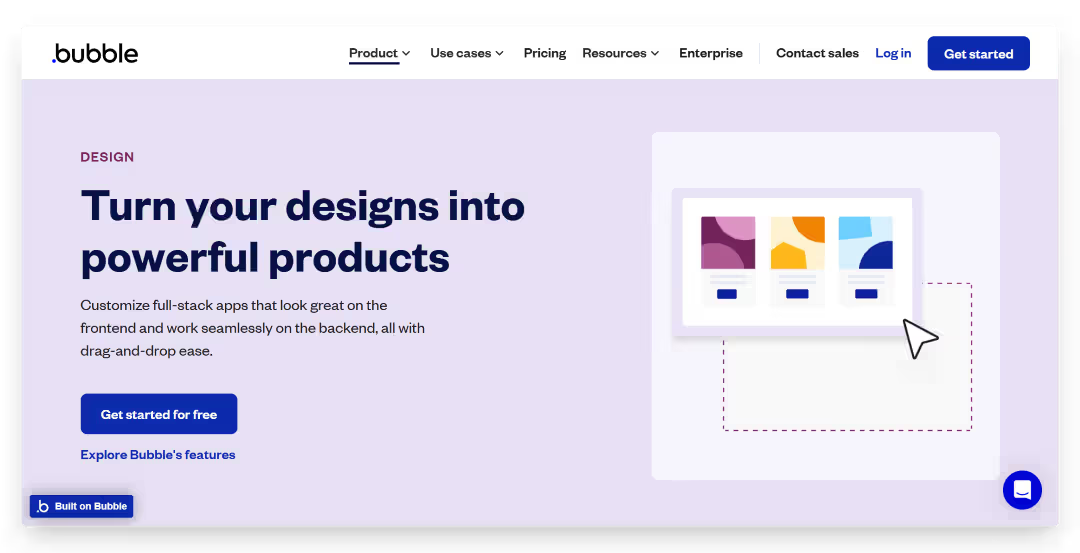
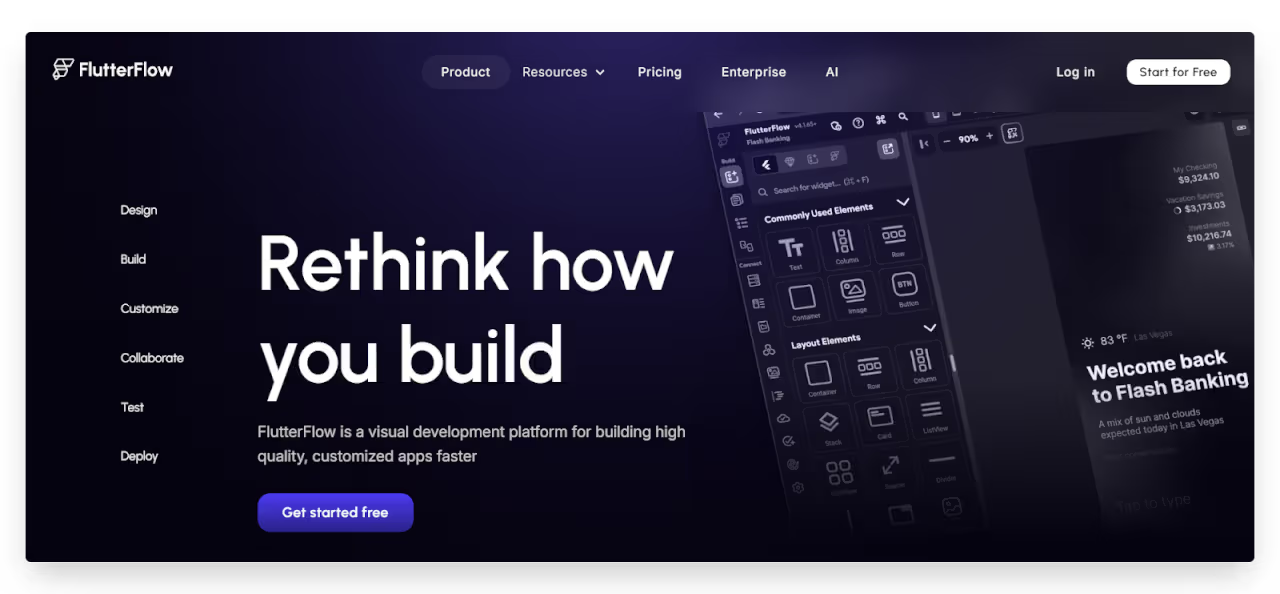
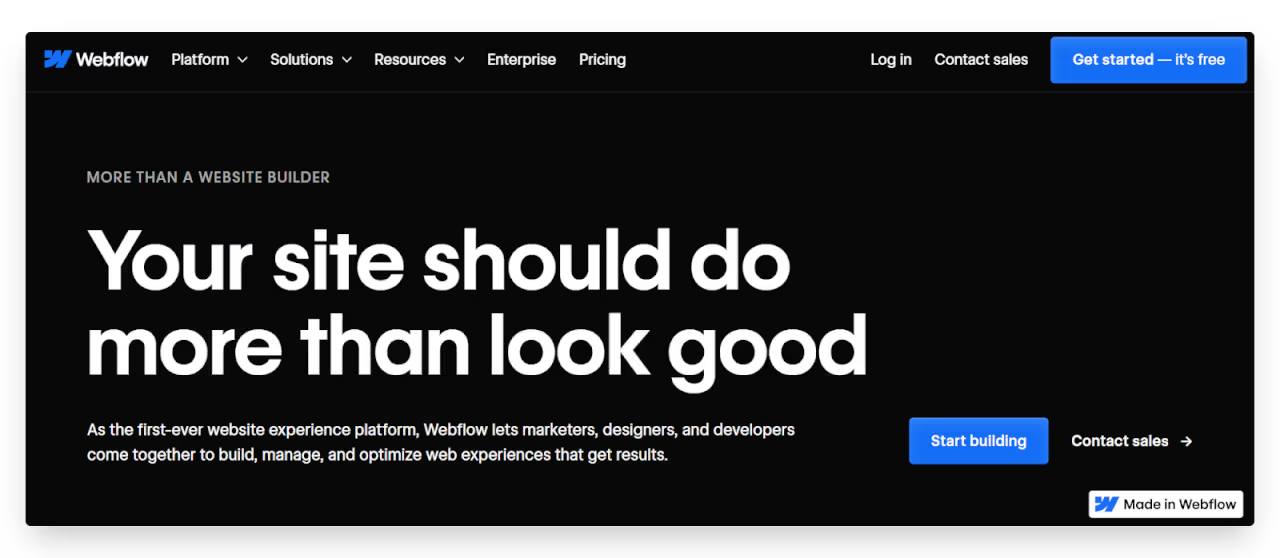
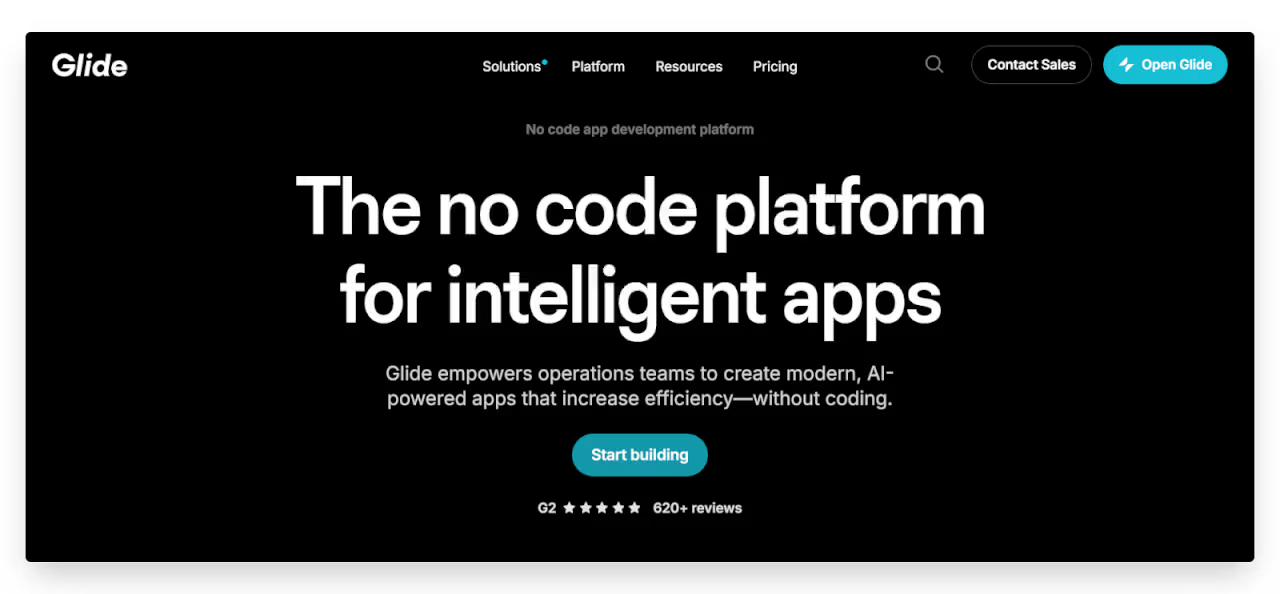
No-code platforms like Bubble, Glide, FlutterFlow, or Webflow have completely changed MVP development, enabling rapid creation of sophisticated applications without coding expertise.
These platforms offer pre-built components, customizable templates, and robust functionality that can bring your MVP to life in weeks rather than months. Each platform has its strengths, allowing you to choose based on your specific needs.
Common mistake: Getting caught up in technical complexities instead of focusing on solving the core problem.
Release your MVP to a carefully selected group of target users who can provide meaningful feedback. Set up clear success metrics such as user engagement rates, feature usage, and customer satisfaction scores, and establish multiple feedback channels including surveys, interviews, and analytics tracking.
Remember to focus on both quantitative metrics and qualitative insights about user behavior and preferences. Plan regular check-ins with your pilot users to gather ongoing feedback and identify patterns in their usage.
Common mistake: Waiting too long to launch while trying to perfect every feature instead of embracing early feedback for improvements.
Bubble is a no-code application builder that excels at creating complex, data-driven applications. Bubble shines when you need robust workflows, user authentication, and database management, making it perfect for SaaS, marketplaces, CRMs and MVPs. Its visual programming approach allows you to create sophisticated features without writing code, while its scalability ensures your MVP can grow with your user base.
Read this guide to learn more about Bubble’s capabilities and limitations.
FlutterFlow enables you to create native iOS and Android apps that feel polished and professional from day one with its intuitive visual interface. Its ability to generate clean, maintainable code and handle complex app logic makes it ideal for startups needing a strong mobile presence with native functionality. Its rapid prototyping abilities allow for rapid MVP development for startups wanting to quickly validate app concepts.
Read this guide to learn more about how to build a SaaS application using FlutterFlow.
When your MVP needs to make a striking first impression, Webflow delivers with its powerful design capabilities. It combines professional-grade website building with CMS functionality, perfect for content-driven startups or those requiring stunning landing pages. Its visual design system ensures responsive behavior across all devices while maintaining complete creative control.
Transform your business logic from data sources into sleek, functional apps. Glide excels at converting data-heavy processes into user-friendly interfaces, making it perfect for internal tools, simple customer apps, or operational dashboards. Its spreadsheet-first approach means you can prototype and iterate quickly based on existing business data.
At LowCode Agency, we've leveraged these platforms to build over 330 apps across various industries. Our expertise lies in choosing the right platform, from Glide, Bubble, FlutterFlow and Webflow, for your specific needs and implementing best practices that ensure your MVP is both scalable and maintainable.
The Lean Startup methodology revolutionizes how we approach MVP development by focusing on a simple yet powerful cycle: Build, Measure, Learn. Instead of spending months perfecting a product, you create quick iterations based on real user feedback to validate your assumptions.
Build: Start with the smallest version of your product that can test your core hypothesis. For example, if you're building a meal planning app, begin with just the basic meal suggestion and shopping list features, leaving out complex diet tracking or social sharing capabilities.
Measure: Collect meaningful data about how users interact with your MVP. Track specific metrics that validate your assumptions, like user engagement rates, feature usage patterns, or conversion metrics. For our meal planning app example, you might measure how many users actually generate shopping lists from suggested meals.
Learn: Analyze the data to make informed decisions about your next iteration. Are users engaging with the features you thought were essential? Are they requesting capabilities you hadn't considered? This feedback guides your product development, ensuring you build what users actually want, not what you think they want.
The key to successful lean development is maintaining speed and agility. Don't get stuck in perfecting features; rather, focus on learning from real user behavior and adapting quickly.
Start with direct user interviews; they're cost-effective and provide deep insights into user behavior. Combine this with simple feedback forms embedded in your MVP and analytics tools, like Hotjar, for user behavior tracking. Instead of complex testing systems, focus on building direct relationships with early users who can provide ongoing, honest feedback about their experience.
Focus on metrics that truly matter for your specific MVP. Rather than tracking everything possible, concentrate on 3-4 key metrics like core feature usage, time spent on key functions, and problem resolution rate.
For instance, if your MVP helps users complete a specific task, measure how many actually complete it rather than just general engagement metrics.
Get creative with low-cost validation methods. Set up a simple landing page with a clear value proposition and measure sign-up rates. Use social media to find potential users and offer early access in exchange for feedback.
What to Avoid: Don't focus only on large-scale testing—prioritize techniques specific to startups. As a startup, they might not have a large budget.
Pro Tips:
Validation isn't about getting thousands of data points; it's about getting quality insights from potential real users. Even feedback from 10 engaged users who fit your target market can provide more valuable insights than surface-level data from hundreds of random users.
Apply the Pareto Principle to focus on the feedback that will drive the most impact. This principle is often referred to as the 80/20 rule, which states that typically 80% of your user value comes from 20% of your features.
Pay special attention to recurring themes in user feedback rather than one-off requests. Create a feedback matrix that weighs user pain points against development effort, helping you identify the most valuable improvements you can make quickly.
Break down feedback-driven changes into small, manageable updates that you can implement and test rapidly. Use a rolling development cycle where you deploy improvements every 1-2 weeks rather than waiting to bundle multiple changes.
Maintain clear documentation of changes and their impact, allowing you to track which iterations drive the most value for users.
Watch for clear signals that your current approach isn't resonating, such as low engagement with core features or users consistently requesting fundamentally different functionality.
If users are solving their problems in unexpected ways with your MVP, consider pivoting to align with their natural behavior. Don't wait too long to make significant changes; if after 2-3 iterations you're not seeing improvement in key metrics, it's time to seriously consider a pivot.
Pro Tip: Document every major iteration and user response to build a knowledge base for future decisions. This helps you avoid repeating unsuccessful approaches and builds a clear picture of what your users truly value.
Most startups face the challenge of needing to move quickly while working with limited resources. The key is to choose development approaches that maximize your initial investment.
No-code platforms offer a strategic advantage by reducing development time from months to weeks, allowing you to validate your idea faster and more cost-effectively. By focusing your budget on the most critical features first and using platforms built for rapid development, you can create a professional MVP that's ready for market testing without compromising on quality or functionality.
Many founders have brilliant ideas but lack the technical expertise to bring them to life.
This is where partnering with LowCode Agency can be a game-changer. Our team of no-code experts can transform your vision into a functional MVP while teaching you how to manage and iterate on the platform we build it on.
We focus on combining our technical expertise with your industry knowledge to create solutions that truly resonate with users. Check out our case studies to learn more about our results.
Every startup feels the urgency to launch quickly, but rushing can lead to a poor user experience. The solution is to identify your MVP's most crucial features and perfect those first.
Focus your quality assurance efforts on the core user journey; the essential functions that solve your users' main problems. Additional features can be simpler at launch and improved based on user feedback.
This approach ensures you deliver a reliable product that effectively validates your concept while maintaining the speed needed in today's competitive market.
MVPs play a crucial role in securing funding by providing tangible evidence of your concept's viability. Instead of pitching ideas based on assumptions, you can show investors real user engagement, initial traction, and validated market demand. This data-driven approach significantly strengthens your position in funding discussions and helps justify your valuation.
When aligning your MVP with your long-term vision, focus on building features that create a strong foundation for future growth. Think of your MVP as the first chapter of your product story, not a separate project.
Each feature should contribute to your broader mission while solving immediate user needs. This balanced approach ensures you're not just validating your concept but also laying groundwork for future development.
We built SuperQueer, which serves as a global LGBTQ+ community hub, connecting 440 Pride organizations and their events within a single app built with FlutterFlow. The project began as an MVP, focusing on essential features to facilitate community engagement.
Following its initial success, the platform expanded to include more comprehensive functionalities, fostering a worldwide network for the LGBTQ+ community.
The key is to view your MVP as a strategic tool rather than just a prototype. Use it to:
Pro Tip: Document every insight from your MVP phase. These early learnings often become invaluable as you scale, helping you stay true to your original mission while evolving your product.
Starting your startup journey with an MVP isn't just about launching faster, it's about creating a smart product taht resonates with what your target audience’s problem or pain points.
By focusing on core features that solve real problems, gathering meaningful feedback, and iterating based on actual user needs, you set your startup up for sustainable success rather than speculative development.
As an MVP is your foundation, not your final destination. Each iteration brings you closer to product-market fit and helps you build something users truly value. The insights you gain during this phase are often more valuable than any amount of market research or theoretical planning.
Looking to transform your startup idea into a market-ready MVP? At LowCode Agency, we've helped over 330 founders bring their ideas to life using powerful no-code platforms. Book an initial free call with us to discuss how we can turn your vision into reality today.
Last updated on
May 29, 2026
.
Jesus Vargas
-
Founder
Jesus is a visionary entrepreneur and tech expert. After nearly a decade working in web development, he founded LowCode Agency to help businesses optimize their operations through custom software solutions.
Custom Automation Solutions
Save Hours Every Week
We automate your daily operations, save you 100+ hours a month, and position your business to scale effortlessly.
Our AI — trained on 300+ shipped products — tells you what to build, what to skip, and what it'll actually cost. No fluff.
Assess My Idea"Working with LowCode Agency was the best decision I made in 2025"
Franklin Frith
CEO at HRM
With no-code platforms and the right expertise, an MVP can typically be developed in 6-8 weeks. However, the timeline varies based on your project's complexity and specific requirements. At LowCode Agency, we've streamlined our development process to deliver most MVPs within 5 weeks, allowing enough time for proper planning, development, and initial testing while ensuring quick market entry.
Start with targeted testing among a small but relevant user group. Use free tools like Google Forms for feedback collection, Google Analytics for user behavior tracking, and social media for user engagement. Launch a simple landing page to test your value proposition, and consider running small-scale ad campaigns to drive targeted traffic. Focus on quality feedback from potential customers rather than quantity.
The biggest challenge is typically feature prioritization, determining what's truly essential for launch versus what can wait for later iterations. Many startups struggle with feature creep, trying to include too many capabilities in their initial release. This often leads to increased development time and costs while potentially complicating the user experience and diluting the core value proposition.
While MVPs are valuable across all sectors, they're particularly effective in startups, SaaS and business automation, e-commerce, marketplace platforms, and service-based businesses. These industries benefit most because they can quickly implement core functionalities, test user behavior, and iterate based on feedback. Additionally, sectors with high development costs or complex user interactions gain significant advantages from validating assumptions before full-scale development.
MVP
No-code/Low-code
No-code MVP Development (How to Build, Validate, and Scale)
Learn how to build a no-code MVP step by step, validate your idea, reduce costs, and scale your product with the right strategy in 2026.
MVP
7 MVP Case Studies: How We Helped Founders Validate Ideas with No-code
Want to launch fast? These 7 MVP case studies show how we helped founders validate ideas with no-code and build products in just 5 weeks. Learn more
MVP
How to Prioritize and Identify Key Features for Your MVP
Learn to prioritize key features for your MVP, avoid common mistakes, and align with customer needs for a successful product launch
MVP
Top 10 MVP Development Agencies (2026) | Top Rated
Find the best MVP agency for your startup. Our 2026 list features fast, trusted teams that help you launch and grow without breaking the bank
MVP
What Is MVP in Web Development? (How to Build One)
Start your web project right with an MVP. This guide explains what a web MVP is, how to build one, real examples, common mistakes, and development tips
MVP
MVP Cost in 2026: Low-code vs Custom Development
Compare MVP costs in 2026 between low-code and custom development. Understand pricing, timelines, and trade-offs to choose the right build path.