|
VOOZH | about |
|
VOOZH | about |
13 min
read
Learn how to build your eCommerce mobile app faster using no-code tools. Explore features, platforms, and tips to launch on iOS, Android, or as a PWA
By
Jesus Vargas
Updated on
May 29, 2026
.
Reviewed by
Real-World Experience with No-Code Tools: With over 320 apps built, we know firsthand what works—and what doesn't—when using no-code platforms like Glide, Bubble, FlutterFlow and Webflow.
Expert Team with 40+ Years of Combined Experience: Our team has deep technical knowledge, with experts who use no-code tools to solve real-world problems for clients every day, ensuring our advice is actionable and reliable.
Detailed Guides Based on Actual Projects: We don’t just talk about no-code; we use it daily to solve real business problems for our clients, from MVPs to complex automations.
Take a deeper look at our editorial guidelines
Mobile shopping isn't just growing; it's become the dominant way people buy online. Your customers expect the convenience of browsing and purchasing from their smartphones, with over 70% of eCommerce traffic now coming from mobile devices.
While responsive websites are important, they simply can't match what a dedicated mobile app offers your business. Apps provide significantly faster loading times, smoother navigation, and a more intuitive shopping experience tailored specifically to mobile users. This enhanced experience translates directly to higher conversion rates, with mobile apps converting at nearly 3x the rate of mobile websites.
The data backs this up - app users typically spend more time browsing products, place larger orders, and make repeat purchases more frequently than website-only customers. For growing eCommerce businesses, a well-designed mobile app isn't just a nice-to-have anymore - it's essential for staying competitive.
At LowCode Agency, we specialize in developing high-performance eCommerce mobile apps without the lengthy timelines and excessive costs of traditional development.
Our team has built over 330 custom applications for businesses across industries, using powerful no-code and low-code platforms like Bubble, FlutterFlow, and Glide.
We understand the unique challenges of eCommerce and create apps that prioritize seamless user experiences, secure payment processing, and effective customer engagement. Our approach delivers custom solutions that match your brand and business needs in weeks, not months.
Ready to transform your eCommerce business with a custom mobile app? Book a free consultation call with our team today.
Understanding exactly who will use your app is the foundation of successful eCommerce app development. Take time to clearly identify your target customers - their age, shopping habits, device preferences, and pain points with your current shopping experience.
Your audience research should reveal what features they truly value in a shopping app. Do they prioritize easy product comparison, detailed product videos, or a lightning-fast checkout? If videos are important, integrating a Compress Video API ensures high-quality product videos load quickly without slowing the app, enhancing the user experience.
Knowing these preferences helps you focus your development resources on what will actually drive conversions rather than flashy but unused features.
Modern no-code platforms have transformed how eCommerce apps are designed, making it possible to create professional interfaces without writing a single line of code.
Using drag-and-drop builders like FlutterFlow, Bubble, and Glide, you can visually assemble your app's screens by simply selecting and placing elements where you want them.
These platforms provide extensive libraries of pre-built components specifically designed for eCommerce. Product cards, image carousels, search bars, and checkout forms can be added to your app with just a few clicks.
Connecting your mobile app to your product data and inventory systems is surprisingly straightforward with modern no-code tools.
You can easily link your app to lightweight data sources like Airtable, Google Sheets, or Glide Tables if you're just starting out. These options provide flexible, manageable databases that work well for smaller catalogs and simpler eCommerce operations.
For established businesses, direct integration with major eCommerce platforms saves you from managing multiple systems. Using APIs, your app can synchronize products, inventory levels, customer accounts, and order data with platforms like Shopify, WooCommerce, or Magento. If you're adopting a headless architecture, understanding Magento Headless API performance becomes essential to ensure fast, seamless synchronization and an optimal user experience across devices.
This two-way communication ensures that prices, stock levels, and order statuses stay consistent between your website and mobile app.
Before launching, thoroughly test your app across different devices to ensure consistent performance. No-code platforms like FlutterFlow and Bubble offer live preview features that let you immediately see how changes affect your app on various screen sizes, making it easier to catch issues early during mobile testing.
Create a staging environment where team members and selected customers can interact with your app under real-world conditions to catch issues before your public launch.
When you're ready to go live, no-code platforms simplify the publishing process. For native apps, most platforms generate the necessary files for submission to the Google Play Store and Apple App Store, though you'll still need to create developer accounts and prepare store listings.
If you've built a PWA, deployment is even simpler since users can access your app directly through a web URL without going through app stores.
Understanding how customers use your app is essential for ongoing improvement. Implement analytics to track key eCommerce metrics like conversion rates, average order value, and cart abandonment patterns.
These insights reveal exactly where customers encounter friction in their shopping journey, allowing you to make targeted improvements to your app's flow and functionality.
Integrating specialized analytics tools gives you deeper visibility into user behavior. Platforms like Mixpanel excel at tracking user paths through your app, while Google Analytics provides comprehensive demographic data and campaign attribution.
One of the biggest advantages of no-code eCommerce apps is the ability to implement changes quickly based on your analytics findings. Unlike traditional mobile apps that require App Store resubmission for every update, platforms like Bubble, Glide and FlutterFlow let you make many changes instantly.
You can adjust layouts, refine copy, update product information, and even modify checkout flows in real-time, allowing you to continuously optimize the shopping experience based on actual user data.
Choosing the right platform for your eCommerce app can dramatically impact your development speed, costs, and the final product's capabilities. Each of these leading no-code tools offers unique advantages for building mobile shopping experiences.
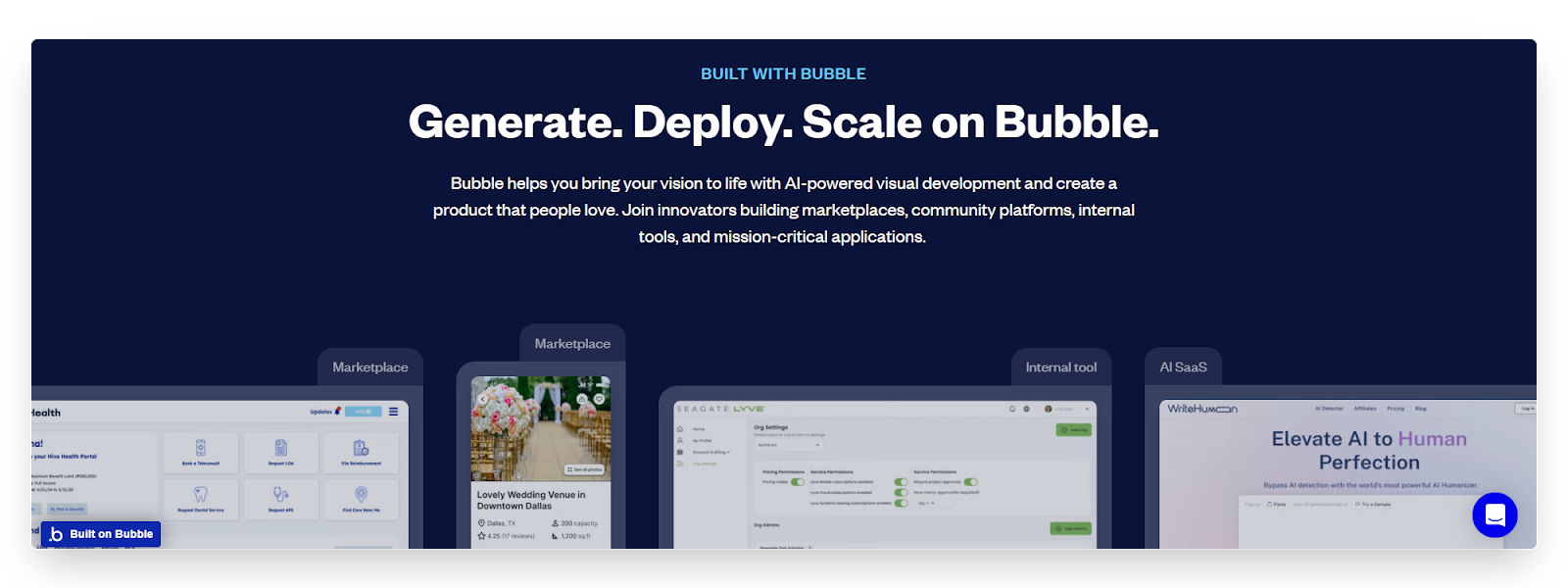
Bubble excels at creating sophisticated eCommerce applications with complex business logic and customized workflows. The platform's visual programming environment lets you build advanced features like personalized recommendations, inventory management systems, and multi-step checkout flows without writing code.
Bubble is particularly valuable when you need to create both customer-facing apps and comprehensive admin panels from a single platform. Its robust database capabilities and API Connector make it easy to integrate with payment processors, shipping services, and product information management systems.
While primarily web-based, Bubble applications can be wrapped as mobile apps, making it ideal for businesses that want to maintain a single codebase across web and mobile.
FlutterFlow stands out as the premier no-code solution for building true native mobile apps for both iOS and Android. It generates clean Flutter code that delivers exceptional performance and native-feeling interactions, which is crucial for keeping mobile shoppers engaged through the entire purchase journey.
The platform's seamless Firebase integration provides a powerful backend for your eCommerce app, handling user authentication, real-time inventory updates, and order processing. FlutterFlow excels at creating visually polished interfaces with smooth animations and transitions that enhance the shopping experience.
If your priority is delivering a high-quality native app experience that can compete with major retailers, FlutterFlow offers the best balance of quality and development speed.
Glide transforms several data sources information into functional mobile apps with remarkable speed. If you already manage your product catalog in Google Sheets or Airtable among many others, Glide can convert that data into a shopping app in half the time than traditional development. This makes it perfect for small businesses or those testing a new product line before investing in more complex development.
While more limited than other platforms in customization, Glide excels at creating straightforward shopping experiences with clean interfaces and essential eCommerce functions.
The platform is particularly well-suited for internal apps like inventory management tools or vendor portals that complement your customer-facing eCommerce system. Glide's pricing model based on users rather than features makes it cost-effective for smaller operations.
Building an eCommerce app with no-code tools dramatically reduces both time and costs compared to traditional development methods. Understanding the different cost factors will help you budget appropriately for your project.
Each no-code platform offers tiered pricing based on features, user limits, and publishing options. Most platforms provide free plans for testing, but you'll need paid tiers for professional eCommerce applications.
One of the most significant advantages of no-code development is the dramatically reduced timeline. Traditional eCommerce app development often takes 4-6 months, while no-code platforms can deliver a fully functional app in just 5-8 weeks.
This accelerated timeline breaks down into approximately:
The actual timeline can vary based on the complexity of your requirements, the number of integrations needed, and the amount of customization required for your brand.
Traditional app development for eCommerce typically costs between $20,000 and $250,000 for professional-quality applications. Using no-code tools dramatically reduces this investment to between $10,000 and $50,000, depending on complexity and customization needs.
This cost reduction comes from several factors:
| Platform | Typical Monthly Cost | Estimated Build Time |
|---|---|---|
| Bubble | $32–$134+ | 6–8 weeks |
| FlutterFlow | $30–$70+ | 5–7 weeks |
| Glide | $60–$250+ | 4–6 weeks |
Remember that these costs don't include design assets, premium plugins, or app store fees. For businesses without in-house expertise, working with a specialized agency like LowCode Agency can provide the expertise needed while still keeping costs significantly lower than traditional development methods.
No-code development has fundamentally changed what's possible for eCommerce businesses. These platforms now offer the speed, affordability, and scalability that used to be available only to enterprises with massive development budgets.
You can build and launch a professional eCommerce app in weeks instead of months, and for thousands rather than hundreds of thousands of dollars.
The best part? These visual development tools use intuitive interfaces that let you focus on what matters, which is creating an exceptional shopping experience for your customers. The technical complexities of payment processing, database management, and cross-platform compatibility are handled by the platforms themselves.
At LowCode Agency, we've helped dozens of eCommerce businesses transform their digital presence with custom mobile apps. Check out our case studies to see real-world examples of what's possible, or book a free consultation call to discuss how we can help your business sell smarter with a custom eCommerce app.
Last updated on
May 29, 2026
.
Jesus Vargas
-
Founder
Jesus is a visionary entrepreneur and tech expert. After nearly a decade working in web development, he founded LowCode Agency to help businesses optimize their operations through custom software solutions.
Custom Automation Solutions
Save Hours Every Week
We automate your daily operations, save you 100+ hours a month, and position your business to scale effortlessly.
Our AI — trained on 300+ shipped products — tells you what to build, what to skip, and what it'll actually cost. No fluff.
Assess My Idea"Working with LowCode Agency was the best decision I made in 2025"
Franklin Frith
CEO at HRM
Start by defining your goals and audience, then choose a no-code platform like FlutterFlow, Bubble, or Glide based on your needs. Design your UI, integrate with your existing eCommerce platform, add payment processing, and test thoroughly before launching. With no-code tools, you can build and launch your app in 5-8 weeks.
Essential features include user accounts, product catalog with search/filters, shopping cart, secure checkout with multiple payment options, order tracking, and push notifications. Advanced features to consider are wishlist functionality, product reviews, personalized recommendations, loyalty programs, and in-app chat support. Focus on features that directly improve the shopping experience.
No-code eCommerce apps typically cost between $5,000-$30,000, depending on complexity and customization. This includes platform subscription fees ($30-$270/month), design assets, and development time. This represents an 80-90% cost reduction compared to traditional development, which can easily exceed $100,000 for similar functionality.
The best platform depends on your specific needs. FlutterFlow excels for true native apps with superior performance. Bubble is ideal for complex business logic and admin panels. Glide offers the fastest development for simple apps. Consider factors like your technical comfort, desired features, budget, and whether you need native apps or PWAs.
Yes, apps built with FlutterFlow, Bubble, and most other no-code platforms can be published to both the Google Play Store and Apple App Store. Each platform generates the necessary files for submission. You'll still need developer accounts ($25 for Google, $99/year for Apple) and must follow their respective guidelines for approval.
Most no-code eCommerce apps can be completed in 5-8 weeks. This timeline includes planning, design, development, testing, and deployment. Simple apps with basic features may be completed in as little as 4 weeks, while more complex applications with custom integrations might require up to 8 weeks. This represents a 50% reduction in timeline compared to traditional development.
Mobile App Development
Best Mobile App Analytics Tools in 2026
Not sure which analytics tool fits your mobile app? Compare the best platforms in 2026 to track users, retention, and performance.
Mobile App Development
No-code/Low-code
11 Best No-code Mobile App Builders | Don’t Miss Out!
Discover the 11 best no-code mobile app builders to create iOS & Android apps without coding. Compare features & pick the right tool for your needs
Mobile App Development
Custom Mobile App Development: What to Know
Considering custom mobile app development? Learn what it involves, how much it costs, and whether it's the right choice for you.
Mobile App Development
Employee Communication Mobile App: What to Build
Thinking of building an employee communication mobile app? Learn what features matter most and what to avoid before you start.
Mobile App Development
Mobile App Maintenance: Who Owns What?
After launch, who handles your mobile app maintenance? Learn how responsibilities are divided between you and your development agency.
Mobile App Development
Flutter vs React Native for Mobile App Dev
Flutter or React Native for your mobile app? Compare performance, cost, community, and use cases to make the right call.