|
VOOZH | about |
|
VOOZH | about |
11 min
read
Learn how to build and launch your SaaS MVP fast. Get a clear, step-by-step roadmap to validate your idea and go to market with confidence
By
Jesus Vargas
Updated on
May 29, 2026
.
Reviewed by
Real-World Experience with No-Code Tools: With over 320 apps built, we know firsthand what works—and what doesn't—when using no-code platforms like Glide, Bubble, FlutterFlow and Webflow.
Expert Team with 40+ Years of Combined Experience: Our team has deep technical knowledge, with experts who use no-code tools to solve real-world problems for clients every day, ensuring our advice is actionable and reliable.
Detailed Guides Based on Actual Projects: We don’t just talk about no-code; we use it daily to solve real business problems for our clients, from MVPs to complex automations.
Take a deeper look at our editorial guidelines
A SaaS MVP (Minimum Viable Product) is a simple version of your software with only the core features. It’s not the final product, but it helps you test your idea fast without spending too much time or money.
Building a SaaS MVP lets you check if real users want your product. Instead of guessing, you get real feedback. This helps you avoid building features no one needs. It also saves money by focusing only on what matters most in the early stage.
An MVP also lowers your risk. If your idea doesn’t work, you find out early before wasting resources. If it does work, you can build better versions based on user feedback. This smart start helps you grow your SaaS product step by step with less stress and more success.
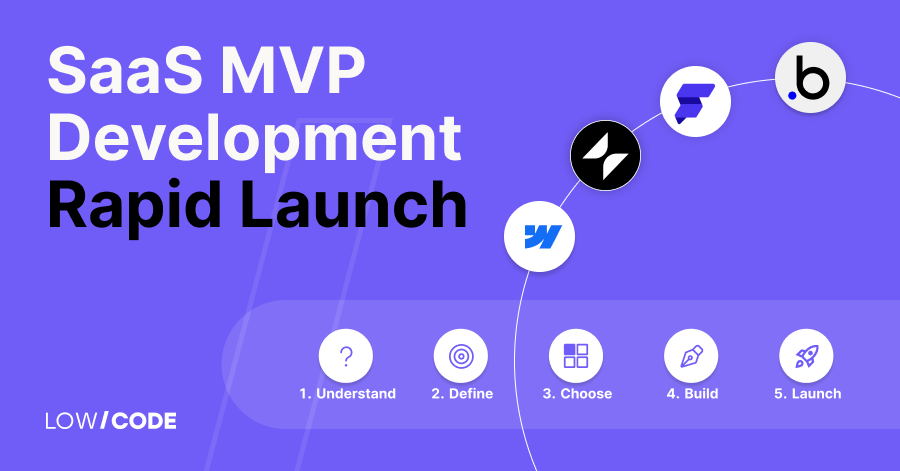
To turn your idea into a real product, follow these clear steps. Each one helps you stay focused, move fast, and build something your users actually want.
Before you build your SaaS MVP, you need to know exactly what problem you're solving and who you're solving it for. Start by identifying your target users.
Use social media platforms like Reddit, LinkedIn polls, online communities, or Google Forms to collect quick feedback. Talk to potential users, not just friends or peers.
You're looking for common patterns in their pain points. If you can clearly define the problem and the people facing it, your SaaS MVP will be much more focused and useful.
This step sets the direction for everything else, so take your time to get it right, but keep it lean and focused.
Once you understand the problem, you need to determine what features your SaaS MVP absolutely needs to include. This is about creating a lean product that effectively solves the core problem without unnecessary complexity.
Use frameworks like the MoSCoW method to categorize your features into Must-haves, Should-haves, Could-haves, and Won't-haves. For your MVP, focus exclusively on the Must-haves that deliver your core value proposition.
Apply the 80/20 rule (Pareto Principle) to feature selection. Identify the 20% of features that will deliver 80% of the value to your users. This helps you avoid feature bloat and keeps your SaaS MVP focused and efficient.
Every additional feature increases development time, costs, and potential bugs. Ask yourself for each feature: "Can we launch without this?" If the answer is yes, save it for a future iteration.
Selecting the right technology for your SaaS MVP can make or break your time-to-market advantage. No-code platforms have completely changed MVP development, enabling rapid creation of sophisticated applications without extensive coding expertise.
No-code platforms like Bubble, Glide, and FlutterFlow offer significant advantages over traditional development methods. They reduce your development timeline from months to weeks and allow for quick iterations based on user feedback.
When evaluating tech options, consider three key factors.
Your SaaS MVP is about validating your idea, not building the perfect tech architecture. Choose a stack that allows you to move quickly while also providing room to grow as your product evolves.
Design can make or break your SaaS MVP. Even if your idea is great, a confusing design will turn people away. Focus on creating a simple, clean interface with clear actions.
Remove anything that doesn't help the user solve their problem. Guide them toward the "aha" moment, when they see the value of your app, in as few steps as possible.
Use familiar layouts, readable fonts, and clean buttons. Decide early if you want to go mobile-first or web-first, based on your target audience’s habits. Tools like Figma or no-code platforms with built-in UI options can help you create a fast, attractive design without needing a professional designer.
The goal of an MVP is to learn, not to be perfect. Start small, build quickly, and launch to real users as soon as possible. Don’t wait to add every feature or perfect every detail.
Instead, adopt an agile mindset: release a working version, gather feedback, and improve with each update. This approach saves time and prevents you from building features no one needs. Early feedback also helps you adjust your idea if something isn’t working.
Your first users aren’t expecting a finished product; they’re helping you shape it. The faster you test, the quicker you can find what truly works and grow from there.
When choosing a no-code platform for your SaaS MVP, each option offers distinct advantages depending on your specific requirements.
Here's a breakdown of the top platforms to consider:
Bubble excels at creating complex, data-driven SaaS applications without writing code. Its visual programming approach allows you to build sophisticated features and workflows while its scalability ensures your SaaS MVP can grow with your user base.
The platform is particularly well-suited for SaaS products that require robust user authentication, complex database management, and advanced business logic.
With Bubble, you can create custom dashboards, subscription management systems, and internal tools that feel like fully-coded applications.
If you're not an expert or don’t feel comfortable using Bubble, reach out to us. We’re a Silver Tier Bubble agency with a team of certified Bubble developers and experience building 330+ no-code apps. We can turn your idea into a fully functional MVP, faster and at half the cost of traditional development.
Glide transforms your business logic from spreadsheets into sleek, functional apps within hours. It's perfect for data-centric SaaS MVPs that need to organize and visualize information in user-friendly interfaces.
If your SaaS concept revolves around organizing, tracking, or displaying data, Glide offers the fastest path to market. It excels at creating operational dashboards, simple CRMs, and business management tools with minimal setup time, making it ideal for validating data-driven SaaS concepts quickly.
If you're not sure how to get started with Glide, we’ve got you covered. We are the largest and leading Glide agency with a team of expert Glide developers and over 330+ no-code apps built. We can help turn your spreadsheet-based idea into a fully working MVP quickly, using best practices.
FlutterFlow enables you to build native mobile and web applications that feel polished and professional from day one. Its drag-and-drop interface combined with Flutter's performance makes it ideal for SaaS MVPs requiring a strong mobile presence.
The platform shines when your SaaS concept needs to work seamlessly across devices or requires native mobile functionality. It's particularly valuable for MVPs focused on field service, on-the-go productivity, or any concept where the mobile experience is central to your value proposition.
If you're looking to build with FlutterFlow but need expert help, we’re here to support you. We’re the leading FlutterFlow agency with a skilled team of developers and over 330+ no-code apps successfully built. We can turn your mobile-first idea into a high-quality MVP that looks and performs like a fully coded app.
Webflow provides exceptional design capabilities for creating visually striking, content-rich SaaS products. Its CMS powers dynamic content while its visual designer gives you pixel-perfect control without coding.
This platform is best for SaaS MVPs where user experience and visual design are critical differentiators. Content-driven applications, marketing automation tools, and design-focused platforms benefit from Webflow's combination of visual design control and CMS capabilities.
If you're looking to build a web-based SaaS MVP, we specialize in creating high-quality Webflow sites or web apps in just 3 weeks. Our team has deep expertise in Webflow and can help you launch a stunning, functional MVP that stands out visually and performs smoothly from day one.
No-code platforms have enabled startups to launch powerful SaaS MVPs in record time. Here are real examples that demonstrate the potential of this approach:
RentFund started as a focused MVP built with Glide that addressed a specific pain point in property management: rent payment verification. Instead of building a complex property management system with dozens of features, we focused on an MVP that concentrated on automating payment verification and offering a 5% cash back rewards program to incentivize timely payments.
This approach paid off dramatically. The streamlined MVP reduced payment processing time by 50% and achieved a $3M valuation within just 4 weeks of launch. By solving one problem exceptionally well, RentFund gained immediate traction with both property managers and tenants.
BarEssay demonstrates how a no-code MVP can leverage AI to create unique value. Built on Bubble, this platform helps law students prepare for the California Bar Exam through personalized feedback on practice essays.
The MVP focused on core functionality: analyzing practice essays, providing detailed suggestions, and identifying improvement areas. This targeted approach reduced study time by 30% while enabling 70% more focus on weak areas.
By starting with a clear use case and core value proposition, BarEssay validated its concept quickly before expanding to additional features.
MaidManage showcases how a targeted MVP can transform operations in traditional service industries. Built with Bubble in just 8 weeks, this solution addresses the specific challenges of domestic cleaning professionals who were losing income to manual pricing calculations and booking confusion.
The MVP focused on three essential features: standardized pricing formulas, professional electronic estimates, and integrated payment processing through Stripe. This focused approach delivered immediate results, with a 25% reduction in administrative time and 40% improvement in payment processing. By solving specific operational pain points with elegant simplicity, MaidManage validated its market value before adding more complex features.
Even a great idea can fail if you make the wrong moves early, so here are key mistakes to watch out for when building your MVP.
Avoiding these mistakes can save you time, money, and stress, helping you launch a stronger and smarter SaaS MVP.
Offering a free MVP can help you attract more early users and gather valuable feedback. It lowers the barrier for people to try your product, which is useful when you're still testing your idea. But it may not show if people are truly willing to pay for your solution.
Going with a paid MVP helps you validate not just interest, but real demand. Even a small price shows your idea has value.
Here are a few smart ways to handle pricing early on:
The right pricing strategy depends on your goals, whether they are growth, feedback, or revenue. Even in the MVP stage, don't hesitate to test what people are willing to pay.
At LowCode Agency, we help you turn your SaaS idea into a fully functional MVP, quickly and affordably. With over 330 apps built using top no-code platforms like Bubble, Glide, FlutterFlow, and Webflow, our team knows what works across industries.
We choose the best platform for your specific concept, whether you need advanced user authentication, real-time data dashboards, or mobile-first design. Our process focuses on speed without compromising quality, most MVPs are delivered in just 5–8 weeks.
Want to see how it works? Book a free consultation. We’ll review your idea, recommend the best platform, and outline the steps to bring your MVP to market.
In the meantime, read our case studies to see how we’ve helped founders like you turn their ideas into fully functional apps.
The key to a successful SaaS MVP is solving a real, painful problem for your users. Don’t get stuck trying to build a perfect product. Just build a useful one. Focus on speed and clarity. Get your core features out quickly, then improve based on real feedback.
An MVP isn’t your final product. It’s just the first step. Its purpose is to test your idea, learn what works, and avoid wasting time on features nobody needs. Every piece of user feedback is a chance to make your app better.
So keep it simple, stay focused on your users, and move fast. The sooner you launch, the sooner you learn. That’s how you turn a rough idea into a product people love and are willing to pay for.
Last updated on
May 29, 2026
.
Jesus Vargas
-
Founder
Jesus is a visionary entrepreneur and tech expert. After nearly a decade working in web development, he founded LowCode Agency to help businesses optimize their operations through custom software solutions.
Custom Automation Solutions
Save Hours Every Week
We automate your daily operations, save you 100+ hours a month, and position your business to scale effortlessly.
Our AI — trained on 300+ shipped products — tells you what to build, what to skip, and what it'll actually cost. No fluff.
Assess My Idea"Working with LowCode Agency was the best decision I made in 2025"
Franklin Frith
CEO at HRM
A SaaS MVP is the first version of your software that delivers core value to users with minimal features. It focuses solely on solving the primary problem your SaaS addresses, allowing you to validate your business idea, gather user feedback, and test market demand before investing in a fully-featured product.
In software development, an MVP is a development strategy that prioritizes building only the essential features needed to solve the core problem for early users. It's a functional product with minimal complexity that helps validate assumptions, attract early adopters, and generate feedback for future iterations while minimizing initial development time and costs.
A SaaS MVP typically takes 6-12 weeks to build, depending on complexity and the platform used. Using no-code tools like Bubble or Glide can reduce this timeline to 4-8 weeks. The key is maintaining focus on core functionality and avoiding scope creep that extends development time.
Building a SaaS MVP typically costs between $7,000-$35,000 using no-code platforms, compared to $50,000-$150,000 with traditional development. The exact cost depends on complexity, features, integrations required, and whether you build it yourself or hire experts. No-code approaches generally offer the most cost-effective path to market.
You should move from MVP to full product when you've validated market demand, established consistent user growth, identified clear patterns in feature requests, and secured sufficient funding for expansion. This transition should be data-driven, occurring when user feedback consistently validates your core value proposition and points to specific enhancement opportunities.
MVP
Top 10 MVP Development Agencies (2026) | Top Rated
Find the best MVP agency for your startup. Our 2026 list features fast, trusted teams that help you launch and grow without breaking the bank
MVP
Healthcare MVP Guide: Steps, Tips, and Mistakes to Avoid
Learn how to build a healthcare MVP step-by-step. Discover key tips, avoid common mistakes, and ensure compliance while launching faster and smarter
MVP
How to Develop a Successful MVP for Your Startup
Learn how to develop a successful Minimum Viable Product for your startup, reduce risks, save costs, and speed up market entry
MVP
How to Prioritize and Identify Key Features for Your MVP
Learn to prioritize key features for your MVP, avoid common mistakes, and align with customer needs for a successful product launch
MVP
What Is MVP in Web Development? (How to Build One)
Start your web project right with an MVP. This guide explains what a web MVP is, how to build one, real examples, common mistakes, and development tips
Mobile App Development
MVP
MVP Mobile App Cost and Scope (Real Budget & Planning Guide)
MVP mobile app cost explained for founders. See real budgets, feature scope, timelines, and how to plan version 1 without overspending or overbuilding.