|
VOOZH | about |
|
VOOZH | about |
We use cookies to improve your experience on our site. By using our site, you are agreeing to the collection and use of data as described in our Privacy Policy.
Cookie Settings×Table of contents
As you look to integrate applications and sync data, you’ll have a number of considerations to address.
At the top of your list is likely deciding between webhooks and REST APIs.
Each comes with distinct advantages and disadvantages, which can leave one better suited than the other for specific integration scenarios.
To help you use webhooks and REST APIs effectively over time, we’ll define each, review their respective advantages and disadvantages, compare them directly, and more.
Related: How to choose between webhooks and API polling
It’s a mechanism that allows applications to send real-time data or events to one another over the internet.
Here’s a bit more on how it works: An application (the destination system) registers a webhook endpoint in another application (the source system) that specifies the application that wants to receive the data/notification and the information it wants to receive. Once the event occurs, the source system makes a POST request to the webhook endpoint; the destination system then processes the data within the POST request, which can potentially trigger additional actions within the application.
To make our definition more tangible, let’s cover a few common webhook examples.
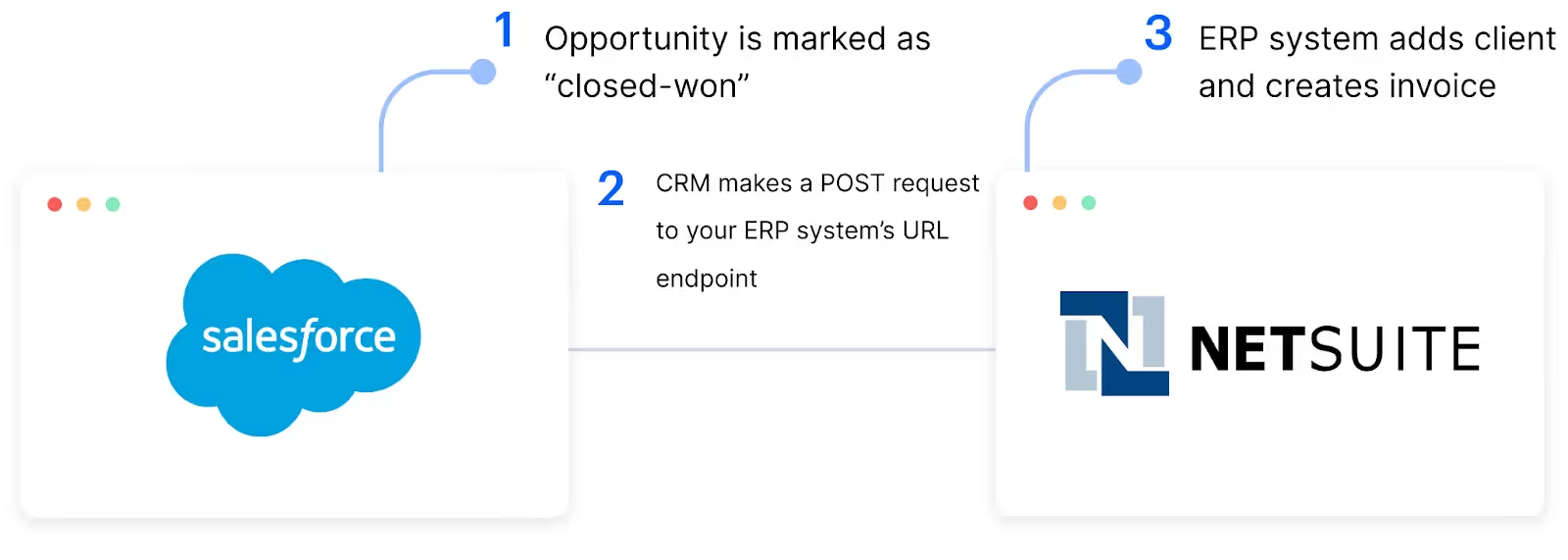
Say you want to add opportunities that close to your ERP system as soon as possible so that finance can create and send out invoices quickly.
To help facilitate this, you can register a URL endpoint in your CRM for when opportunities get marked as “closed-won.”
Any time this happens, the CRM makes a POST request to the registered endpoint, leading the ERP system to add the new client in real-time. The POST request can also include several details on the new client, allowing the ERP system to automatically create a fully-completed invoice on the finance team’s behalf.
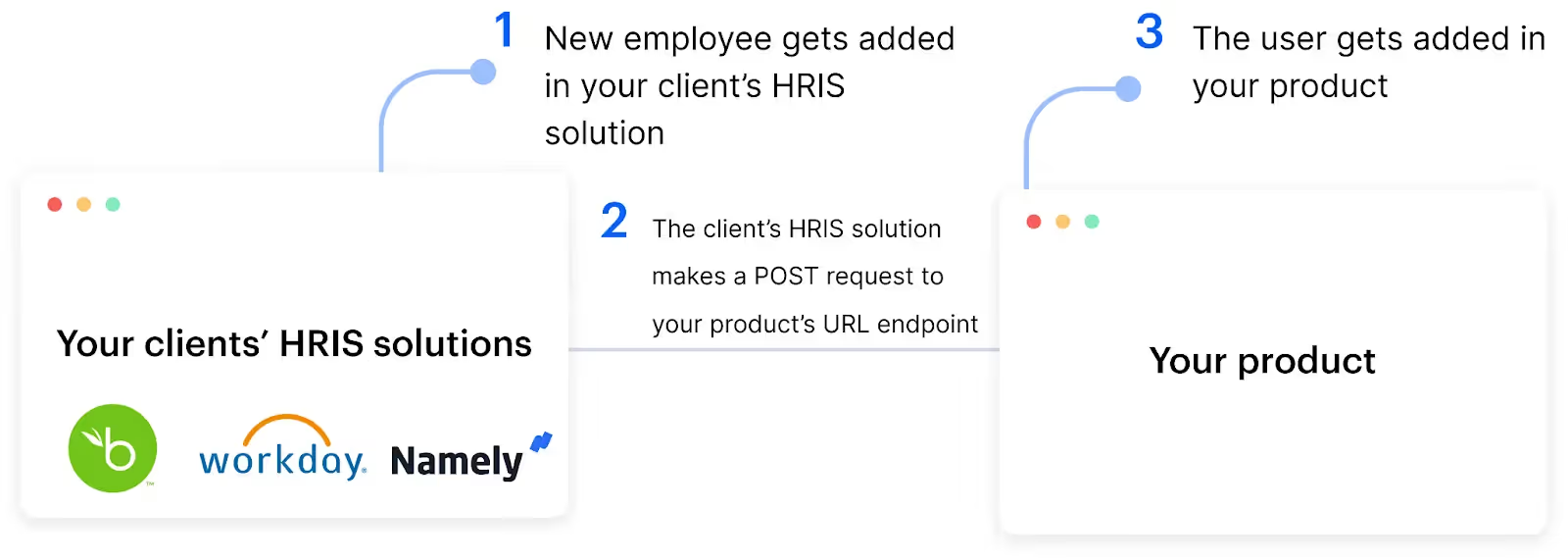
Imagine that you want to help clients add users to your product with little effort. Moreover, you want each user to be assigned the appropriate role based on their job level and department.
You can support this use case by registering webhooks in clients’ HRIS solutions that listen for new employees. Once an employee gets added to a client’s HRIS solution, the solution makes a POST request to your endpoint. Your product can then process the employee and their associated information, allowing you to add them as a user with the right level of permissions.
Here are some of the advantages of using webhooks:
Webhooks also come with disadvantages:
{{this-blog-only-cta}}
A REST (representational state transfer) API follows the constraints of the REST architectural style.
More specifically, REST APIs provide a standardized way for applications to request information from and send information to one another. This includes creating, reading, updating, or deleting a specific resource (i.e. a specific type of data or object) via HTTP methods.
While there are countless examples of API integrations to choose from, here are a few common use cases:
To help your sales reps uncover high-fit leads quickly and reach out to them while they’re still warm, you can integrate your CRM with your marketing automation platform. From there, you can set up a flow where every 5 minutes, your CRM makes a GET request to retrieve new high-fit leads in your marketing automation platform.
As your customer-facing employees manage prospect and client relationships, they’ll likely handle several types of documents, such as non-disclosure agreements, subscription agreements, service level agreements, etc.
To ensure these documents are stored securely and easy to access for the relevant stakeholders over time, you can integrate your CRM with your file storage solution and build the following flow: Once a document gets added for a given opportunity or client in your CRM, the document gets uploaded to the client’s or prospect's folder in your file storage application (a folder would first get created if it doesn’t already exist).
Here are some of the advantages of using REST APIs:
Here are some drawbacks to keep in mind:
So, given all the pros and cons of webhooks and REST APIs, which should you use? We’ll address this question head on in the following section.
Related: A guide to REST API integration
If you need to receive data or notifications in real-time, you should look to use webhooks. But if there isn’t a time-sensitive need for the data or notifications, or your integration requirements extend beyond POST requests, REST APIs are likely a better approach.
Merge, the leading unified API platform, lets you build to a single unified API to access a whole category of integrations—from CRM to HRIS to ATS to file storage—for your product.
Through the product integrations built in Merge, you can sync data in various frequencies, which include real-time (via webhooks) syncs, time-based (via API polling) syncs, or ad-doc syncs.
Learn more about Merge by scheduling a demo with one of our integration experts.
Merge lets you add hundreds of cross-category integrations to your product through our Unified API.







.png)