Introduction
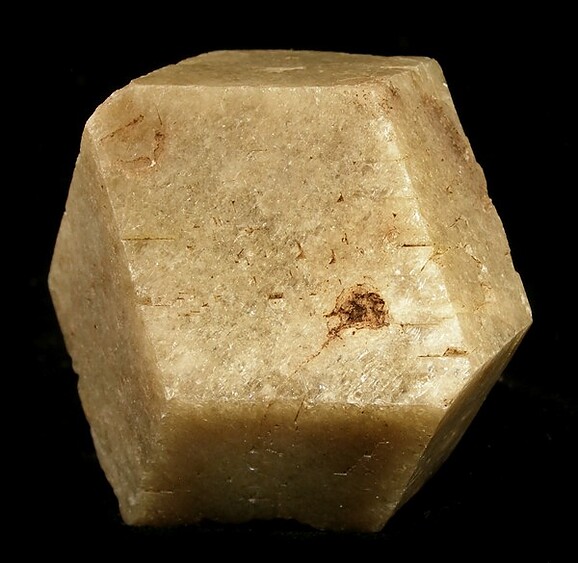
Grossular is one of the more common garnets, and beautifully crystallized specimens are can be found at many localities. It is registered from 1858 localities in Mindat (2021).
Grossular forms a continuous series towards andradite. Intermediate compositions, and both grossular dominant and andradite dominant garnets are common, even from the same localities. Some crystals are zoned, containing both grossular and andradite-rich layers. Because of the close relationship between these two minerals, specimens are often mislabeled. In many cases, specimens would benefit from being labelled grossular-andradite series (or grandite for short) rather than guessing on a specific mineral name.
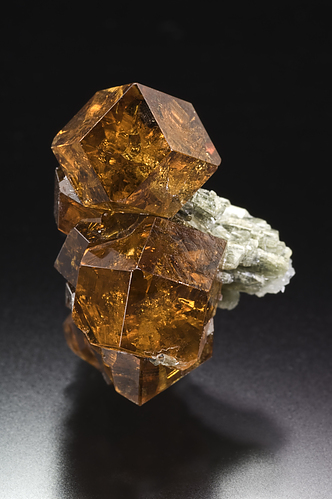
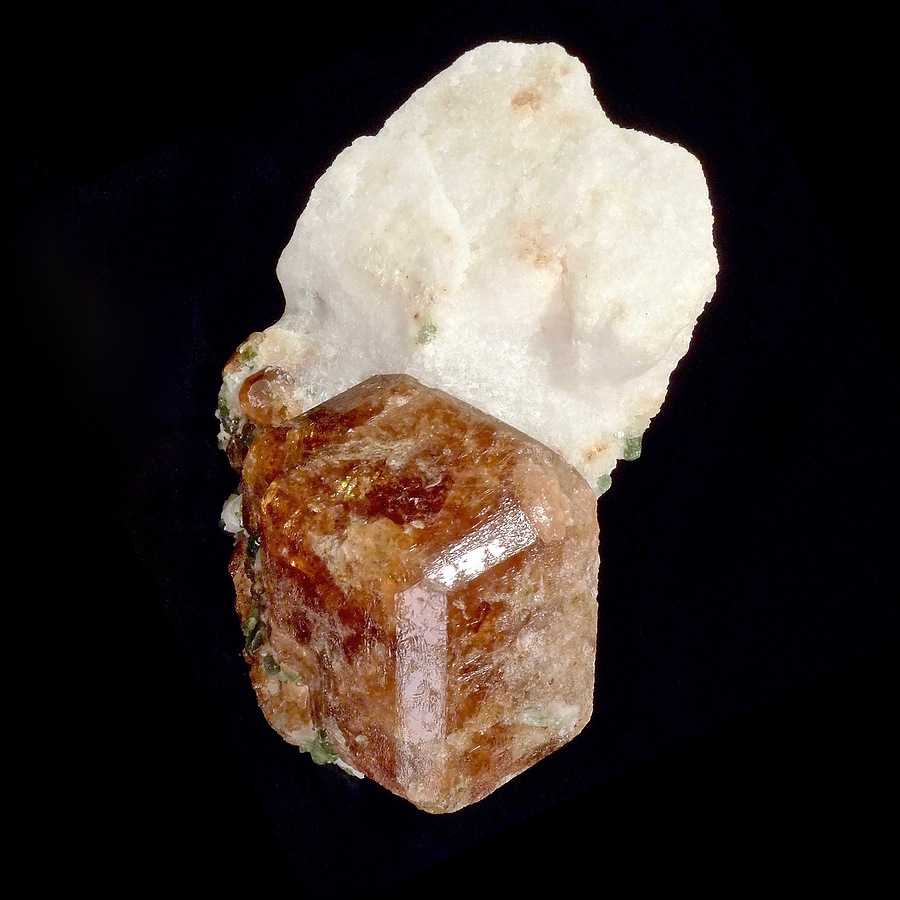
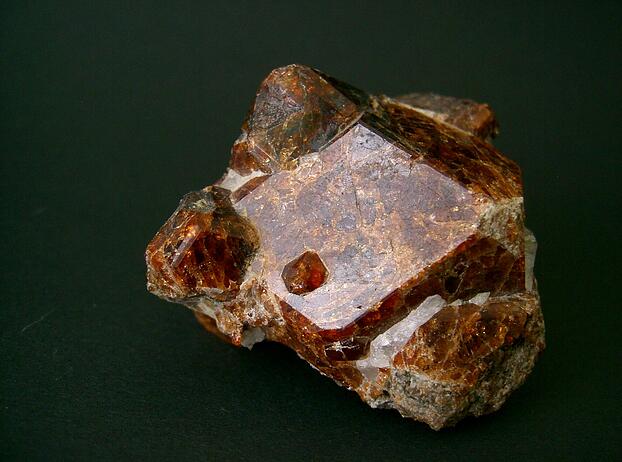
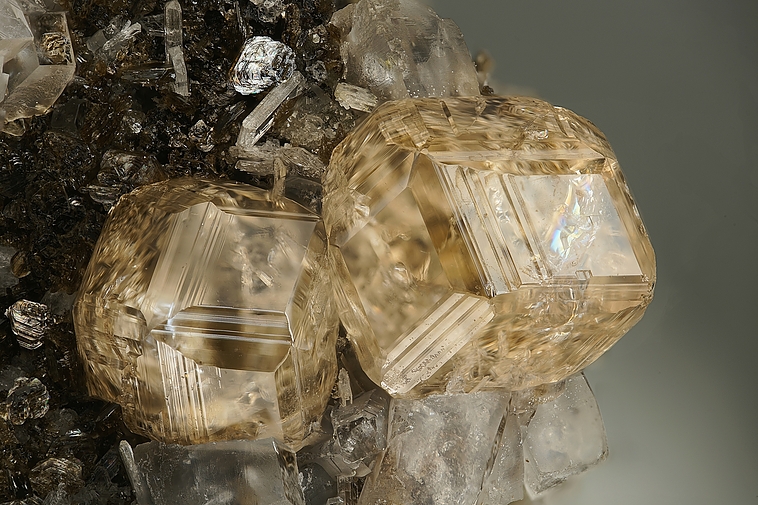
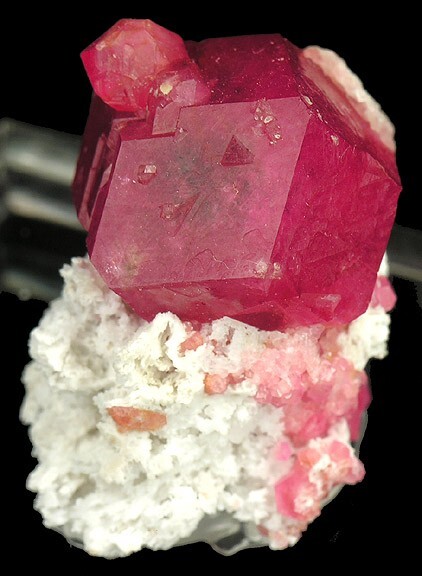
Grossular can come in a wide range of colors, and several are given their own varietal names. Hessonite is a cinnamon-colored variety, tsavorite is a deep green variety colored by vanadium. Topazolite and demantoid are yellowish to green varieties. The latter two varieties are most(?) often andradite, but compositions within the grossular stability field is not unheard of. Other colors include colorless, yellow, orange, brown, red, pink, and green.
Because grossular can be found in large well-formed crystals in attractive colors, it is a much sought-after mineral by collectors. The most attractive specimens with transparent, well-formed crystals with bright colors can commence high prices in the collector’s market. The most attractive specimens are the crystals from Jeffrey Mine, Quebec, Canada, the hessonites from Italy and the tsavorites from Kenya and Tanzania. Other localities can, as can be seen in this article, produce specimens that can rival those from the more famous localities listed above.
Afghanistan
Ladjuar Medam, Sar-e-Sang, Kuran wa Munjan District, Badakhshan, Afghanistan
Garnet-biotite-sillimanite schists and gneisses occur intimately intermixed with the marble layers at Sar-e-Sang. Garnets in the andradite-grossular series up to at least 2 cm can be found near the contact between these rocks. The crystals are dark greenish brown and are found embedded in white marble.
Austria
Exel (1993) describes magnificent specimens from the Ochsner-Rotkopf-Massif in Zillertal. Very nice grossulars were found on the Ochsenriegel on the Kärtner side of the Koralpe in the early 1990-ties.
Canada
Sabina (1986) describe grossular as one of the more prominent minerals from this locality. It occurs as pink to brownish orange and brown aggregates of crystals, or less commonly, as individual crystals. The crystals and aggregates are generally translucent grading to opaque as the size of the crystals increases.
Sabina (1992) lists 20 mines and quarries under the generic Thetford mines area. These were operated on asbestos and soapstone found in association with an altered peridotite. The Black Lake-Thetford asbestos deposits were discovered in 1876 and mining operations began shortly after the discovery.
Colorless to peach pink and pale yellow to olive green garnets are found together with other Ca-Mg silicates such as diopside and vesuvianite. The garnet crystals are generally not larger than 5 mm. This mineralization has been found in the contact between the peridotite and the surrounding rock.
Both Dunn (1978) and Defnet et al. (2021) provides analytical data showing 81,7 and 94,6 mol% grossular respectively from Thetford.
Colorful specimens of emerald-green, transparent to translucent garnet with cream-white to grey, yellow-green, or greyish green diopside and/or white calcite occurred plentiful at this mine.
The garnet occurs as aggregates of tiny crystals with individual crystals less than 3 mm across; these are not of gemstone quality. The grossular from here contains an appreciable Chromium content and has therefore, in the past, incorrectly been named uvarovite. Dunn (1978) provides analytical data that show more than 60 mol% grossular and up to 30 mol% uvarovite.
The Jeffrey mine in Asbestos, Québec, Canada, is a huge chrysotile mine which began operating in 1879 and closed in 2001. The mine itself is an open pit about 2 km in diameter and about 350 meters deep, exploiting a cylindrical orebody of asbestos. It is a world-famous locality for beautiful crystals of orange, pink and green grossular; violet vesuvianite crystals and well-terminated crystals of prehnite and pectolite. The calcium silicate minerals that have made the locality famous occur at the contact between peridotite and granitic rocks.
During the 1970’s and 1980’s, specimens from the Jeffrey mine were fairly abundant on the mineral market, and lustrous, gemmy orange grossular crystals were particularly popular. Since the mine’s closure, specimen colleting has been infrequent, and new material is scarce. The grossular from the Jeffrey mine show a wide variety of colors and crystal shapes. Some crystals are striated and show complex growth patterns. Both Akizuki (1989) and Badar et al. (2015) have studied these growth forms in detail. ‘
The color of the grossulars from the Jeffrey mine includes colorless, pink, green, orange, and brown, and individual crystals up to 4 cm are known.
The composition is variable, but well within the grossular compositional space. Badar et al. (2015) analyzed a orange-brown crystal finding a near end member composition of Grs97.4Alm1.2Sps1.2Prp0.1, whereas Dunn (1978) analyzed a green crystal with a grossular component of 92.13 and small (0.71 wt%) Cr
2O
3 content being responsible for the green color.
China
Data from Zhang Jinmin and Cao Zhengmin (1988) indicate that most of the garnets from this locality are andradite, rather than grossular.
Czech Republic
Grossular in the Vycpálek Quarry occurs in a skarn in the contact between a marble and a biotite-granite.
The most sought after garnets are euhedral crystals of brownish-red rhombic dodecahedra embedded in the marble. Many crystals contains abundant inclusions of calcite, which causes a honeycomb like appearance. Crystals up 5 to 8 cm is not unusual, and sizes exceeding 10 cm are known.
France
Attractive grossular (and some andradite) crystals were found when this chrysotile-asbestos mine was in operation from 1927 to 1965, and probably also for some time thereafter.
The grossular occurs in crystals from a few mm to three cm, the smaller crystals being transparent. The most common crystal forms are rhombic dodecahedra and tetragonotrioctahedral, or the combination of the two. Smaller, dark red to black and green crystals may also show trapezohedral crystal faces. These dark red to black crystals being andradites.
The grossular were found in clefts in rodingites and in gabbro bodies intertwined in a serpentine. Because of local chemical differences between the different clefts, the garnet composition, appearance, and color also differ. Abreal (2011) reports pale yellow to orange and pinkish as the most common colors, but also colorless, light to deep green and the before mentioned deep red to black garnet crystals have been found.
Italy
Geologically similar localities yielding attractive garnet specimens are scattered along the entire western Alpine arc in Northwestern Italy. The garnets are invariably found in association with serpentine bodies. There are three visually distinct types of garnets recorded from these localities, an orange to red to brown type (hessonite) that are generally considered grossular, yellow to yellowish green (topazolite/demantoid) and black (melanite) types that are generally considered andradite. Analytical data show that the color-based identification of the garnets in this environment are most often correct. The grossular crystals has been popular amongst mineral collectors since the 18th century.
Grossular typically occurs in rodingite lenses that are quite small, rarely more than 10 m
3, but there may be several of them exposed at each locality. Grossular is a dominant mineral in many of these rodingites and forms both monomineralic crusts, crystal groups and isolated crystals usually surrounded by chlorite. The individual crystals are not huge, typically ranging from a few mm and up to 2 cm, but the crystals are lustrous and show a wide variety of forms. The prevailing form is the rhombic dodecahedron, often in combination with icosahedral, cubic and octahedral forms, and more rarely in combination with other more complex forms. Distorted crystals are common, as is parallel growth and hopper growth of the crystals. Most interesting is perhaps the elongated up to 5 cm long distorted crystals.
In this text, photos from a handful of localities distributed in the Aosta Valley, and the regions of Piedmont and Liguria are included. These photos give an overview of the material that has been found and show that there are no systematic differences between the localities.
Aosta valley
Kenya
Except from a brief note in Cairncross (2019), very little information is available on these striking honey-colored crystals in blue calcite.
The deep green grossular variety tsavorite are closely linked with the Scorpion mine and the discoverer of the deposit and former owner of the mine, the Scottish geologist Campbell Bridges. The Scorpion mine deposit was in 1971, the first commercial mining operation for tsavorite. It was also from this locality the variety got its name. Mr. Bridges and gem company Tiffany’s agreed that a new varietal name was justified because of the color of the gem and because the deposit could provided a sustainable production over time.
In the Scorpion mine, Tsavorite occurs as irregular porphyroblasts in nodules randomly distributed in graphite-muscovite gneiss. The tsavorite porphyroblasts and only rarely show any crystal faces. Any tsavorite from here larger than 2-3 cm must be considered good.
Rossman and Aimes (1991) provide data showing that the grossular from here is of near endmember composition.
See also:
Tsavorite - the vanadian type
Mali
The grossular garnets from the Kayes region has been known since at least 1914, but it was not until 1994 they became commercially available for the mineral specimen and gem industries. At one point there were several thousand people digging for garnets, hoping that the greenish stones were emeralds and that they could secure the future for their families by selling the greenish stones.
The garnets occur abundantly in the contact between limestone and diabase veins/basalt intrusion in a large area (100km long), known as “the Zone of SangafeIt”. Garnets are found together with epidote, prehnite and other minerals. They are excavated both in situ and in nearby placers. The more rounded crystals coming from the placers. Some of the key localities are:
• Koukouri diggings, Arrondissement of Diakon (Diako),
• Sibinndi, Arrondissement of Diakon (Diako)
• Mendié Kossa, Arrondissement of Kontela,
• Sandaré, Arrondissement Sandaré,
There are several independent localities and diggings within each of these localities, and any attempt to pinpoint an exact locality for a specimen will normally be in vain.
The crystals are often well formed, typically with a dodecahedral habit, commonly also with some trapezohedral faces. Most crystals have regular shapes, but a few of them are distorted and or flattened.
The crystals can be large. Crystals of up to 20cm and 3.5kg, (Abreal, 2018) and 5.5 kg (Johnson et al ,1995) are reported. Their color is typically an olive greenish color, but also more yellow, green, and brown colors are common. Dark, almost black crystals are also known. The crystals are generally opaque with a dull luster and patchy appearance, but their core is often more transparent, and sometimes transparent patches can be seen on the surface of the crystals.
Johnsen et al. (1995) provide analytical data, showing that the majority of the garnets are grossular, with the odd andradite crystals thrown into the mix.
Mexico
Raspberry-red grossular garnet mineral specimens have been popular in the collector market since their discovery in 1994 in the Sierra de Cruces range in the State of Coahuila, Mexico (Lueth, V. W., & Jones, R., 2003). The garnets are found in the eastern part of the Sierra de Cruces Range.
The garnets are formed in skarns that have formed in the contact between an alkaline diorite dome and limestones with minor dolomite. The main minerals in addition to grossular are quartz, phlogopite, vesuvianite and calcite.
The grossular can be found as single crystals intergrown in the matrix, sometimes perched on top of it. The crystals are rarely significantly larger than 1 cm.
The raspberry garnet contains more than 90% of the grossular component and are the striking color is caused by a small Mn
3+ content
Pakistan
Gilgit is a trade center for mineral specimens and is used as a locality name for specimens found several places in Pakistan and possibly also Afghanistan.
Hussain (2005) describes brown grossular from several localities in Northern Pakistan. He found the best crystals near Dabar, Prang Ghar in the Mohmand Agency. He described the grossular honey-brown to brown crystal aggregates with the individual crystals up to maximum 12mm. The crystals occur in the contact between the host rock and calcite veins and pods.
Very little information on this locality has been found. The most specific description is from Kazmi and Quasim Jan (1997). They say that “beautiful honey yellow euhedral crystals of hessonite garnets are found in mineable quantities in quartz-mica schist”. Whether there is one or more localities, how large the crystals get and details on their composition has been difficult to find out.
Russia
Asbestos has been mined from the Bazhenovsk ophiolite complex since 1889, and a long list of minerals has been identified from here.
Grossular is a common mineral in rodingites, and Antonov (1997) describe transparent crystals up to 2 cm from cavities in rodingite veins. Abreal (2018) describe crystals up to 5cm, incorrectly naming them spessartine.
The type of occurrence and quality of garnets from this locality indicates that this locality has the potential to rival the more famous Jeffrey mine. Antonov (1997) describe both colorless, orange, yellow, brown and green grossular as well as darker colored andradites. The green chromium bearing grossulars are considered the rarest variety, only occurring together with magnetite and chlorite replacing magnesio-chromite. Erokhin (2006) describe small brown and greenish uvarovite crystals in chromite ores.
Vilyui is the type locality of grossular, first found by the explorer Eric Laxman early in the 19th century. The original locality is now at the bottom of a water reservoir established in the 1960-ties in conjunction with the construction of a hydro-electric plant. During the construction work, three new localities with a similar geology and mineralogy as the original locality were found.
Grossular is found in a skarn in the contact between a limestone and an intruding dolerite body. The grossular crystals is found both embedded in the limestone and in fissures in the skarn. The crystals can be up to 4 cm in diameter. Both grossular and andradite are known from these localities.
Taiwan
Beautiful grossular specimens was found in rodingites from this abandoned (since 1980) serpentinite quarry.
Tanzania
Tsavorite is found in the same geological environments and mining areas as tanzanite at this locality. It is believed that tanzanite can form from tsavorite by metasomism. Pardieu and Hughes (2008) has reported tsavorite porphyroblasts with a tanzanite rim.
The Merelani deposit is the source of the largest tsavorite porphyroblasts. Olivier (2008) reports grossular up to 10cm from Merelani. He points out the variable color in the grossular from here, ranging from very light to deep green. The porphyroblasts are often fractured, but crystals with well-defined faces are also known.
The Karo mine, in Merelani Block B, is known as possibly the only place where large, clean gemmy tsavorite are found. The color saturation is most often relatively poor here. The grossular is often mint colored and too light to be sold as tsavorite. When large stones are cut, the resulting color increases in saturation and the Karo mine has produced exceptional gems as large at 300 carats after cutting.
See also:
Tsavorite - the vanadian type
USA
The Consumnes copper mine has been worked only in brief periods (a few years at the time) from 1859 to 1955. Although the copper ore must have been meagre, Murdoch and Webb (1966) reports that large crystals of grossular have been found.
Several skarn-hosted scheelite ores have been worked in the Bishop mining district. Garnet is a dominant mineral in these skarns together with pyroxene and sometimes vesuvian.
The garnet is reddish brown and mostly massive. Euhedral (commonly dodecahedral) crystals are only found when the garnet is in direct contact with marble or quartz but can form very attractive specimens in this setting. In the marginal parts of the skarn, the garnet may be of a pinkish color.
Bateman et al. (1965) provide an overview of garnet compositions, mostly based on refractive index. He finds that the garnet compositions are variable with grossular and andradite as the dominant end members. He finds that the grossular component range from 90% to 28%, with most garnets having between 59 and 73% grossular end member. The garnets may also contain notable amounts of the spessartine and almandine components, with up to 2.9 wt% MnO recorded.
Grossular from the Pitts – Tenney Quarry is found in calc-silicate and skarn rocks. The best specimens were found in the 1950-ties and before.
Shaub (1957), quoted in Thompson et al. (1998), describe individual crystals up to 10 cm and clusters more than 30 cm across. Most of the crystals protrude from grossular seams in the host rock, and only some crystal faces are developed for the individual crystals. A small percentage of the crystals are complete; these are embedded in quartz.
Light green grossular crystals are not uncommon in the contact between rhyolite intrusions and sedimentary limestones. The crystals are rarely more than 2 cm in size.
The Belvidere Mountain quarries are considered as one of the finest grossular localities in the USA. Grossular and vesuvianite are found in rodingites in serpentinized ultramafic rocks.
The grossular are found as dodecahedral crystals up to 2 cm in diameter. Their color is normally reddish brown but green grossulars (sometimes incorrectly referred to as “uvarovites”) are also known.
The garnets are relatively pure grossulars.
Grossular together with hedenbergite, titanite, apatite, axinite and quartz are found in metamorphosed limestone lenses in a chert.
Sharp and lustrous, deep orange to orange-brown grossular form continuous crystal crusts in vugs. Also, specimens where grossular crystals sit on prismatic hedenbergite crystals are common. The grossular range in size from 0.75 to 2 cm in diameter. A single 3m long pocket hosted nodular aggregates of dark brownish orange crystals up to 2.5 cm. These crystals often showed well developed cube faces.
The most attractive specimens were found in quartz pockets, where quartz crystals up to 15cm were covered with orange to green grossular crystals.
References
Abreal, A.(2011). Les Grenats des Rodingites. J. of Pers. Mineralogist, 4, 119-207
Abreal, A.(2018). Les Grenats - Nature, Structure et Propriétés J. of Pers. Mineralogist, 11, 151-227
Akizuki, M. (1989). Growth structure and crystal symmetry of grossular garnets from the Jeffrey mine, Asbestos, Quebec, Canada. American Mineralogist, 74(7-8), 859-864.
Allen, F. M., & Buseck, P. R. (1988). XRD, FTIR, and TEM studies of optically anisotropic grossular garnets. American Mineralogist, 73(5-6), 568-584.
Amabili, M., Miglioli, A., & Spertini, F. (2004). Recent discoveries at the Jeffrey mine asbestos, Québec. Mineralogical Record, 35(2), 123.
Antonov, A.,A.(1997) Mineralogy and genesis of rodingites of the Bazhenovskoye chrysotile-asbestos deposit (abstract). Doctoral dissertation, Saint Petersburg State University.
Badar, M. A., Hussain, S., & Niaz, S. (2019). Optical anomaly in near-end-member grossular garnet from the Jeffrey mine, Asbestos, Quebec, Canada. International Journal of Economic and Environmental Geology, 1-7.
Bateman, P. C., Pakiser, L. C., & Kane, M. F. (1965). Geology and tungsten mineralization of the Bishop district, California, with a section on gravity study of Owens Valley and a section on seismic profile (No. 470). US Govt. Print. Off.
Cairncross, B. (2019). Minerals & Gemstones of East Africa - Burundi, Kenya, Rwanda, Tanzania and Uganda. Penguin Random House South Africa.144 p.
Cannon, B.(1994). The Skarns of Washington State Bart Cannon (1994). Pacific Northwest Chapter Friends of mineralogy. Bulletin, 8-9
Diella, V., Bocchio, R., Marinoni, N., Caucia, F., Spalla, M. I., Adamo, I., ... & Mancini, L. (2019). Garnets from Val d’Ala Rodingites, Piedmont, Italy: An Investigation of Their Gemological, Spectroscopic and Crystal Chemical Properties. Minerals, 9(12), 728.
Defnet, P. A., Wise, M. A., Harmon, R. S., Hark, R. R., & Hilferding, K. (2021). Analysis of Garnet by Laser-Induced Breakdown Spectroscopy—Two Practical Applications. Minerals, 11(7), 705.
Donati, E. (ed) (2017)- Granati. IVM Magazine, (2). 24 pages.
Erokhin, Y., V.(2006). Mineralogy of the Bazhenov ophiolite complex (abstract). Doctoral dissertation, Institute of Geology and Geochemistry of the Ural Branch of the Russian Academy of Sciences.
Exel, R. (1993). Die Mineralien und Erzlagerstätten Österreichs. Geschichte der mineralogischen Erforschung Österreichs, 179-387.
Feneyrol, J. (2012). Pétrologie, géochimie et genèse des gisements de tsavorite associés aux gneiss et roches calco-silicatées graphiteux de Lemshuku et Namalulu, Tanzanie Doctoral dissertation, Université de Lorraine.
Feneyrol, J., Giuliani, G., Ohnenstetter, D., Fallick, A. E., Martelat, J. E., Monié, P., ... & Saul, M. (2013). New aspects and perspectives on tsavorite deposits. Ore Geology Reviews, 53, 1-25.
Frank-Kamenetskaya, O. V., Rozhdestvenskaya, I. V., Shtukenberg, A. G., Bannova, I. I., & Skalkina, Y. A. (2007). Dissymmetrization of crystal structures of grossular-andradite garnets Ca 3 (Al, Fe) 2 (SiO 4) 3. Structural Chemistry, 18(4), 493-503.
Geiger, C. A., Stahl, A., & Rossman, G. R. (1999). Raspberry-red grossular from Sierra de Cruces Range, Coahuila, Mexico. European Journal of Mineralogy, 11(6), 1109-1113.
Hussain, S. S. (2005). Geology of the Indus Sutuite Zone and High Himalayan crystalline block west of Besham syntaxis and the study of some associated minerals. Doctoral dissertation, University of Punjab.
Johnson, M. L., Boehm, E., Krupp, H., Zang, J. W., & Kammerling, R. C. (1995). Gem-quality grossular-andradite: a new garnet from Mali. Gems Gemol, 31, 152-166.
Kazmi, A. H., & Jan, M. Q. (1997). Geology and tectonics of Pakistan. Graphic publishers. 554 p.
Lueth, V. W., & Jones, R. (2003). Red grossular from the Sierra de Cruces, Coahuila, Mexico. Mineralogical Record, 34(6), 73.
McAloon, B. P., & Hofmeister, A. M. (1995). Single-crystal IR spectroscopy of grossular-andradite garnets. American Mineralogist, 80(11-12), 1145-1156.
Moore, T. P., & Woodside, R. W. M. (2014). The Sar-e-Sang Lapis Mines, Kuran Wa Munjan district, Badakhshan Province, Afghanistan. The Mineralogical Record, 45, 280-336.
Murdoch, J., & Webb, R. W. (1966). Minerals of California: Centennial Volume, 1866-1966 (Vol. 189). California Division of Mines and Geology.
Panseri, M., Fontana, E., & Tartarotti, P. (2008). Evolution of rodingitic dykes: Metasomatism and metamorphism in the Mount Avic serpentinites (Alpine Ophiolites, southern Aosta Valley). Ofioliti, 33(2), 165-185.
Pavlushin, A., D. (2004) Features of crystal morphology and ontogeny of garnet from the Vilyui metasomatic rocks (abstract). Doctoral dissertation.
Pipino, G. (1981). Granatiti e rodingiti. Rivista Mineralogica Italiana, (4) 103-116
Rossman, G. R., & Aines, R. D. (1991). The hydrous components in garnets: Grossular-hydrogrossular. American Mineralogist, 76(7-8), 1153-1164.
Sabina, A. P. (1986). Rocks and minerals for the collector: Bancroft-Parry Sound area and southern Ontario. Geological Survey of Canada Miscellaneous Report 39
Sabina, A. P. (1992). Rocks and Minerals for the Collector: Estrie and Gaspésie, Quebec, and Parts of New Brunswick Geological Survey of Canada Miscellaneous Report 46
Sun, Z., & Renfro, N. D. (2017). Raspberry-red garnet with black core. Gems & Gemology, 53, (2)
Thompson, W.B., Joyner, D.L., Woodman, R.G., King, V.T. (1998).A Collector's Guide to Maine Mineral Localities By Woodrow B. Donald L. Joyner Raymond G. W 00dman Vandall T. King, BULLETIN 41, Third Edition, Maine Geological Survey, 114p.
Van Baalen, M. R., Francis, C. A., Mossman, B. T., & Wright, S. F. (1999, October). Mineralogy, petrology and health issues at the ultramafic complex, Belvidere Mt., Vermont, USA. In Guidebook to Field Trips in Vermont and adjacent regions of New Hampshire and New York. New England Intercollegiate Geological Conference, 91st Annual Meeting (pp. 95-111).
Wang, Y., Sun, Q., Duan, D., Bao, X., & Liu, X. (2019). The study of crystal structure on grossular–andradite solid solution. Minerals, 9(11), 691.
Zhang Jinmin and Cao Zhengmin (1988): Characters and growth conditions of garnets from Fushan iron deposit, Hebei Province. Contributions to Geology and Mineral Resources Research 3(2).
http://mineraux-de-corse.over-blog.com/article-27344455.html, accessed Juli 2021
https://pruvodce.geol.morava.sci.muni.cz/Vapenna/Vapenna-text.htm
https://www.crystalclassics.co.uk/news/248/the-jeffrey-mine-asbestos-canada/, accessed Nov 2020.
https://www.mineraly-prodej.cz/clanek/vycpalkuv-lom-u-vapenne-klasicka-lokalita-granatu.html
Version History
RevisionHistory |
| Revision no | date | description | editor |
|---|
| 1.0 | 2021 | First Published | Olav Revheim |
|
Last photo reviewed: 1101944