|
VOOZH | about |
|
VOOZH | about |
Archera built something genuinely different: an insurance product for cloud commitments. You buy a Reserved Instance or Savings Plan, Archera wraps it in a policy that lets you walk away after 30 days or a year, and you pay a monthly premium for that flexibility. It’s clever. But as AI adoption accelerates how quickly infrastructure evolves, commitments are getting out of sync faster — and a lot of organizations are realizing that insuring commitments is a workaround rather than a solution to their cloud bill problem.
This guide covers the Archera alternatives worth evaluating in 2026 — what each does well, where each falls short, and how to pick the right one based on your infrastructure.
Archera (originally Reserved.ai, founded 2019) is a cloud commitment management platform centered on an insurance model. Here’s the mechanics: Archera purchases long-term RIs or Savings Plans, then offers them to you as “Guaranteed Reserved Instances” (GRIs) with flexible exit terms. You pick a 30-day minimum or 1-year minimum commitment, pay the discounted rate plus an insurance premium, and if you need to bail early, Archera eats the remaining obligation.
The puts it plainly: “Customers pay a fixed monthly premium per commitment when they choose to use Archera to guarantee a SP or RI against underutilization and reduce its term to 30 days or one year.” Premiums are value-based — you only pay when Archera generates net savings on your AWS bill.
Per , the free tier includes commitment recommendations and basic reporting features. Insurance kicks in when you opt for GRIs, and Advanced Reporting is a separate flat-rate service. The platform supports AWS, Azure, and Google Cloud for forecasting, though its insurance product is strongest on AWS.
There’s also scenario modeling to quantify underutilization risk before you commit, and budget-aligned reporting for finance teams. For organizations where commitment risk is the primary blocker, Archera makes that risk more manageable—at a cost.
Cloud environments today are fragmented across accounts, services, and increasingly AI-driven workloads. Usage shifts constantly, but the data needed to understand those shifts is scattered and hard to interpret.
Archera’s reporting covers commitment performance — utilization trends, financial exposure, budget tracking. What it doesn’t do is allocate costs by Kubernetes namespace, tag resources automatically, or show you which engineering team is burning through your compute budget. If your organization needs to answer “who spent what and where,” you’ll need more than commitment analytics.
Without that visibility, you can’t identify what to fix, measure impact, or operate FinOps as an ongoing process — which means you’ll need another tool to do it.
Archera supports multiple clouds for forecasting and analysis. But the core product — insured commitments — has been primarily an AWS story. Teams with meaningful Azure or GCP spend need optimization that goes native on each provider’s pricing instruments.
That gap extends beyond compute. Modern spending on the cloud increasingly comes from AI services, managed databases, and security tooling — each with its own pricing models and optimization levers. Without native support across these services, optimization remains incomplete.
Archera’s pricing model is built around insuring commitment risk — you pay a premium to protect against underutilization. That makes it easier to move forward with commitments, but the underlying problem doesn’t change.
The conditions that create that risk — shifting usage, inefficient resources, and constantly evolving workloads — are still there. Instead of reducing that risk over time, you’re paying to absorb it.
That distinction matters. Without a system that continuously adjusts to real usage and optimizes your environment, commitment risk doesn’t go away — it just becomes something you budget for.
Can the platform automate RI/SP purchasing to maximize your effective savings rate and minimize your commitment lock-in risk? Does it handle the full lifecycle — buy, monitor, exchange, retire?
Does it execute optimizations or just recommend them? Recommendations without execution create engineering toil.
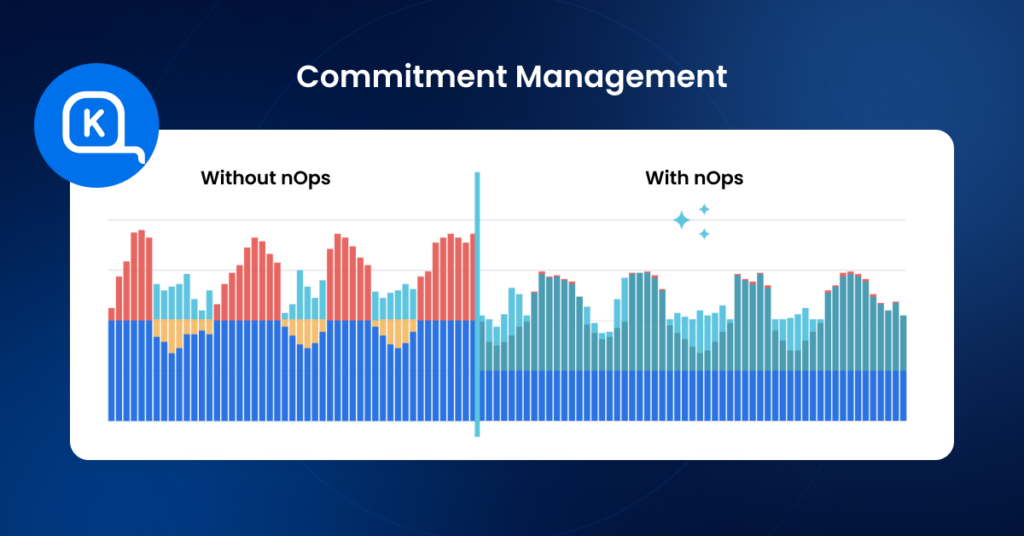
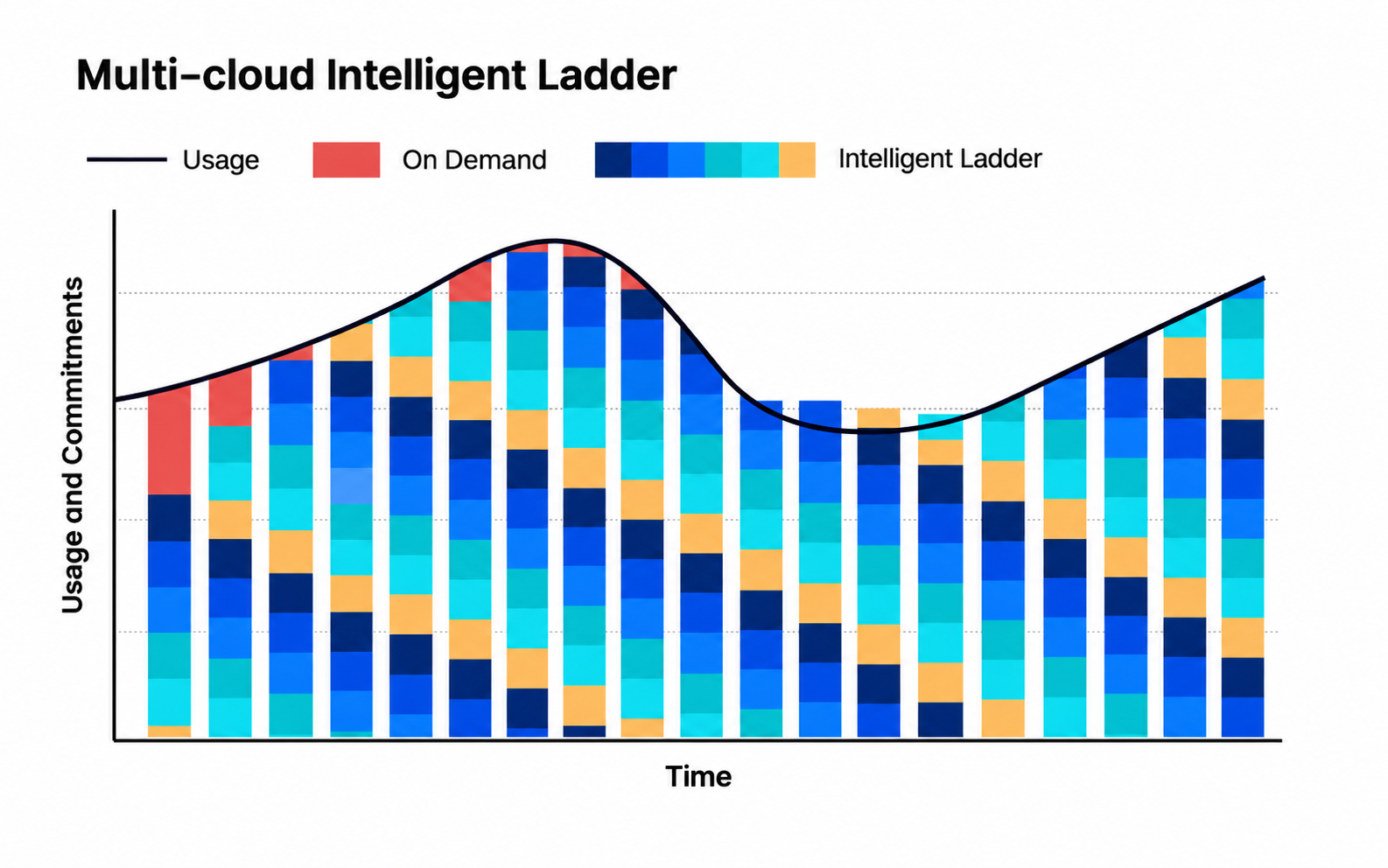
is a multicloud optimization platform that integrates commitment management with multi-cloud visibility and allocation. Where Archera insures commitment risk after the fact, nOps automatically reduces it by laddering commitments in small, hourly increments. The only cost is the portion of additional savings we generate — no premiums, no claims process.
Key Capabilities: Autonomous commitment management that continually adjusts AWS, Azure, Google Cloud and AI portfolios across compute and non-compute. Extensive cost visibility with hourly granularity for multicloud, SaaS, AI and Kubernetes. FinOps AI agent to answer cloud questions for technical and non technical users.
Ideal For: Teams that need comprehensive visibility and savings, not just commitment risk mitigation.
Pros:
Cons:
Pricing: Performance-based — percentage of savings generated. You can get a to find out if you’re perfectly optimized or if there’s still more you can save.
automates commitment management across AWS, Azure, and Google Cloud. Their ML-driven engine continuously adjusts RI and SP portfolios. Founded 2018.
Key Capabilities:
Ideal For: Multi-cloud teams that need automated commitment management without broader FinOps.
Pros:
Cons:
Pricing: Savings-share — percentage of commitment savings generated.
translates cloud spend into business metrics — cost per customer, cost per feature, COGS. The platform focuses on cost intelligence rather than holistic cost optimization. Achieved in January 2026.
Key Capabilities:
Ideal For: SaaS companies that need unit economics rather than automation.
Pros:
Cons:
Pricing: Cloud-spend based — per $1,000 of monthly spend, with custom enterprise tiers.
Apptio Cloudability, now under IBM, is an enterprise cloud financial management platform. Recognized in the . Kubernetes capabilities got a boost from IBM’s Kubecost acquisition.
Key Capabilities:
Ideal For: Large enterprises needing finance-grade reporting and governance across multi-cloud.
Pros:
Cons:
Pricing: Enterprise contract based on spend under management and feature modules.
is a cloud management module within the Harness software delivery platform. The standout feature is AutoStopping — it automatically detects, shuts down, and restarts idle cloud resources.
Key Capabilities:
Ideal For: DevOps teams already on Harness that want integrated cost management, especially for dev/test waste.
Pros:
Cons:
Pricing: Tiered subscription based on spend. Free tier available.
Spot by NetApp (formerly Spotinst) focuses on workload automation using Spot instances, with an Eco module for commitment management and Ocean for Kubernetes infrastructure.
Key Capabilities:
Ideal For: Teams running heavy Spot workloads that need capacity management and failover.
Pros:
Cons:
Pricing: Based on managed compute hours and spend.
Zesty automates resource management for AWS, with a particular strength in EBS/disk optimization that dynamically resizes volumes based on actual usage.
Key Capabilities:
Ideal For: AWS teams wanting hands-off storage and compute automation.
Pros:
Cons:
Pricing: Performance-based, tied to savings generated.
Kubex uses machine learning to analyze workload patterns and deliver rightsizing recommendations across AWS, Azure, GCP, and Kubernetes. Also supports on-prem/hybrid environments.
Key Capabilities:
Ideal For: Enterprises with hybrid infrastructure needing ML-driven rightsizing with governance guardrails.
Pros:
Cons:
Pricing: Enterprise subscription based on managed workloads.
| Platform | Commitment Optimization | Automation | Multi-Cloud | Cost Visibility | Governance |
|---|---|---|---|---|---|
| nOps | ✅ Full lifecycle, 100% guarantee | ✅ Rightsizing, Spot, scheduling, storage | ✅ AWS, Azure, GCP | ✅ Full allocation + K8s | ✅ Budgets, alerts, tagging |
| ProsperOps | ✅ Automated RI/SP, 99% guarantee | ⚠️ Commitments only | ✅ AWS, Azure, GCP | ⚠️ Commitment reports | ❌ Limited |
| CloudZero | ❌ None | ❌ Visibility only | ✅ AWS, Azure, GCP | ✅ Strong unit economics | ⚠️ Anomaly alerts |
| Cloudability | ⚠️ Recommendations | ⚠️ Mostly recommendations | ✅ AWS, Azure, GCP | ✅ Enterprise-grade | ✅ Full governance |
| Harness CCM | ⚠️ Recommendations | ✅ AutoStopping | ✅ AWS, Azure, GCP | ✅ Good + K8s | ⚠️ Budgets |
| Spot by NetApp | ⚠️ Eco module | ✅ Spot + Ocean K8s | ✅ AWS, Azure, GCP | ⚠️ Functional | ❌ Limited |
| Zesty | ✅ Automated RI/SP | ✅ EBS + compute | ❌ AWS primary | ⚠️ Basic | ❌ Limited |
| Densify/Kubex | ❌ None | ⚠️ Recommendations | ✅ Multi-cloud + on-prem | ⚠️ Rightsizing focus | ✅ ITSM integration |
| Archera | ✅ Insurance-based | ⚠️ Commitments only | ⚠️ AWS primary | ⚠️ Commitment reports | ⚠️ Budget tracking |
The core difference is structural. Archera insures commitment risk — you pay a premium, and if utilization drops, they cover it. That premium reduces your net savings on every commitment, and the protection only covers underutilization of the commitments themselves.
A different approach is to fix the problem rather than pay to treat the symptoms. nOps helps you:
• Eliminate commitment risk: nOps shortens commitment windows from years to a fraction of the time, leveraging advanced strategies like dynamic seeding, laddering, and squishing.
• Maximize savings on autopilot: nOps continuously adjusts commitments every hour to match real usage, helping customers capture incremental savings that slower optimization approaches can miss. Savings are often 20% higher than competitors — customers have described switching to nOps as “picking $20 bills off the ground”.
• Savings-first pricing model: You don’t pay us until we’ve delivered measurable cost savings. No upfront platform fees, no percentage-of-spend charges, no premiums.
nOps offers a free savings assessment, so you can see exactly how much you can save while eliminating commitment risk.
nOps was recently ranked #1 in G2’s Cloud Cost Management category and manages $4 billion in multicloud spending.
Last Updated: June 7, 2026, Commitment Management
Last Updated: June 7, 2026, Commitment Management
AI-powered rate optimization with risk-free guarantee
AI-powered commitment management with risk-free guarantee