|
VOOZH | about |
|
VOOZH | about |
As cloud spending quickly becomes one of the most expensive resources in organizations around the world, C-suite leaders are steadily prioritizing tools and strategies for optimizing, reducing, and centralizing cloud cost management.
In fact, according to a survey, 88% of organizations state that optimizing and reducing spend on their cloud resources is very important. 50% of IT executives struggle to get cloud costs under control.
And that isn’t news. Cloud cost management is undeniably complicated with all the different resources, storage, and SKUs. Cloud spend can seem like a complex mass of charges you can never make sense of.
That is why the first step toward cloud cost management is visibility. With cloud cost visibility, you can make sense of your cloud spend and usage and, in turn, optimize cloud costs.
In this article, we dig deep into the details of cloud cost visibility and how to achieve it.
Cloud cost visibility is the process of analyzing the different costs associated with cloud services, including costs of applications, resources, and infrastructure. The goal is to use cloud spending data to gain insight into how you use cloud resources and how much those resources are costing you.
Though it’s important to remember that cloud cost visibility isn’t just about making information available. It’s about how easy it is to access and extract insights from that information. The more organized data is, the easier it will become to achieve visibility.
Almost 53% of organizations already invested in FinOps still believe they don’t have enough visibility into cloud costs.
With volatile market situations, there is increased pressure on businesses to cut costs by reducing cloud costs and decreasing waste. But at the same time, businesses are also finding it difficult to get visibility into cloud costs which are, in turn, making it challenging to cut down on costs.
There are numerous challenges to cloud visibility, including:
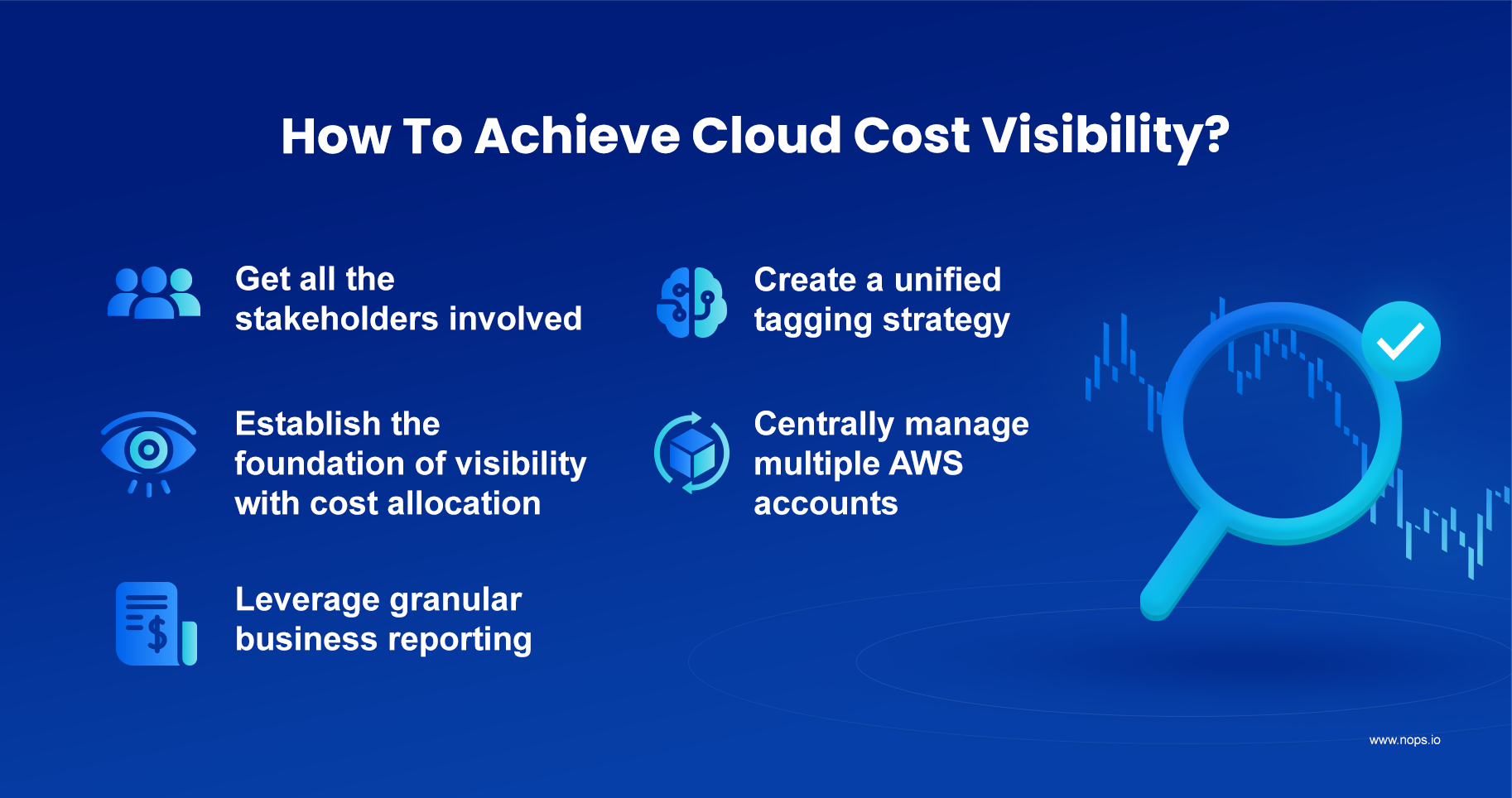
Achieving cloud visibility requires a comprehensive understanding of your cloud infrastructure, applications, and data. Here are some steps to help you achieve cloud visibility:
Getting all the stakeholders on board is the step towards gaining complete visibility into your organization’s overall cloud costs. You can start by assembling financial operations or FinOps team with stakeholders from development, operations, engineering, and finance.
The idea is to make everyone involved understand the connection between cloud infrastructure, AWS infrastructure costs, and business goals.
You should ensure that your FinOps team follows a structure that reflects how your business operates.
Cost allocation is crucial for establishing the foundation of cloud cost visibility. Cost allocation tags provide a structure for you to categorize the AWS infrastructure.
Tags in AWS are metadata labels assigned to cloud resources, usually with a key and a value. While tags have no semantic purpose, they help identify the purpose and owner of every resource.
The more granularity you have, the more information you will have available and the more cloud-cost visibility you can achieve.
Granular reporting can identify which resources are taking up the most significant chunk of your cloud usage and thus costing you more money. You can also monitor the usage of Reserved Instances and identify the ones you are underutilizing. Most importantly, it can help you analyze cost trends over time and detect any abnormal spikes in cloud usage before it causes any significant issues.
Just tagging resources isn’t going to help you achieve visibility into your cloud costs. You need to create a strategy around how to tag resources. It’s important to remember that tags are only meaningful to you, so you need to create a tagging strategy that mirrors your internal structure and reporting system.
When executed in the right manner, a unified tagging strategy can give you high tag coverage and also create a culture of visibility where all the resources are tagged correctly, and there is complete allocation of costs.
Note that tags start to track data as soon as they are applied and activated. They are not applied retroactively. That means you need to plan your tagging strategy in advance in order to achieve comprehensive reporting.
As your organization grows and your cloud resources grow with it, you will have to find a way to manage multiple AWS accounts through a centralized dashboard. After all, it is not possible to manually manage every AWS account from a different dashboard and still find a way to unify their cloud costs to achieve visibility.
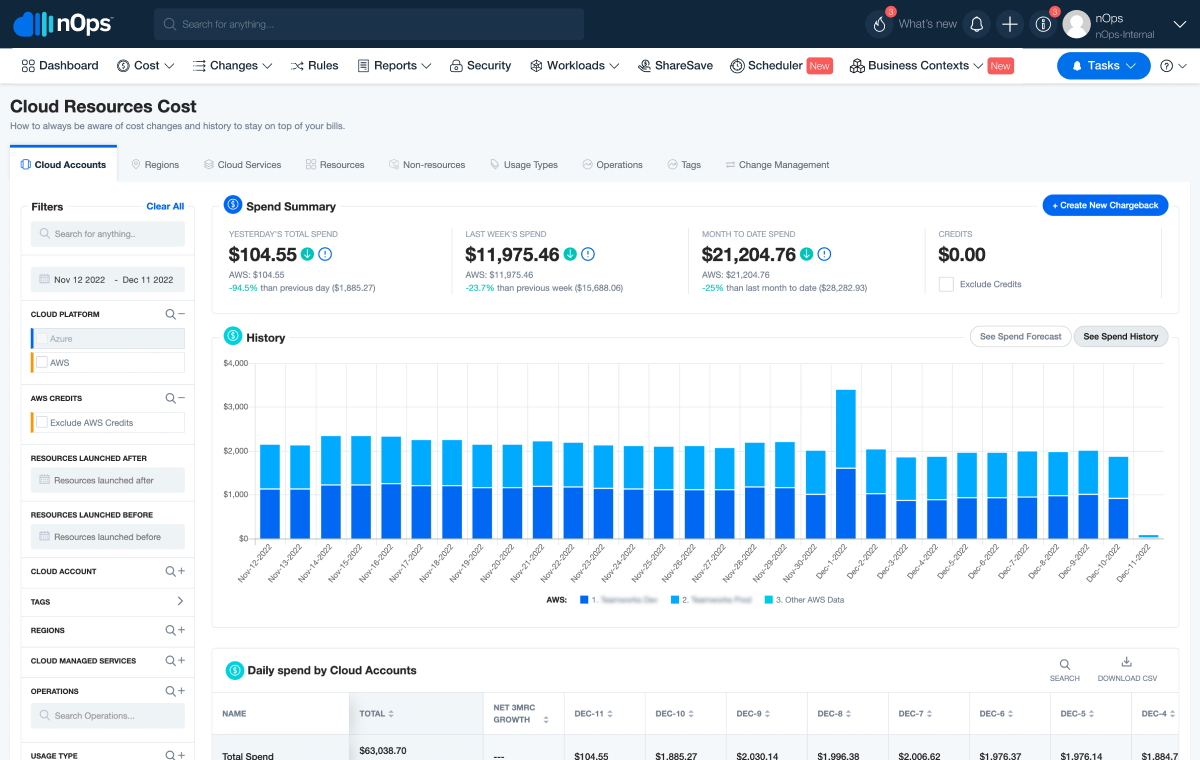
A fully automated AWS cloud management platform, nOps gives you access to a centralized dashboard for managing the entire AWS infrastructure, which can, in turn, significantly improve cloud visibility.
You can monitor all AWS resources, ensure resources are correctly tagged, generate granular reports, and even identify idle resources – all through a single dashboard.
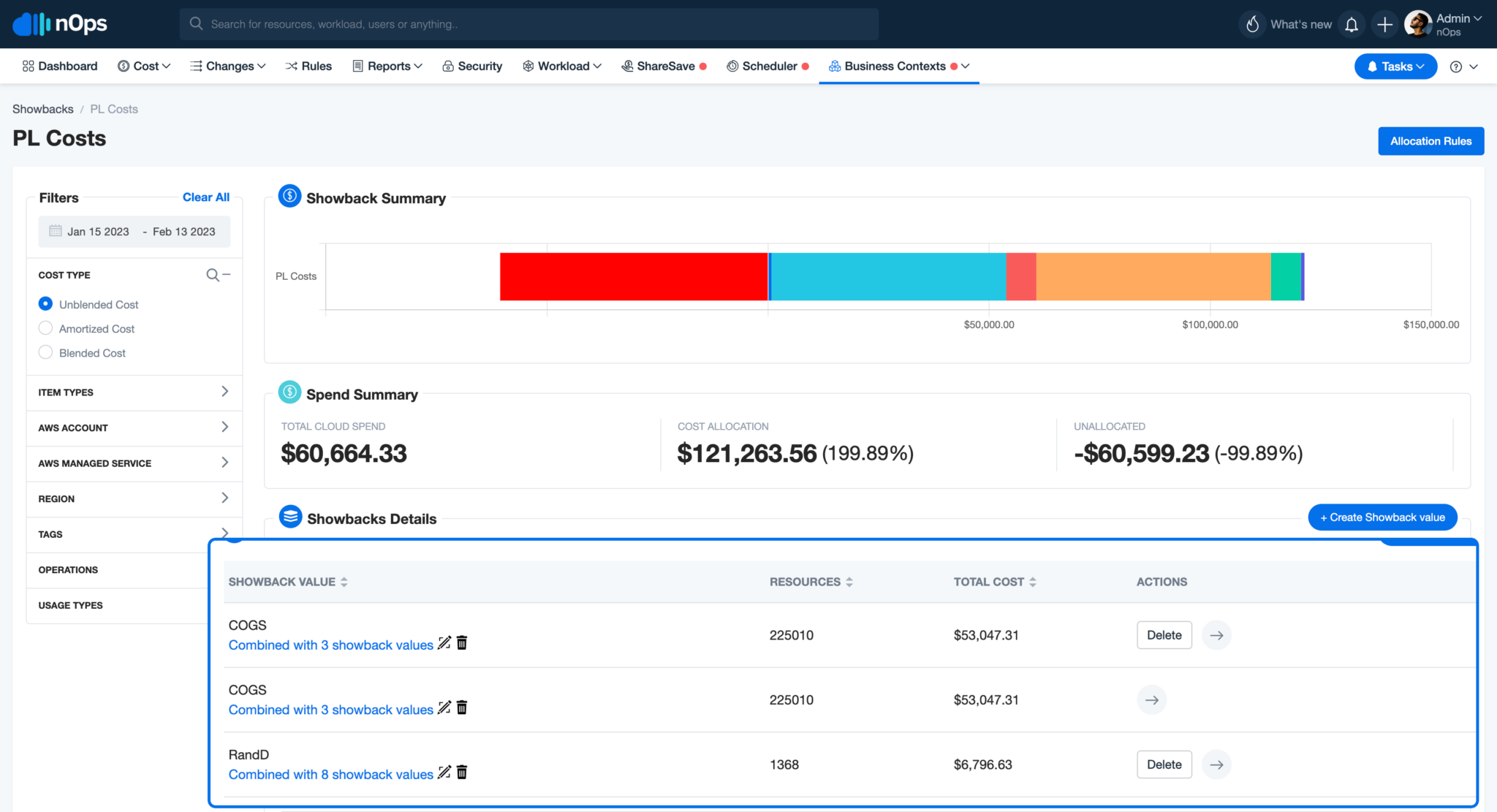
Through its Business Contexts feature, nOps can streamline the tagging strategy and even identify untagged or inaccurately tagged resources. You can access past billing data in a visual and interactive environment instead of manually checking AWS cloud bills with thousands of rows of data.
By incorporating nOps as part of your cloud cost visibility strategy, you can:
Let’s save up on cloud costs! Sign up for nOps today.
Last Updated: May 2, 2024, Cost Allocation & Reporting
Last Updated: May 2, 2024, Cost Allocation & Reporting