







1NHA | pdb_00001nha
Solution Structure of the Carboxyl-Terminal Domain of RAP74 and NMR Characterization of the FCP-Binding Sites of RAP74 and CTD of RAP74, the subunit of Human TFIIF
- PDB DOI: https://doi.org/10.2210/pdb1NHA/pdb
- BMRB: 5685
- Classification: TRANSCRIPTION
- Organism(s): Homo sapiens
- Expression System: Escherichia coli BL21(DE3)
- Mutation(s): No
- Deposited: 2002-12-19 Released: 2003-02-25
- Deposition Author(s): Nguyen, B.D., Chen, H.T., Kobor, M.S., Greenblatt, J., Legault, P., Omichinski, J.G.
Experimental Data Snapshot
- Method: SOLUTION NMR
- Conformers Calculated: 67
- Conformers Submitted: 20
- Selection Criteria: structures with acceptable covalent geometry,structures with the least restraint violations,structures with the lowest energy
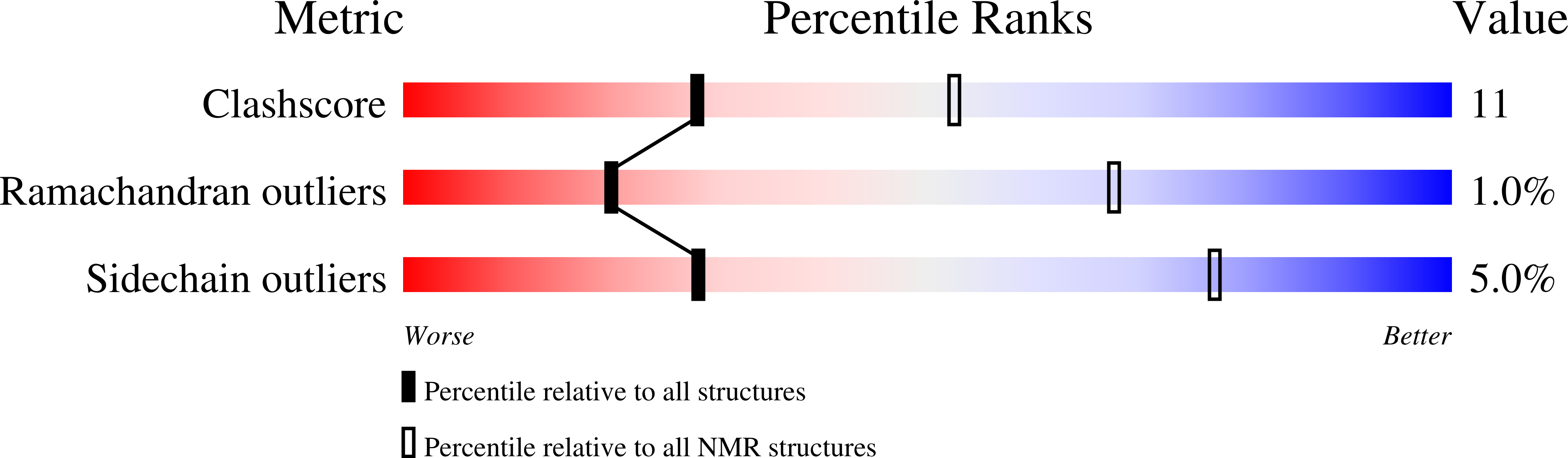
wwPDB Validation 3D Report Full Report
- 👁 Image
Download Mendeley

Solution Structure of the Carboxyl-Terminal Domain of RAP74 and NMR Characterization of the FCP1-Binding Sites of RAP74 and Human TFIIB.
Nguyen, B.D., Chen, H.T., Kobor, M.S., Greenblatt, J., Legault, P., Omichinski, J.G.(2003) Biochemistry 42: 1460-1469
- PubMed: 12578358 Search on PubMed
- DOI: https://doi.org/10.1021/bi0265473
- Primary Citation Related Structures:
1NHA - PubMed Abstract:
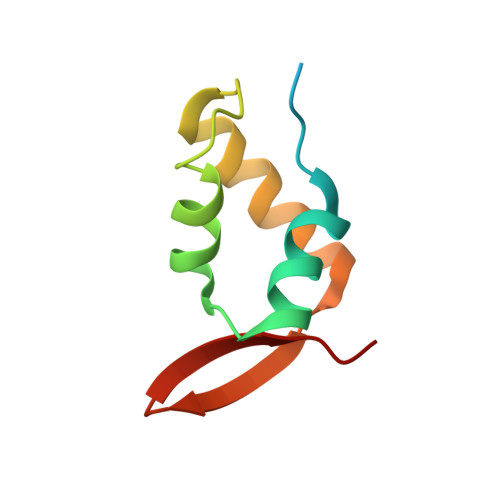
FCP1 (TFIIF-associated CTD phosphatase) is the only known phosphatase specific for the phosphorylated CTD of RNAP II. The phosphatase activity of FCP1 is strongly enhanced by the carboxyl-terminal domain of RAP74 (cterRAP74, residues 436-517), and this stimulatory effect of TFIIF can be blocked by TFIIB. It has been shown that cterRAP74 and the core domain of hTFIIB (TFIIBc, residues 112-316) directly interact with the carboxyl-terminal domain of hFCP1 (cterFCP, residues 879-961), and these interactions may be responsible for the regulatory activities of TFIIF and TFIIB on FCP1. We have determined the NMR solution structure of human cterRAP74, and we have used NMR methods to map the cterFCP-binding sites for both cterRAP74 and human TFIIB. We show that cterFCP binds to a groove of cterRAP74 between alpha-helices H2 and H3, without affecting the secondary structure of cterRAP74. We also show that cterFCP binds to a groove of TFIIBc between alpha-helices D1 and E1 in the first cyclin repeat. We find that the cterFCP-binding site of TFIIBc is very similar to the binding site for the HSV transcriptional activator protein VP16 on the first cyclin repeat of TFIIBc. The cterFCP-binding sites of both RAP74 and TFIIBc form shallow grooves on the protein surface, and they are both rich in hydrophobic and positively charged amino acid residues. These results provide new information about the recognition of acidic-rich activation domains involved in transcriptional regulation, and provide insights into how TFIIF and TFIIB regulate the FCP1 phosphatase activity in vivo.
- Department of Biochemistry and Molecular Biology, University of Georgia, Athens, Georgia 30602, USA.
Organizational Affiliation:
Explore in 3D: Structure | Sequence Annotations | Validation Report
Global Symmetry: Asymmetric - C1
Global Stoichiometry: Monomer - A1
Find Similar Assemblies
Biological assembly 1 assigned by authors.
Macromolecule Content
- Total Structure Weight: 9.34 kDa
- Atom Count: 552
- Modeled Residue Count: 67
- Deposited Residue Count: 82
- Unique protein chains: 1
Entity ID: 1 | |||||
|---|---|---|---|---|---|
| Molecule | Chains | Sequence Length | Organism | Details | Image |
| Transcription initiation factor IIF, alpha subunit | 82 | Homo sapiens | Mutation(s): 0 Gene Names: RAP74 | 👁 Image | |
UniProt & NIH Common Fund Data Resources | |||||
Find proteins for P35269 (Homo sapiens) Explore P35269 Go to UniProtKB: P35269 | |||||
GTEx: ENSG00000125651 | |||||
Entity Groups | |||||
| Sequence Clusters | 30% Identity50% Identity70% Identity90% Identity95% Identity100% Identity | ||||
| UniProt Group | P35269 | ||||
Sequence AnnotationsExpand | |||||
| |||||

Experimental Data
- Method: SOLUTION NMR
- Conformers Calculated: 67
- Conformers Submitted: 20
- Selection Criteria: structures with acceptable covalent geometry,structures with the least restraint violations,structures with the lowest energy
Deposition Data
- Released Date: 2003-02-25 Deposition Author(s): Nguyen, B.D., Chen, H.T., Kobor, M.S., Greenblatt, J., Legault, P., Omichinski, J.G.
Revision History (Full details and data files)
- Version 1.0: 2003-02-25
Type: Initial release - Version 1.1: 2008-04-29
Changes: Version format compliance - Version 1.2: 2011-07-13
Changes: Version format compliance - Version 1.3: 2022-02-23
Changes: Database references, Derived calculations - Version 1.4: 2024-05-22
Changes: Data collection







