







- FASTA Sequence
- PDBx/mmCIF Format
- PDBx/mmCIF Format (gz)
- BinaryCIF Format (gz)
- Legacy PDB Format
- Legacy PDB Format (gz)
- PDBML/XML Format (gz)
- Validation Full (PDF - gz)
- Validation (XML - gz)
- Validation (CIF - gz)
- Biological Assembly 1 (CIF - gz)
- Biological Assembly 2 (CIF - gz)
- Biological Assembly 1 (PDB - gz)
- Biological Assembly 2 (PDB - gz)
1NLJ | pdb_00001nlj
CRYSTAL STRUCTURE OF THE CYSTEINE PROTEASE HUMAN CATHEPSIN K IN COMPLEX WITH A COVALENT AZEPANONE INHIBITOR
- PDB DOI: https://doi.org/10.2210/pdb1NLJ/pdb
- Classification: HYDROLASE
- Organism(s): Homo sapiens
- Expression System: Spodoptera frugiperda
- Mutation(s): No
- Deposited: 2003-01-07 Released: 2003-01-14
- Deposition Author(s): Smith, W.W., Janson, C.A., Zhao, B.
Experimental Data Snapshot
- Method: X-RAY DIFFRACTION
- Resolution: 2.40 Å
- R-Value Free: 0.295 (Depositor)
- R-Value Work: 0.263 (Depositor)
- R-Value Observed: 0.263 (Depositor)
Starting Model: experimental
View more details
wwPDB Validation3D Report Full Report

Literature
- 👁 Image
Download Mendeley

Azepanone-Based Inhibitors of Human and Rat Cathepsin K
Marquis, R.W., Ru, Y., LoCastro, S.M., Zeng, J., Yamashita, D.S., Oh, H.J., Erhard, K.F., Davis, L.D., Tomaszek, T.A., Tew, D., Salyers, K., Proksch, J., Ward, K., Smith, B., Levy, M., Cummings, M.D., Haltiwanger, R.C., Trescher, G., Wang, B., Hemling, M.E., Quinn, C.J., Cheng, H.-Y., Lin, F., Smith, W.W., Janson, C.A., Zhao, B., McQueney, M.S., D'Alessio, K., Lee, C.P., Marzulli, A., Dodds, R.A., Blake, S., Hwang, S.M., James, I.E., Gress, C.J., Bradley, B.R., Lark, M.W., Gowen, M., Veber, D.F.(2001) J Med Chem 44: 1380-1395
- PubMed: 11311061 Search on PubMed
- DOI: https://doi.org/10.1021/jm000481x
- Primary Citation Related Structures:
1NL6, 1NLJ - PubMed Abstract:
The synthesis, in vitro activities, and pharmacokinetics of a series of azepanone-based inhibitors of the cysteine protease cathepsin K (EC 3.4.22.38) are described. These compounds show improved configurational stability of the C-4 diastereomeric center relative to the previously published five- and six-membered ring ketone-based inhibitor series. Studies in this series have led to the identification of 20, a potent, selective inhibitor of human cathepsin K (K(i) = 0.16 nM) as well as 24, a potent inhibitor of both human (K(i) = 0.0048 nM) and rat (K(i,app) = 4.8 nM) cathepsin K. Small-molecule X-ray crystallographic analysis of 20 established the C-4 S stereochemistry as being critical for potent inhibition and that unbound 20 adopted the expected equatorial conformation for the C-4 substituent. Molecular modeling studies predicted the higher energy axial orientation at C-4 of 20 when bound within the active site of cathepsin K, a feature subsequently confirmed by X-ray crystallography. Pharmacokinetic studies in the rat show 20 to be 42% orally bioavailable. Comparison of the transport of the cyclic and acyclic analogues through CaCo-2 cells suggests that oral bioavailability of the acyclic derivatives is limited by a P-glycoprotein-mediated efflux mechanism. It is concluded that the introduction of a conformational constraint has served the dual purpose of increasing inhibitor potency by locking in a bioactive conformation as well as locking out available conformations which may serve as substrates for enzyme systems that limit oral bioavailability.
- Department of Medicinal Chemistry, GlaxoSmithKline, 709 Swedeland Road, King of Prussia, Pennsylvania 19406, USA. robert_w_marquis@sbphrd.com
Organizational Affiliation:
Explore in 3D: Structure | Sequence Annotations | Validation Report | Ligand Interaction (2CA)
Biological Assembly 1
Explore in 3D: Structure | Sequence Annotations | Validation Report | Ligand Interaction (2CA)
Global Symmetry: Asymmetric - C1
Global Stoichiometry: Monomer - A1
Find Similar Assemblies
Biological assembly 1 assigned by authors.
Biological Assembly 2
Explore in 3D: Structure | Sequence Annotations | Validation Report | Ligand Interaction (2CA)
Global Symmetry: Asymmetric - C1
Global Stoichiometry: Monomer - A1
Find Similar Assemblies
Biological assembly 2 assigned by authors.
Macromolecule Content
- Total Structure Weight: 48.1 kDa
- Atom Count: 3,372
- Modeled Residue Count: 430
- Deposited Residue Count: 430
- Unique protein chains: 1
Macromolecules
Entity ID: 1 | |||||
|---|---|---|---|---|---|
| Molecule | Chains | Sequence Length | Organism | Details | Image |
| CATHEPSIN K | 215 | Homo sapiens | Mutation(s): 0 EC: 3.4.22.38 | 👁 Image | |
UniProt & NIH Common Fund Data Resources | |||||
PHAROS: P43235 GTEx: ENSG00000143387 | |||||
Entity Groups | |||||
| Sequence Clusters | 30% Identity50% Identity70% Identity90% Identity95% Identity100% Identity | ||||
| UniProt Group | P43235 | ||||
Sequence AnnotationsExpand | |||||
Reference Sequence | |||||

Small Molecules
| Ligands 1 Unique | |||||
|---|---|---|---|---|---|
| ID | Chains | Name / Formula / InChI Key | 2D Diagram | 3D Interactions | |
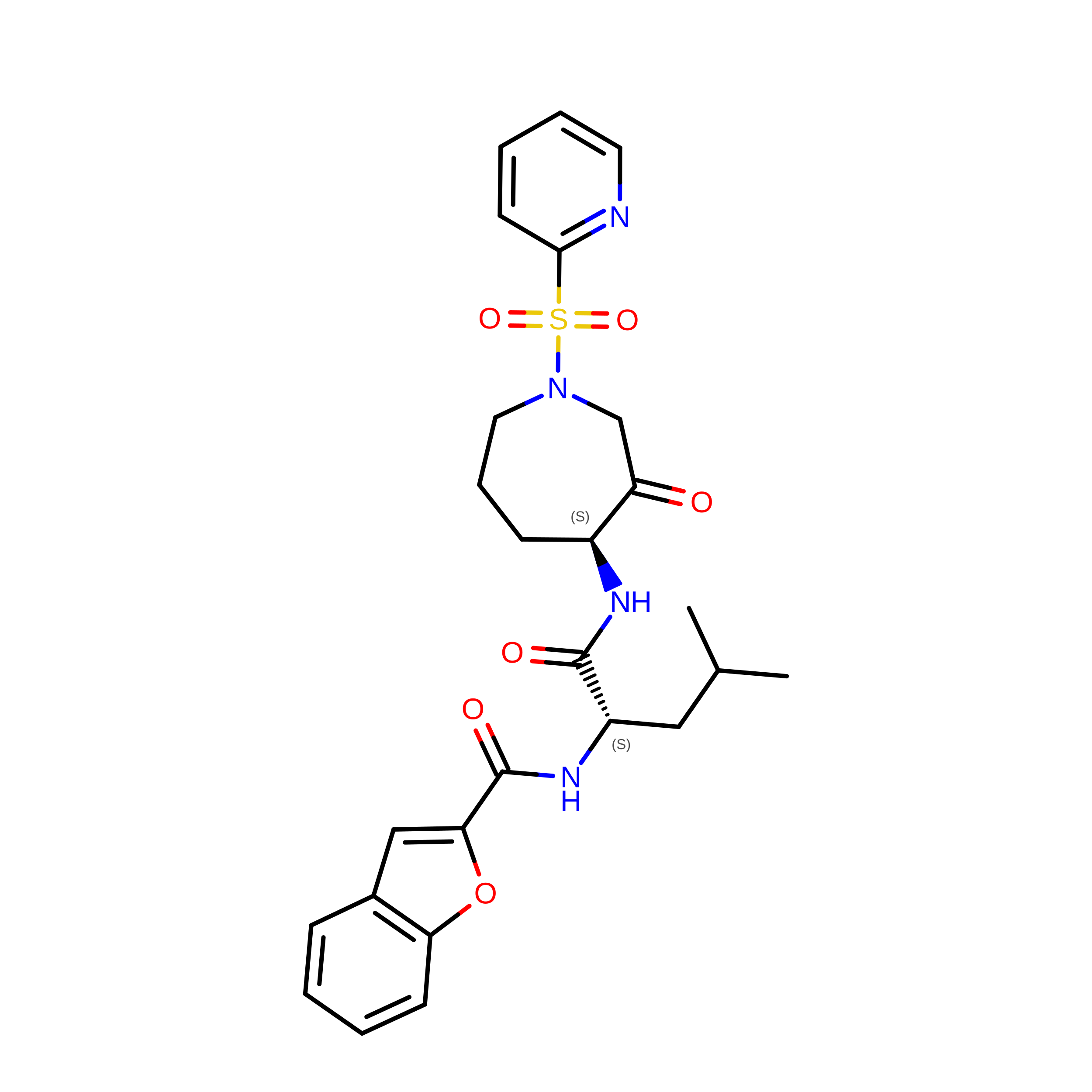
| 2CA Download:Ideal Coordinates CCD File | C [auth A], D [auth B] | BENZOFURAN-2-CARBOXYLIC ACID {(S)-3-METHYL-1-[3-OXO-1-(PYRIDIN-2-YLSULFONYL)AZEPAN-4-YLCARBAMOYL]BUTYL}AMIDE C26 H30 N4 O6 S VBPPNJCVXGAZDD-PMACEKPBSA-N | 👁 Image | ||
Experimental Data & Validation
Experimental Data
- Method: X-RAY DIFFRACTION
- Resolution: 2.40 Å
- R-Value Free: 0.295 (Depositor)
- R-Value Work: 0.263 (Depositor)
- R-Value Observed: 0.263 (Depositor)
| Length ( Å ) | Angle ( ˚ ) |
|---|---|
| a = 100.96 | α = 90 |
| b = 100.96 | β = 90 |
| c = 53.694 | γ = 90 |
| Software Name | Purpose |
|---|---|
| MAR345 | data collection |
| SCALEPACK | data scaling |
| CNS | refinement |
| CNS | phasing |
Entry History
Deposition Data
- Released Date: 2003-01-14 Deposition Author(s): Smith, W.W., Janson, C.A., Zhao, B.
Revision History (Full details and data files)
- Version 1.0: 2003-01-14
Type: Initial release - Version 1.1: 2008-04-29
Changes: Version format compliance - Version 1.2: 2011-07-13
Changes: Version format compliance - Version 1.3: 2017-10-11
Changes: Refinement description - Version 1.4: 2023-08-16
Changes: Data collection, Database references, Derived calculations, Refinement description - Version 1.5: 2024-10-30
Changes: Structure summary







