







- FASTA Sequence
- PDBx/mmCIF Format
- PDBx/mmCIF Format (gz)
- BinaryCIF Format (gz)
- Legacy PDB Format
- Legacy PDB Format (gz)
- PDBML/XML Format (gz)
- NMR Restraints (Text)
- NMR Restraints (Text - gz)
- NMR Restraints v2 (Text)
- NMR Restraints v2 (Text - gz)
- Chemical Shifts (STAR)
- Chemical Shifts (STAR - gz)
- Validation Full (PDF - gz)
- Validation (XML - gz)
- Validation (CIF - gz)
- Biological Assembly 1 (CIF - gz)
- Biological Assembly 1 (PDB - gz)
2M6Y | pdb_00002m6y
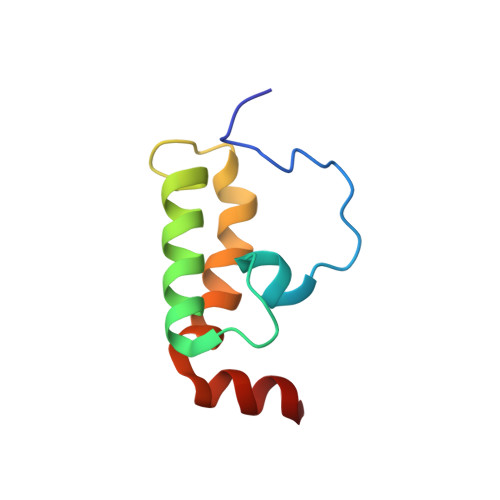
The solution structure of the J-domain of human DnaJA1
- PDB DOI: https://doi.org/10.2210/pdb2M6Y/pdb
- BMRB: 19163
- Classification: CHAPERONE
- Organism(s): Homo sapiens
- Expression System: Escherichia coli
- Mutation(s): No
- Deposited: 2013-04-14 Released: 2013-06-26
- Deposition Author(s): Stark, J.L., Mehla, K., Chaika, N., Acton, T.B., Xiao, R., Singh, P.K., Montelione, G.T., Powers, R., Northeast Structural Genomics Consortium (NESG)
Experimental Data Snapshot
- Method: SOLUTION NMR
- Conformers Calculated: 400
- Conformers Submitted: 20
- Selection Criteria: structures with the lowest energy
wwPDB Validation 3D Report Full Report

- 👁 Image
Download Mendeley

Structure and function of human DnaJ homologue subfamily a member 1 (DNAJA1) and its relationship to pancreatic cancer.
Stark, J.L., Mehla, K., Chaika, N., Acton, T.B., Xiao, R., Singh, P.K., Montelione, G.T., Powers, R.(2014) Biochemistry 53: 1360-1372
- PubMed: 24512202 Search on PubMedSearch on PubMed Central
- DOI: https://doi.org/10.1021/bi401329a
- Primary Citation Related Structures:
2M6Y - PubMed Abstract:
Pancreatic cancer has a dismal 5 year survival rate of 5.5% that has not been improved over the past 25 years despite an enormous amount of effort. Thus, there is an urgent need to identify truly novel yet druggable protein targets for drug discovery. The human protein DnaJ homologue subfamily A member 1 (DNAJA1) was previously shown to be downregulated 5-fold in pancreatic cancer cells and has been targeted as a biomarker for pancreatic cancer, but little is known about the specific biological function for DNAJA1 or the other members of the DnaJ family encoded in the human genome. Our results suggest the overexpression of DNAJA1 suppresses the stress response capabilities of the oncogenic transcription factor, c-Jun, and results in the diminution of cell survival. DNAJA1 likely activates a DnaK protein by forming a complex that suppresses the JNK pathway, the hyperphosphorylation of c-Jun, and the anti-apoptosis state found in pancreatic cancer cells. A high-quality nuclear magnetic resonance solution structure of the J-domain of DNAJA1 combined with a bioinformatics analysis and a ligand affinity screen identifies a potential DnaK binding site, which is also predicted to overlap with an inhibitory binding site, suggesting DNAJA1 activity is highly regulated.
- Department of Chemistry, University of Nebraska-Lincoln , Lincoln, Nebraska 68588, United States.
Organizational Affiliation:
Explore in 3D: Structure | Sequence Annotations | Validation Report
Global Symmetry: Asymmetric - C1
Global Stoichiometry: Monomer - A1
Find Similar Assemblies
Biological assembly 1 assigned by authors.
Macromolecule Content
- Total Structure Weight: 9.1 kDa
- Atom Count: 641
- Modeled Residue Count: 77
- Deposited Residue Count: 77
- Unique protein chains: 1
Entity ID: 1 | |||||
|---|---|---|---|---|---|
| Molecule | Chains | Sequence Length | Organism | Details | Image |
| DnaJ homolog subfamily A member 1 | 77 | Homo sapiens | Mutation(s): 0 Gene Names: DNAJA1, DNAJ2, HDJ2, HSJ2, HSPF4 | 👁 Image | |
UniProt & NIH Common Fund Data Resources | |||||
Find proteins for P31689 (Homo sapiens) Explore P31689 Go to UniProtKB: P31689 | |||||
PHAROS: P31689 GTEx: ENSG00000086061 | |||||
Entity Groups | |||||
| Sequence Clusters | 30% Identity50% Identity70% Identity90% Identity95% Identity100% Identity | ||||
| UniProt Group | P31689 | ||||
Sequence AnnotationsExpand | |||||
| |||||

Experimental Data
- Method: SOLUTION NMR
- Conformers Calculated: 400
- Conformers Submitted: 20
- Selection Criteria: structures with the lowest energy
Deposition Data
- Released Date: 2013-06-26 Deposition Author(s): Stark, J.L., Mehla, K., Chaika, N., Acton, T.B., Xiao, R., Singh, P.K., Montelione, G.T., Powers, R., Northeast Structural Genomics Consortium (NESG)
Revision History (Full details and data files)
- Version 1.0: 2013-06-26
Type: Initial release - Version 1.1: 2015-04-15
Changes: Database references - Version 1.2: 2024-05-01
Changes: Data collection, Database references







