







- FASTA Sequence
- PDBx/mmCIF Format
- PDBx/mmCIF Format (gz)
- BinaryCIF Format (gz)
- Legacy PDB Format
- Legacy PDB Format (gz)
- PDBML/XML Format (gz)
- Structure Factors (CIF)
- Structure Factors (CIF - gz)
- Validation Full (PDF - gz)
- Validation (XML - gz)
- Validation (CIF - gz)
- Validation 2fo-fc coefficients (CIF - gz)
- Validation fo-fc coefficients (CIF - gz)
- Biological Assembly 1 (CIF - gz)
- Biological Assembly 2 (CIF - gz)
- Biological Assembly 1 (PDB - gz)
- Biological Assembly 2 (PDB - gz)
3SCK | pdb_00003sck
Crystal structure of spike protein receptor-binding domain from a predicted SARS coronavirus civet strain complexed with human-civet chimeric receptor ACE2
- PDB DOI: https://doi.org/10.2210/pdb3SCK/pdb
- Classification: HYDROLASE/VIRAL PROTEIN
- Organism(s): Paguma larvata, Homo sapiens, Severe acute respiratory syndrome-related coronavirus
- Expression System: Spodoptera frugiperda
- Mutation(s): No
- Deposited: 2011-06-07 Released: 2012-02-08
- Deposition Author(s): Wu, K., Peng, G., Wilken, M., Geraghty, R., Li, F.
Experimental Data Snapshot
- Method: X-RAY DIFFRACTION
- Resolution: 3.00 Å
- R-Value Free: 0.285 (Depositor), 0.291 (DCC)
- R-Value Work: 0.239 (Depositor), 0.245 (DCC)
- R-Value Observed: 0.242 (Depositor)
wwPDB Validation3D Report Full Report

Literature
- 👁 Image
Download Mendeley

Mechanisms of host receptor adaptation by severe acute respiratory syndrome coronavirus.
Wu, K., Peng, G., Wilken, M., Geraghty, R.J., Li, F.(2012) J Biological Chem 287: 8904-8911
- PubMed: 22291007 Search on PubMedSearch on PubMed Central
- DOI: https://doi.org/10.1074/jbc.M111.325803
- Primary Citation Related Structures:
3SCI, 3SCJ, 3SCK, 3SCL - PubMed Abstract:
The severe acute respiratory syndrome coronavirus (SARS-CoV) from palm civets has twice evolved the capacity to infect humans by gaining binding affinity for human receptor angiotensin-converting enzyme 2 (ACE2). Numerous mutations have been identified in the receptor-binding domain (RBD) of different SARS-CoV strains isolated from humans or civets. Why these mutations were naturally selected or how SARS-CoV evolved to adapt to different host receptors has been poorly understood, presenting evolutionary and epidemic conundrums. In this study, we investigated the impact of these mutations on receptor recognition, an important determinant of SARS-CoV infection and pathogenesis. Using a combination of biochemical, functional, and crystallographic approaches, we elucidated the molecular and structural mechanisms of each of these naturally selected RBD mutations. These mutations either strengthen favorable interactions or reduce unfavorable interactions with two virus-binding hot spots on ACE2, and by doing so, they enhance viral interactions with either human (hACE2) or civet (cACE2) ACE2. Therefore, these mutations were viral adaptations to either hACE2 or cACE2. To corroborate the above analysis, we designed and characterized two optimized RBDs. The human-optimized RBD contains all of the hACE2-adapted residues (Phe-442, Phe-472, Asn-479, Asp-480, and Thr-487) and possesses exceptionally high affinity for hACE2 but relative low affinity for cACE2. The civet-optimized RBD contains all of the cACE2-adapted residues (Tyr-442, Pro-472, Arg-479, Gly-480, and Thr-487) and possesses exceptionally high affinity for cACE2 and also substantial affinity for hACE2. These results not only illustrate the detailed mechanisms of host receptor adaptation by SARS-CoV but also provide a molecular and structural basis for tracking future SARS-CoV evolution in animals.
- Department of Pharmacology,University of Minnesota Medical School, Minneapolis, Minnesota 55455, USA.
Organizational Affiliation:
Explore in 3D: Structure | Sequence Annotations | Electron Density | Validation Report | Ligand Interaction (ZN)
Biological Assembly 1
Explore in 3D: Structure | Sequence Annotations | Electron Density | Validation Report | Ligand Interaction (ZN)
Global Symmetry: Asymmetric - C1
Global Stoichiometry: Hetero 2-mer - A1B1
Find Similar Assemblies
Biological assembly 1 assigned by authors.
Biological Assembly 2
Explore in 3D: Structure | Sequence Annotations | Electron Density | Validation Report | Ligand Interaction (ZN)
Global Symmetry: Asymmetric - C1
Global Stoichiometry: Hetero 2-mer - A1B1
Find Similar Assemblies
Biological assembly 2 assigned by authors.
Macromolecule Content
- Total Structure Weight: 182.39 kDa
- Atom Count: 12,518
- Modeled Residue Count: 1,540
- Deposited Residue Count: 1,576
- Unique protein chains: 2
Macromolecules
Entity ID: 1 | |||||
|---|---|---|---|---|---|
| Molecule | Chains | Sequence Length | Organism | Details | Image |
| Angiotensin-converting enzyme 2 chimera | 603 | Paguma larvata, Homo sapiens This entity is chimeric | Mutation(s): 0 Gene Names: ACE2, UNQ868/PRO1885 EC: 3.4.17.23 (PDB Primary Data), 3.4.17 (UniProt) | 👁 Image | |
UniProt & NIH Common Fund Data Resources | |||||
PHAROS: Q9BYF1 GTEx: ENSG00000130234 | |||||
Entity Groups | |||||
| Sequence Clusters | 30% Identity50% Identity70% Identity90% Identity95% Identity100% Identity | ||||
| UniProt Groups | Q9BYF1Q56NL1 | ||||
Sequence AnnotationsExpand | |||||
Reference Sequence | |||||
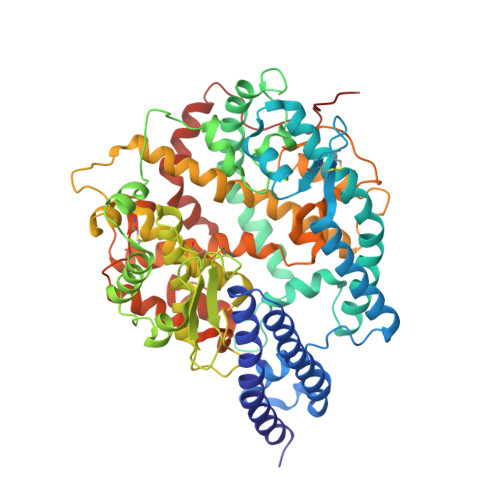
Entity ID: 2 | |||||
|---|---|---|---|---|---|
| Molecule | Chains | Sequence Length | Organism | Details | Image |
| Spike glycoprotein | C [auth E], D [auth F] | 185 | Severe acute respiratory syndrome-related coronavirus | Mutation(s): 0 Gene Names: S, 2 | 👁 Image |
UniProt | |||||
Entity Groups | |||||
| Sequence Clusters | 30% Identity50% Identity70% Identity90% Identity95% Identity100% Identity | ||||
| UniProt Group | P59594 | ||||
Sequence AnnotationsExpand | |||||
Reference Sequence | |||||
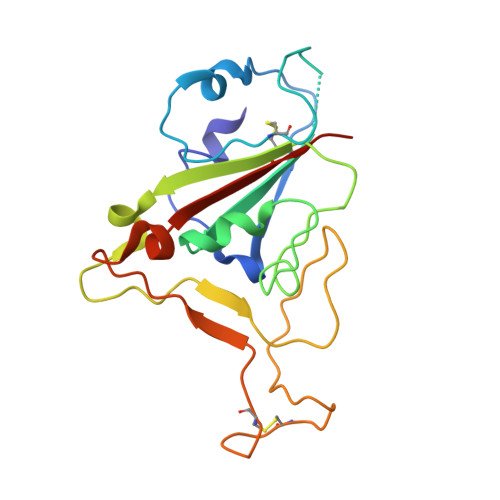
Small Molecules
| Ligands 2 Unique | |||||
|---|---|---|---|---|---|
| ID | Chains | Name / Formula / InChI Key | 2D Diagram | 3D Interactions | |
| ZN Download:Ideal Coordinates CCD File | E [auth A], G [auth B] | ZINC ION Zn PTFCDOFLOPIGGS-UHFFFAOYSA-N | 👁 Image | ||
| CL Download:Ideal Coordinates CCD File | F [auth A], H [auth B] | CHLORIDE ION Cl VEXZGXHMUGYJMC-UHFFFAOYSA-M | 👁 Image | ||


Experimental Data & Validation
Experimental Data
- Method: X-RAY DIFFRACTION
- Resolution: 3.00 Å
- R-Value Free: 0.285 (Depositor), 0.291 (DCC)
- R-Value Work: 0.239 (Depositor), 0.245 (DCC)
- R-Value Observed: 0.242 (Depositor)
| Length ( Å ) | Angle ( ˚ ) |
|---|---|
| a = 81.219 | α = 90 |
| b = 119.277 | β = 92.19 |
| c = 113.236 | γ = 90 |
| Software Name | Purpose |
|---|---|
| REFMAC | refinement |
| CNS | refinement |
| HKL-2000 | data collection |
| HKL-2000 | data reduction |
| HKL-2000 | data scaling |
| CNS | phasing |
Entry History
Deposition Data
- Released Date: 2012-02-08 Deposition Author(s): Wu, K., Peng, G., Wilken, M., Geraghty, R., Li, F.
Revision History (Full details and data files)
- Version 1.0: 2012-02-08
Type: Initial release - Version 1.1: 2017-07-26
Changes: Refinement description, Source and taxonomy - Version 1.2: 2019-07-17
Changes: Data collection, Refinement description - Version 1.3: 2020-09-16
Changes: Database references, Derived calculations - Version 1.4: 2024-10-09
Changes: Data collection, Database references, Structure summary







