







- FASTA Sequence
- PDBx/mmCIF Format
- PDBx/mmCIF Format (gz)
- BinaryCIF Format (gz)
- Legacy PDB Format
- Legacy PDB Format (gz)
- PDBML/XML Format (gz)
- Structure Factors (CIF)
- Structure Factors (CIF - gz)
- Validation Full (PDF - gz)
- Validation (XML - gz)
- Validation (CIF - gz)
- Validation 2fo-fc coefficients (CIF - gz)
- Validation fo-fc coefficients (CIF - gz)
- Biological Assembly 1 (CIF - gz)
- Biological Assembly 1 (PDB - gz)
3SME | pdb_00003sme
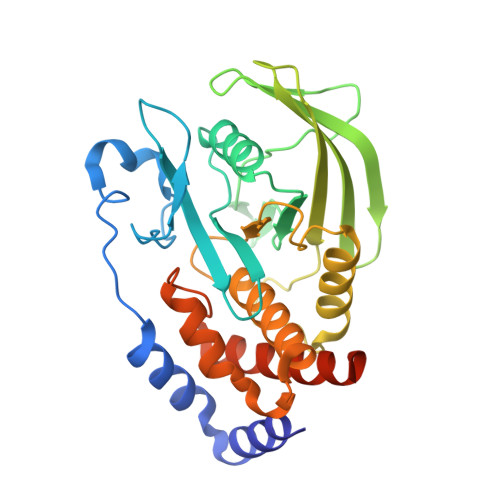
Structure of PTP1B inactivated by H2O2/bicarbonate
- PDB DOI: https://doi.org/10.2210/pdb3SME/pdb
- Classification: HYDROLASE
- Organism(s): Homo sapiens
- Expression System: Escherichia coli
- Mutation(s): No
- Deposited: 2011-06-27 Released: 2011-10-19
- Deposition Author(s): Tanner, J.J., Singh, H.
Experimental Data Snapshot
- Method: X-RAY DIFFRACTION
- Resolution: 1.70 Å
- R-Value Free: 0.210 (Depositor), 0.200 (DCC)
- R-Value Work: 0.197 (Depositor), 0.190 (DCC)
- R-Value Observed: 0.198 (Depositor)
Starting Model: experimental
View more details
wwPDB Validation 3D Report Full Report

- 👁 Image
Download Mendeley

The Biological Buffer Bicarbonate/CO(2) Potentiates H(2)O(2)-Mediated Inactivation of Protein Tyrosine Phosphatases.
Zhou, H., Singh, H., Parsons, Z.D., Lewis, S.M., Bhattacharya, S., Seiner, D.R., Labutti, J.N., Reilly, T.J., Tanner, J.J., Gates, K.S.(2011) J Am Chem Soc 133: 15803-15805
- PubMed: 21913686 Search on PubMedSearch on PubMed Central
- DOI: https://doi.org/10.1021/ja2077137
- Primary Citation Related Structures:
3SME - PubMed Abstract:
Hydrogen peroxide is a cell signaling agent that inactivates protein tyrosine phosphatases (PTPs) via oxidation of their catalytic cysteine residue. PTPs are inactivated rapidly during H(2)O(2)-mediated cellular signal transduction processes, but, paradoxically, hydrogen peroxide is a rather sluggish PTP inactivator in vitro. Here we present evidence that the biological buffer bicarbonate/CO(2) potentiates the ability of H(2)O(2) to inactivate PTPs. The results of biochemical experiments and high-resolution crystallographic analysis are consistent with a mechanism involving oxidation of the catalytic cysteine residue by peroxymonocarbonate generated via the reaction of H(2)O(2) with HCO(3)(-)/CO(2).
- Department of Chemistry, University of Missouri, Columbia, Missouri 65211, United States.
Organizational Affiliation:
Explore in 3D: Structure | Sequence Annotations | Electron Density | Validation Report | Ligand Interaction (MG)
Explore in 3D: Structure | Sequence Annotations | Electron Density | Validation Report | Ligand Interaction (MG)
Global Symmetry: Asymmetric - C1
Global Stoichiometry: Monomer - A1
Find Similar Assemblies
Biological assembly 1 assigned by authors and generated by PISA (software)
Macromolecule Content
- Total Structure Weight: 34.94 kDa
- Atom Count: 2,436
- Modeled Residue Count: 282
- Deposited Residue Count: 300
- Unique protein chains: 1
Entity ID: 1 | |||||
|---|---|---|---|---|---|
| Molecule | Chains | Sequence Length | Organism | Details | Image |
| Tyrosine-protein phosphatase non-receptor type 1 | 300 | Homo sapiens | Mutation(s): 0 Gene Names: PTP1B, PTPN1 EC: 3.1.3.48 | 👁 Image | |
UniProt & NIH Common Fund Data Resources | |||||
Find proteins for P18031 (Homo sapiens) Explore P18031 Go to UniProtKB: P18031 | |||||
PHAROS: P18031 GTEx: ENSG00000196396 | |||||
Entity Groups | |||||
| Sequence Clusters | 30% Identity50% Identity70% Identity90% Identity95% Identity100% Identity | ||||
| UniProt Group | P18031 | ||||
Sequence AnnotationsExpand | |||||
| |||||

| Ligands 1 Unique | |||||
|---|---|---|---|---|---|
| ID | Chains | Name / Formula / InChI Key | 2D Diagram | 3D Interactions | |
| MG Query on MG Download Ideal Coordinates CCD File | B [auth A] | MAGNESIUM ION Mg JLVVSXFLKOJNIY-UHFFFAOYSA-N | 👁 Image | ||


Experimental Data
- Method: X-RAY DIFFRACTION
- Resolution: 1.70 Å
- R-Value Free: 0.210 (Depositor), 0.200 (DCC)
- R-Value Work: 0.197 (Depositor), 0.190 (DCC)
- R-Value Observed: 0.198 (Depositor)
| Length ( Å ) | Angle ( ˚ ) |
|---|---|
| a = 88 | α = 90 |
| b = 88 | β = 90 |
| c = 104 | γ = 120 |
| Software Name | Purpose |
|---|---|
| d*TREK | data reduction |
| PHENIX | refinement |
| PDB_EXTRACT | data extraction |
| d*TREK | data scaling |
| PHENIX | phasing |
Deposition Data
- Released Date: 2011-10-19 Deposition Author(s): Tanner, J.J., Singh, H.
Revision History (Full details and data files)
- Version 1.0: 2011-10-19
Type: Initial release - Version 1.1: 2023-09-13
Changes: Data collection, Database references, Derived calculations, Refinement description - Version 1.2: 2024-11-20
Changes: Structure summary







