







- FASTA Sequence
- PDBx/mmCIF Format
- PDBx/mmCIF Format (gz)
- BinaryCIF Format (gz)
- Legacy PDB Format
- Legacy PDB Format (gz)
- PDBML/XML Format (gz)
- Structure Factors (CIF)
- Structure Factors (CIF - gz)
- Validation Full (PDF - gz)
- Validation (XML - gz)
- Validation (CIF - gz)
- Validation 2fo-fc coefficients (CIF - gz)
- Validation fo-fc coefficients (CIF - gz)
- Biological Assembly 1 (CIF - gz)
- Biological Assembly 1 (PDB - gz)
4DMX | pdb_00004dmx
Cathepsin K inhibitor
- PDB DOI: https://doi.org/10.2210/pdb4DMX/pdb
- Classification: Hydrolase/Hydrolase inhibitor
- Organism(s): Homo sapiens
- Expression System: Escherichia coli
- Mutation(s): No
- Deposited: 2012-02-08 Released: 2012-07-11
- Deposition Author(s): Dossetter, A.G., Beeley, H., Bowyer, J., Cook, C.R., Crawford, J.J., Finlayson, J.E., Heron, N.M., Heyes, C., Highton, A.J., Hudson, J.A., Kenny, P.W., Martin, S., MacFaul, P.A., McGuire, T.M., Gutierrez, P.M., Morley, A.D., Morris, J.J., Page, K.M., Rosenbrier Ribeiro, L., Sawney, H., Steinbacher, S., Krapp, S., Jestel, A., Smith, C., Vickers, M.
Experimental Data Snapshot
- Method: X-RAY DIFFRACTION
- Resolution: 1.70 Å
- R-Value Free: 0.206 (Depositor), 0.212 (DCC)
- R-Value Work: 0.156 (Depositor), 0.170 (DCC)
- R-Value Observed: 0.158 (Depositor)

Literature
- 👁 Image
Download Mendeley

(1R,2R)-N-(1-cyanocyclopropyl)-2-(6-methoxy-1,3,4,5-tetrahydropyrido[4,3-b]indole-2-carbonyl)cyclohexanecarboxamide (AZD4996): a potent and highly selective cathepsin K inhibitor for the treatment of osteoarthritis.
Dossetter, A.G., Beeley, H., Bowyer, J., Cook, C.R., Crawford, J.J., Finlayson, J.E., Heron, N.M., Heyes, C., Highton, A.J., Hudson, J.A., Jestel, A., Kenny, P.W., Krapp, S., Martin, S., MacFaul, P.A., McGuire, T.M., Gutierrez, P.M., Morley, A.D., Morris, J.J., Page, K.M., Ribeiro, L.R., Sawney, H., Steinbacher, S., Smith, C., Vickers, M.(2012) J Med Chem 55: 6363-6374
- PubMed: 22742641 Search on PubMed
- DOI: https://doi.org/10.1021/jm3007257
- Primary Citation Related Structures:
4DMX, 4DMY - PubMed Abstract:
Directed screening of nitrile compounds revealed 3 as a highly potent cathepsin K inhibitor but with cathepsin S activity and very poor stability to microsomes. Synthesis of compounds with reduced molecular complexity, such as 7, revealed key SAR and demonstrated that baseline physical properties and in vitro stability were in fact excellent for this series. The tricycle carboline P3 unit was discovered by hypothesis-based design using existing structural information. Optimization using small substituents, knowledge from matched molecular pairs, and control of lipophilicity yielded compounds very close to the desired profile, of which 34 (AZD4996) was selected on the basis of pharmacokinetic profile.
- AstraZeneca R&D, Mereside, Alderley Park, Macclesfield, Cheshire, SK10 4TG, UK. al.dossetter@astrazeneca.com
Organizational Affiliation:
Explore in 3D: Structure | Sequence Annotations | Electron Density | Validation Report | Ligand Interaction (0LB)
Biological Assembly 1
Explore in 3D: Structure | Sequence Annotations | Electron Density | Validation Report | Ligand Interaction (0LB)
Global Symmetry: Asymmetric - C1
Global Stoichiometry: Monomer - A1
Find Similar Assemblies
Biological assembly 1 assigned by authors and generated by PISA (software)
Macromolecule Content
- Total Structure Weight: 24.01 kDa
- Atom Count: 1,831
- Modeled Residue Count: 215
- Deposited Residue Count: 215
- Unique protein chains: 1
Macromolecules
Entity ID: 1 | |||||
|---|---|---|---|---|---|
| Molecule | Chains | Sequence Length | Organism | Details | Image |
| Cathepsin K | 215 | Homo sapiens | Mutation(s): 0 Gene Names: CTSK, CTSO, CTSO2 EC: 3.4.22.38 | 👁 Image | |
UniProt & NIH Common Fund Data Resources | |||||
PHAROS: P43235 GTEx: ENSG00000143387 | |||||
Entity Groups | |||||
| Sequence Clusters | 30% Identity50% Identity70% Identity90% Identity95% Identity100% Identity | ||||
| UniProt Group | P43235 | ||||
Sequence AnnotationsExpand | |||||
Reference Sequence | |||||

Small Molecules
| Ligands 2 Unique | |||||
|---|---|---|---|---|---|
| ID | Chains | Name / Formula / InChI Key | 2D Diagram | 3D Interactions | |
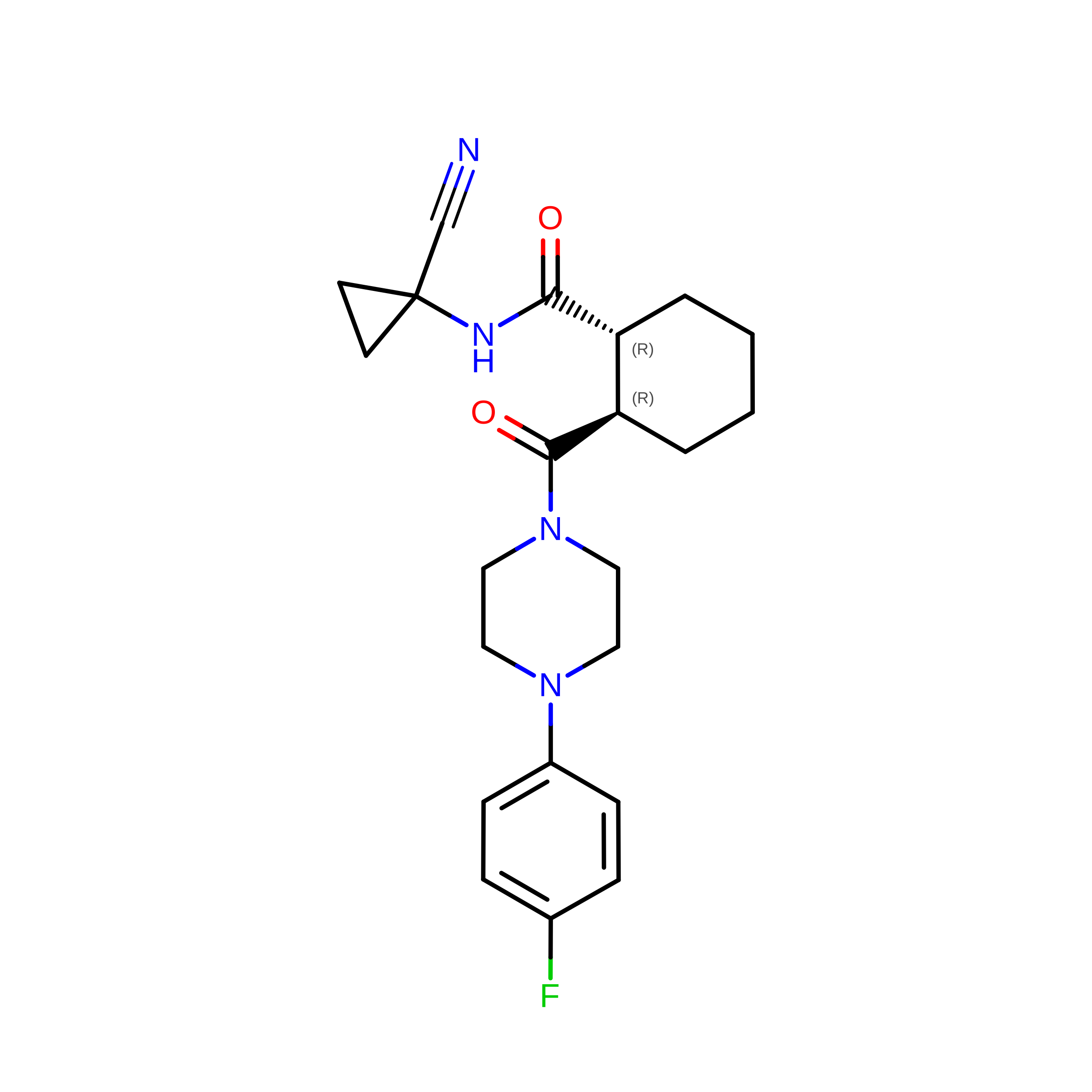
| 0LB Download:Ideal Coordinates CCD File | B [auth A] | (1R,2R)-N-(1-cyanocyclopropyl)-2-{[4-(4-fluorophenyl)piperazin-1-yl]carbonyl}cyclohexanecarboxamide C22 H27 F N4 O2 GHDIYQHGVKVLJX-RTBURBONSA-N | 👁 Image | ||
| GOL Download:Ideal Coordinates CCD File | C [auth A] | GLYCEROL C3 H8 O3 PEDCQBHIVMGVHV-UHFFFAOYSA-N | 👁 Image | ||

Experimental Data & Validation
Experimental Data
- Method: X-RAY DIFFRACTION
- Resolution: 1.70 Å
- R-Value Free: 0.206 (Depositor), 0.212 (DCC)
- R-Value Work: 0.156 (Depositor), 0.170 (DCC)
- R-Value Observed: 0.158 (Depositor)
| Length ( Å ) | Angle ( ˚ ) |
|---|---|
| a = 32.362 | α = 90 |
| b = 83.958 | β = 109.96 |
| c = 35.999 | γ = 90 |
| Software Name | Purpose |
|---|---|
| PXSOFT | data collection |
| MOLREP | phasing |
| REFMAC | refinement |
| MOSFLM | data reduction |
| SCALA | data scaling |
Entry History
Deposition Data
- Released Date: 2012-07-11 Deposition Author(s): Dossetter, A.G., Beeley, H., Bowyer, J., Cook, C.R., Crawford, J.J., Finlayson, J.E., Heron, N.M., Heyes, C., Highton, A.J., Hudson, J.A., Kenny, P.W., Martin, S., MacFaul, P.A., McGuire, T.M., Gutierrez, P.M., Morley, A.D., Morris, J.J., Page, K.M., Rosenbrier Ribeiro, L., Sawney, H., Steinbacher, S., Krapp, S., Jestel, A., Smith, C., Vickers, M.
Revision History (Full details and data files)
- Version 1.0: 2012-07-11
Type: Initial release - Version 1.1: 2013-01-02
Changes: Database references - Version 1.2: 2014-11-26
Changes: Structure summary - Version 1.3: 2018-01-24
Changes: Advisory, Structure summary - Version 1.4: 2024-10-30
Changes: Advisory, Data collection, Database references, Derived calculations, Structure summary







