







- FASTA Sequence
- PDBx/mmCIF Format
- PDBx/mmCIF Format (gz)
- BinaryCIF Format (gz)
- Legacy PDB Format
- Legacy PDB Format (gz)
- PDBML/XML Format (gz)
- Structure Factors (CIF)
- Structure Factors (CIF - gz)
- Validation Full (PDF - gz)
- Validation (XML - gz)
- Validation (CIF - gz)
- Validation 2fo-fc coefficients (CIF - gz)
- Validation fo-fc coefficients (CIF - gz)
- Biological Assembly 1 (CIF - gz)
- Biological Assembly 1 (PDB - gz)
4X6I | pdb_00004x6i
Development of N-(Functionalized benzoyl)-homocycloleucyl-glycinonitriles as Potent Cathepsin K Inhibitors.
- PDB DOI: https://doi.org/10.2210/pdb4X6I/pdb
- Classification: HYDROLASE
- Organism(s): Homo sapiens
- Expression System: Komagataella phaffii GS115
- Mutation(s): No
- Deposited: 2014-12-08 Released: 2015-09-30
- Deposition Author(s): Borisek, J., Mohar, B., Vizovisek, M., Sosnowski, P., Turk, D., Turk, B., Novic, M.
Experimental Data Snapshot
- Method: X-RAY DIFFRACTION
- Resolution: 1.87 Å
- R-Value Free: 0.237 (Depositor), 0.241 (DCC)
- R-Value Work: 0.181 (Depositor), 0.191 (DCC)
- R-Value Observed: 0.184 (Depositor)
Starting Model: experimental
View more details

Literature
- 👁 Image
Download Mendeley

Development of N-(Functionalized benzoyl)-homocycloleucyl-glycinonitriles as Potent Cathepsin K Inhibitors.
Borisek, J., Vizovisek, M., Sosnowski, P., Turk, B., Turk, D., Mohar, B., Novic, M.(2015) J Med Chem 58: 6928-6937
- PubMed: 26280490 Search on PubMed
- DOI: https://doi.org/10.1021/acs.jmedchem.5b00746
- Primary Citation Related Structures:
4X6H, 4X6I, 4X6J - PubMed Abstract:
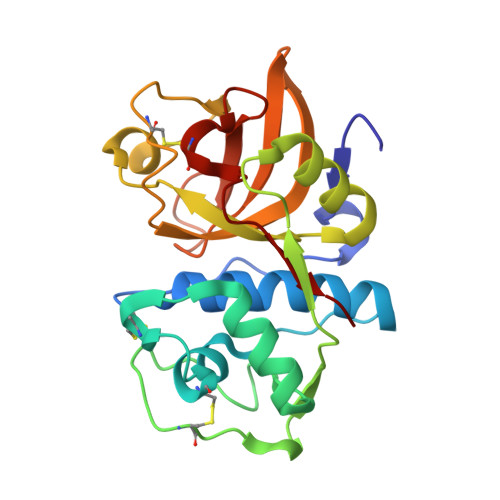
Cathepsin K is a major drug target for osteoporosis and related-bone disorders. Using a combination of virtual combinatorial chemistry, QSAR modeling, and molecular docking studies, a series of cathepsin K inhibitors based on N-(functionalized benzoyl)-homocycloleucyl-glycinonitrile scaffold was developed. In order to avoid previous problems of cathepsin K inhibitors associated with lysosomotropism of compounds with basic character that resulted in off-target effects, a weakly- to nonbasic moiety was incorporated into the P3 position. Compounds 5, 6, and 9 were highly selective for cathepsin K when compared with cathepsins L and S, with the Ki values in the 10-30 nM range. The kinetic studies revealed that the new compounds exhibited reversible tight binding to cathepsin K, while the X-ray structural studies showed covalent and noncovalent binding between the nitrile group and the catalytic cysteine (Cys25) site.
- National Institute of Chemistry, Hajdrihova 19, SI-1001 Ljubljana, Slovenia.
- Department of Biochemistry, Molecular and Structural Biology, Jozef Stefan Institute , Jamova cesta 39, SI-1000 Ljubljana, Slovenia.
- Centre of Excellence for Integrated Approaches in Chemistry and Biology of Proteins, Jamova cesta 39, SI-1000 Ljubljana, Slovenia.
- Faculty of Chemistry and Chemical Technology, University of Ljubljana , Večna pot 113, SI-1000 Ljubljana, Slovenia.
Organizational Affiliation:
Explore in 3D: Structure | Sequence Annotations | Electron Density | Validation Report | Ligand Interaction (3Y1)
Biological Assembly 1
Explore in 3D: Structure | Sequence Annotations | Electron Density | Validation Report | Ligand Interaction (3Y1)
Global Symmetry: Asymmetric - C1
Global Stoichiometry: Monomer - A1
Find Similar Assemblies
Biological assembly 1 assigned by authors and generated by PISA (software)
Macromolecule Content
- Total Structure Weight: 24.38 kDa
- Atom Count: 1,909
- Modeled Residue Count: 215
- Deposited Residue Count: 215
- Unique protein chains: 1
Macromolecules
Entity ID: 1 | |||||
|---|---|---|---|---|---|
| Molecule | Chains | Sequence Length | Organism | Details | Image |
| Cathepsin K | 215 | Homo sapiens | Mutation(s): 0 Gene Names: CTSK, CTSO, CTSO2 EC: 3.4.22.38 | 👁 Image | |
UniProt & NIH Common Fund Data Resources | |||||
PHAROS: P43235 GTEx: ENSG00000143387 | |||||
Entity Groups | |||||
| Sequence Clusters | 30% Identity50% Identity70% Identity90% Identity95% Identity100% Identity | ||||
| UniProt Group | P43235 | ||||
Sequence AnnotationsExpand | |||||
Reference Sequence | |||||
Small Molecules
| Ligands 2 Unique | |||||
|---|---|---|---|---|---|
| ID | Chains | Name / Formula / InChI Key | 2D Diagram | 3D Interactions | |
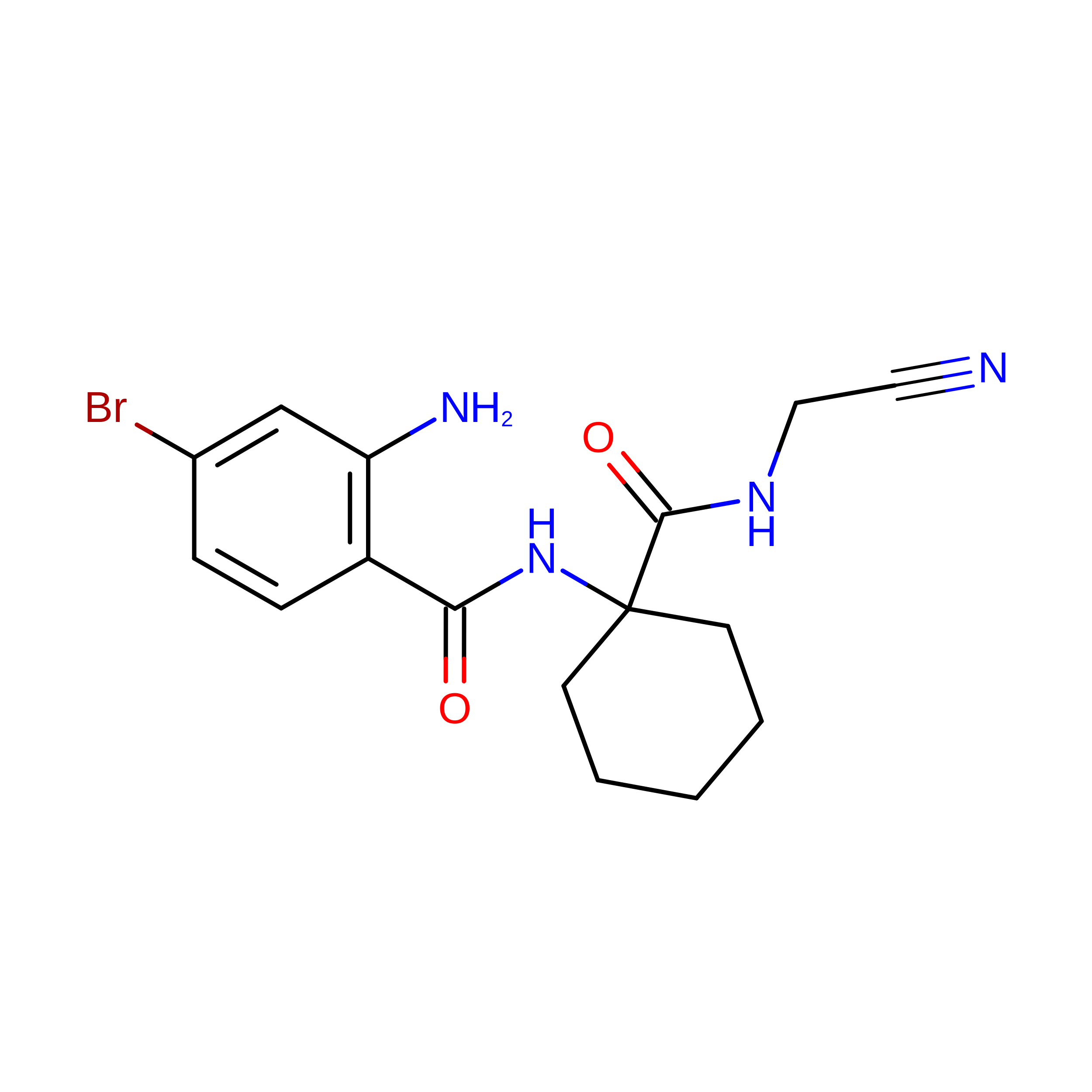
| 3Y1 Download:Ideal Coordinates CCD File | B [auth A] | 2-amino-4-bromo-N-{1-[(cyanomethyl)carbamoyl]cyclohexyl}benzamide C16 H19 Br N4 O2 KVQZUZVIKTWMTQ-UHFFFAOYSA-N | 👁 Image | ||
| SO4 Download:Ideal Coordinates CCD File
| C [auth A], D [auth A], E [auth A], F [auth A], G [auth A] | SULFATE ION O4 S QAOWNCQODCNURD-UHFFFAOYSA-L | 👁 Image | ||

Experimental Data & Validation
Experimental Data
- Method: X-RAY DIFFRACTION
- Resolution: 1.87 Å
- R-Value Free: 0.237 (Depositor), 0.241 (DCC)
- R-Value Work: 0.181 (Depositor), 0.191 (DCC)
- R-Value Observed: 0.184 (Depositor)
| Length ( Å ) | Angle ( ˚ ) |
|---|---|
| a = 36.459 | α = 90 |
| b = 54.45 | β = 90 |
| c = 87.87 | γ = 90 |
| Software Name | Purpose |
|---|---|
| REFMAC | refinement |
| SCALEPACK | data scaling |
| PHASER | phasing |
| PDB_EXTRACT | data extraction |
| PROTEUM PLUS | data reduction |
Entry History
Deposition Data
- Released Date: 2015-09-30 Deposition Author(s): Borisek, J., Mohar, B., Vizovisek, M., Sosnowski, P., Turk, D., Turk, B., Novic, M.
Revision History (Full details and data files)
- Version 1.0: 2015-09-30
Type: Initial release - Version 1.1: 2024-01-10
Changes: Data collection, Database references, Derived calculations, Refinement description - Version 1.2: 2024-11-06
Changes: Structure summary







